Translate

Pages

Tuesday, July 30, 2013

Off to School


Another new-found pleasure of life: seeing off son to school. Every morning between 7.45 to 8, there's a huge racket at the gate of our apartment complex. Kids and their parents waiting for the school buses. Kids are all bubbling with energy and joy on seeing their playmates. There are handing over school bags, water bottles, lunch boxes. Late comers rushing in at the last minute. 'Byes' and hugs and kisses when the tiny-tots huddle into the buses. Occasionally, some of them (Vigyan included) become a little sentimental and get a bit teary eyed. But just for a brief moment. The energy infects most parents. After seeing their kids get into their buses, parents return home or start off to office. Most are carrying a smile they got from their kids.

What a brilliant way to give such a positive start to the day! :)

Related:
More photos
A Day Stolen from Childhood

Monday, July 08, 2013

Birthday 2013

Yesterday was a very special birthday.

Firstly, my friend Pritesh ordered a beautiful cake for me which was the shape of a study table. On top of it were all things I (used to) spend my time with: writing pad, drawing material, ramen noodles, coffee and so on. Thanks Pritesh! For remembering, and personalising the gift to the extent only a true friend and a true artist can do. As many thanks are due to Sathya! He drove to Malleswaram at 6 AM to collect the cake and was at my house at 7.30 AM. Never was someone so fortunate as I am to have an ace musician and friend playing the delivery boy! :) Sathya! Thanks, man! I must also thank Itsy Bitsy Bytes who made the lovely cake. Lovely work of art!

Cake presented by Pritesh, delivered by Sathya, and made by Itsy Bitsy Bytes

Yesterday was convocation day in IIITB. So, I was there at the institute by 9 in the morning, all dressed up. Then came the next pleasant surprise. Our director, Prof. Sadagopan, in the midst of all the business of preparation of the grand convocation ceremony, had remembered to order a cake for me. And I cut the cake in his very office in the presence of people like Mrs. Sudha Murthy and other important dignitaries.

Post-dinner tea isn't encouraged by my dear wife. However, yesterday, an exception was made, and I was served a cup of delicious hot tea after my dinner. And Shilpi topped it up by having tea herself, and sitting (alone with me) chatting for over an hour -- a prized treat for me!

I am thankful for having made it this far. For having had a life which makes me have more and more of it. For having people in my life who love and appreciate me as I am. And those who keep the excitement up by making me want to learn something new everyday.

I'll stop before it starts sounding like the vote-of-thanks speech I delivered yesterday in the convocation. :)


Tuesday, July 02, 2013

What Have You Learned So Far?

Often, I suffer from this sudden feeling -- almost like a panic attack -- of blankness. I ask myself the question: 'What have you learnt so far?' And I can't remember anything that I consider worth a mention. Most of the things I seem to know appear too easy, too natural, too unavoidable for me to have learned. As if the gravity of my destiny took me through a path I didn't decide for myself. Whatever learning that happened seem to be dust on the road that stuck to my feet. Most importantly, the context in which I can demonstrate my mastery of any subject, or their applicability to an important problem, are ridiculously specialised and elaborate.

Language? What except a few grammatical constructs, a lexicon of memorised words, a cunning (not-so-respectable) insight into idioms -- what sounds fashionable and appropriate?
Art? Ha! What are you, man?
Math and Science? Try to remember one thing useful you have succeeded in doing with your knowledge in science.
Programming? What but a few ifs, and elses, and brackets and semicolons? How many people have used the programs you have written?
Engineering? What have you built or fixed with your own hands so far?
Worldly knowledge? Look at the shabby, absent-minded, nervous misfit that you are!
Philosophy and Spirituality? How many of the millions of seconds you have lived were truly truly blissful, by the way?

Please don't equate the above feeling with a feeling of worthlessness. I don't feel worthless at all. For example, there are many worthwhile things I have learnt to do: to make the bed, to do the laundry and grocery, drive family and friends around in my car/2-wheeler, purchasing travel/movie-tickets online, entertain people by chit-chatting and cracking non-sense jokes. So, I don't suffer from any feeling of worthlessness. It's just that, there are these moments when I feel seriously doubtful if any of the things I like to call my learning or education or whatever has added even a penny of worth into my real life. My education allows me to shuttle around in various professional positions, some of which are at least so-called respectable and/or somewhat high-paying: a good vehicle of subsistence. They allow me to spin out conversations which sound wise at times. I can boast of knowing probably 20 programming languages in which I can write hardly anything more significant than 'Hello world!' programs. I know 6-7 natural languages in which the most complex communication I am probably able to do is that of my inadequate knowledge of that language: 'kannada gottila!'  (I don't know kannada)

Part of the above state of mind is surely due to my somewhat low-in-confidence personality. Part of it is probably due to my lack of comprehension of how complex the world and the life is so that I even start expecting to see a direct consequence of my learning attaining some sort of a closure on my and others' lives.

But a major part of it -- I have recently realised -- is due to my own forgetfulness. I seem to have somehow forgotten how much struggle it's been to learn whatever I know -- however trivial and inconsequential it might be in the big scheme of things.

I have enjoyed some recent opportunities of teaching youngsters things that my CV says that I might be knowing something about. Math, Electrical engineering, computer science including programming, language and communication skills. More than anything else, I have learnt to appreciate and get reminded of all the trials one must go through to learn such little things which, after learning, invariably appear trivial to us. Here's a list of things which appear deceptively simple, but are learned through tremendous hard work and even luck. For some strange reason, they surely don't end up in the kitty of a large majority of the population, unfortunately.

Logic. The ability to use existing knowledge to deduce or induce further inferences. To understand about theorems and proofs, about possibilities and probabilities, in a day-to-day sort of way. 
Communication. The ability to express a thought as it exists in one's mind. To listen and interpret what other's are conveying as they mean to.
Concentration. The fundamental experience of being in a flow while thinking of or doing one and only one thing. And to enjoy it. It brings out the real power from inside. It helps you to not get tired even in an intensely effortful activity. It makes you want to have a repeat experience thus enabling the habit of hard work to set in, increasing efficiency and effectiveness in the long run. 
Alertness. To be aware of the world around. For example, It helps manoeuvring safely in a complex traffic condition and making timely decisions in crisis situations. This also gives us the ability to enjoy little experiences and find value in moments which would be a drudgery for most.
Abstraction. The ability to think of thoughts, ideas, dreams, patterns, as real entities. It allows you to do things which are distinct from the knee-jerk thing that any beast would do, that of taking the path of least intellectual resistance. It allows you to set up businesses. It allows you to try and serve the society. It enables to you model and design complex systems. It gives you the courage to cut open a body and fix an ailing heart. It allows you to compose concertos and visualise impressionistic or surrealistic paintings and write novels. It enables you to thing big. It prepares you to be curious and experimentative.
Open-mindedness. The ability to accept, appreciate and be comfortable with the different ways people and situations are. This enables us to take genuine interest in and engage with people apparently different from us and profit from the numerous good things they bring with them in a win-win way.
Self-awareness. The ability to turn one's eyes on oneself, to examine, question, study oneself. The ability to gather the instruments -- scientific, philosophical, sociological, anthropological, spiritual -- that allow such a study to be done. This gradually grows the comfort with the good and bad things about oneself, and find virtue and meaning in life in presence of failures, losses, weaknesses and vices.

I don't mean to say that I am an expert in all the above. But surely I have got to the point that I know that they exist and they are very powerful. They affect the way you live your life and influence others'. I also understand that it's probably vain for me or anybody to try and assess the value of one's learning through the knowledge of science, arts, or engineering. These, with all their success, are too specialised to matter in the general context of an individual's life. There are rather these other things which are listed above, whose value isn't restricted to specific contexts and settings, but are generally applicable in all walks of life, and any setting.

Related:

Monday, June 24, 2013

Painting and Life


Some reasons why paintings look similar to life.

  • If you want to be happy with drawing, draw for yourself. Then share your happiness with others.
  • You may want to sell it, but it is worth nothing unless you feel it is worthwhile.
  • Each brush stroke brings the painting closer to what it would become, and only the artist can guess.
  • Little mistakes are all forgotten. Unless you see the big picture, there's no hope. It's too complex if you only look at the details.
  • A copy is just a copy, not a painting. A painting is a painting only if it has its own story to tell.
  • A part of the beauty lies in the eyes of the beholder.

Related:

Friday, June 21, 2013

A Day Stolen from Childhood

(Welcome the 250th post on this blog!)


Yesterday was Vigyan's first day at Christ Academy as an LKG student. We were there in the first few moments. The assembly. The prayer. The national anthem. The news, the thought-for-the-day, the saavdhan-vishraam. The school parade-band. While Vigyan stood awestruck and overwhelmed, Shilpi and I stood with millions of memories of our childhood flooding in. The happiness and nostalgia, too intense to be expressed in words, found its outlet through a big lump in the throat and a moment of dampness in my eyes. 

Who says the childhood, gone once, never comes back? We live it day by day, through our child.


Related:

Photo album
Fall of the Hero
Poem for My Beloved Son
The Day the School Reopens
The Dark Night

Monday, June 03, 2013

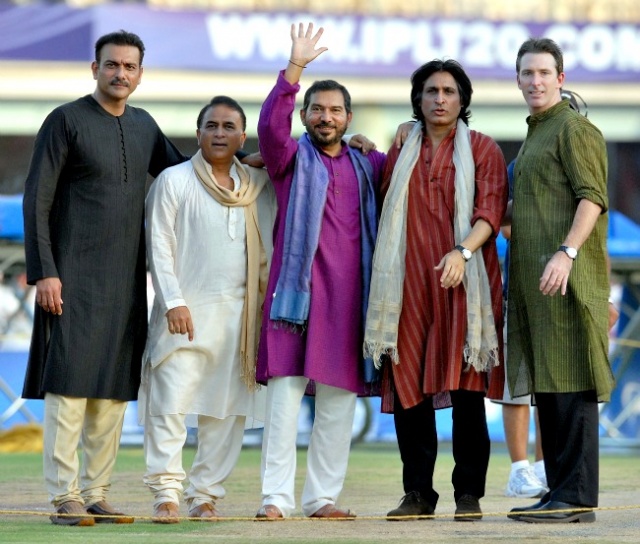
IPL's Sexism

With reference to the article, India’s premier sexist league (May 16, 2013, The Hindu), I have the following observations:

Old-timer stalwarts, good at cricket and talking about it, are made to pose
Models, good at posing, are made to comment on cricket

Firstly, use of women as cheerleaders or sexily attired woman hosts in cricket isn't very much in the traditional spirit of cricket. These are the real acts which have associated objectification of women via cricket.

Secondly, the way cricket commentary has evolved in the recent years has put some otherwise remarkable people in very awkward situations. Remember Mandira Bedi, a fairly talented actress and model? She was the first in India brought in to give a make-over (not necessarily much-needed) to Indian Cricket commentary. I am sure she would make a very lovely host to a reality show. But when she was made to sit alongside the likes of Ravi Shastri and Harsha Bhogle, it is hard to expect her to match them in her insights about cricket. No wonder, she was found goofing up rather often. Now, matters have proceeded further in the direction of glamourisation of cricket commentary and analysis. Now, the cricket studio is very little about insightful analysis and mostly about acting like socialites, something models would do much better than cricketers. No wonder, it's the cricket experts' turn to goof up. First, the seniors are made to adapt to this very foreign style of talking and conducting themselves, thereby forcing them to commit errors. Then, they are ridiculed or criticised in public. Not fair!


Finally, I agree that the way IPL is being clothed up, it shows a demeaning attitude towards women. Talking of rapes and harrassment in the same breath is a bit of a stretch, if not irrelevant. But our seniors should be left out of this debate, if required, by not subjecting them to the completely changed scenes in the IPL studio.

Related:


Thursday, May 23, 2013

The Endpoint of Electronics City

People think, probably rightly, that Electronics City is a special economic zone(SEZ) or something. Then, how come we stay in Electronics City? They keep asking. After all, an SEZ isn't supposed to have residential complexes in it, isn't it? I don't know the answer. I write Electronics City in my residential address. I have probably expected a couple of mails or parcels at my residential address so far. They have all reached me. And my guests have never lost their way too. So, colloquially, our residence is indeed within the Electronics City limits. But formally, probably not.

Where is the formal boundary of Electronics City? I don't know who could give me the precise answer. But a bit of looking around gives me a hint. I guess, the answer is: Wipro Gate.

I clicked a few photographs this afternoon while on my way to office after lunch. The sudden contrast in the scenery seems to be a reliable enough indicator. I am quoting some of the photos in this post. For a few more, you are welcome to visit the album.

That's before Wipro Gate
Red Carpet welcome and Guard of Honour right on crossing Wipro Gate

A lake bang in the middle of the road

Glimpse of the hell


Thursday, May 16, 2013

How To Avoid Gross Generalisations

Here's a list of the kind of generalisations I am talking about:


  • Muslims are terrorists.
  • Men are sex-maniacs.
  • Women are poor in mathematics.
  • Wearing short dresses increases your risk of being raped.
  • Intellectuals are socially impaired.
We live with many such generalisations, most of them are true bullshit. But we often have to tolerate them. People all around us throw at us such nonsense everyday. Opposing each and everyone of them would throw you out from fashionable gatherings in no time. So, there's often no other way but to keep quiet.

But we must protect ourselves at all costs from one thing: making such generalisations ourselves.

Here's one simple trick.

Almost all these generalisations are of the form: "G is/are C." where G is a group of people, and C is a characteristic.

Now, before you admit to any generalisation of the above form, check also if the following are true:
  1. not G is C.
  2. G is not C.
  3. not G is not C.
The first, not G is C, means that people not belonging to the group G have the characteristic C. If so, the generalisation probably doesn't hold.

The second, G is not C, means that there are people belonging to the group G who don't have the characteristic C. If so, this too weakens the case for your generalisation.

The third and the last one, not G is not C, means that people not belonging to the group G are found not to have the characteristic C.

Only after you have examined your hypothesis from all the above angles is there is any significant probability that the hypothesis is well-founded. Otherwise, it's merely a thought, a stereotyping, a gross generalisation.

You may find the above little trick useful to work your way through any unpleasant argument that you may unfortunately get into with someone making an intolerable generalisation. But, without fail, make sure you put it to good use against getting trapped yourself making any such generalisation.

Monday, May 06, 2013

Fall of The Hero


Yesterday, when our housemaid was about to leave after finishing her work, her umbrella broke. I tried to see if I could fix it. I fiddled around with the rods, and buttons and springs and the linkages and the unwieldy cloth on top for a while. Eventually, I found the matter to be more complex than I could handle, and meekly surrendered.

All this action had an audience in my son Vigyan who watched with rapt attention, repeatedly coming dangerously close to all the poky things coming out the broken umbrella and had to be shooed away. He was watching his dad try fixing an umbrella!

Eventually, I handed over the separate pieces to our housemaid begging her pardon and asking her to take them to an umbrella-maker. She left. And we were about get back to our own respective chores and forget all about the little incident when Vigyan did something that made sure that this little incident would stay forever etched in my mind.

I felt a pull on my shirt, and I saw an almost teary-eyed Vigyan looking up at me. I took him in my arms when he asked: 'Baba! I know you are very strong? Then why couldn't you fix the umbrella?'

It was just a matter of time. It had to happen. This painful experience is the destiny of every son and daughter to realise that his father is not the strongest person in the world but an ordinary mortal. That the father too fails and falters like everyone else.

While I hailed him with kisses and hugs, I told him that even strong people can't do everything. My own eyes welled up to imagine how many times Vigyan will be subjected to the excruciating experience of witnessing his father's weaknesses!


Related:

Vigyan's Points of View

Wednesday, April 24, 2013

We on Our Roads

I just went through this article, and I couldn't agree more.

The article points towards some research findings that being rich robs you of your empathetic nature.

It's really true according to me. Recently, I was discussing on a related matter with a friend of mine about the behaviour of people residing in posh apartment complexes. Particularly on how they find it perfectly justified for them to waste resources like water, electricity and food, just because they have paid for it. It seems when my friend suggested in one of the casual conversations to one of his acquaintances that we should be considerate on such matters, the other person there said, 'that's not life!'


Can anything be any more degrading than to believe that being considerate is no more an option for humans?!

Before this article gets dismissed as another social bitching piece, I want to bring to your notice another issue: about how we look at our right to use public infrastructure, particularly roads. We have no order on our roads. They are polluted and dangerous. But above all, our roads are excessively crowded. The road cries out in pain when yet another car gets added to this mayhem, even if that car is yours or mine! Cars are the main reason why our roads are so dangerous, not the other vehicles like autos, 2-wheelers and buses, however much we might like to blame them for the chaos, and to take pride in our awareness of the mannerisms of more orderly roads of other countries. And that's simply because cars are so inefficient in terms of everything: fuel, space, maneuverability. Once we give up for good all the other more efficient and compassionate modes of travel for a car, what's this we are trying to convey by criticising those other people who scramble around for that little space we have left them with on the roads?

Please consider using public transport sometimes. Please use a 2-wheeler instead of a car if you can. Please take out your rusty bicycle for little personal excursions in and around your locality. It's good for your health. It doesn't pollute. It glides smoothly and noiselessly on the roads and quickly gets you to your destination. It burns up that fat in your body which you struggle to burn on the treadmill in your air-conditioned gym.
I have seen people going further than not accepting the nobility in minimalism. By calling such acts vanity in the disguise of simplicity.

Start by taking the first step: by accepting that it is good to be considerate and compassionate on the road and elsewhere. Please have the courage to accept that the people who have chosen not to crowd and pollute have done an act of integrity. They deserve your respect and admiration; not ignorance and definitely not scorn. And accept that if you aren't able to do the same thing, it's not a happy choice, but has got to do with some limitation on your part: distance, lack of fitness, or -- as is most probably the case  -- mere laziness, or even worse, vanity.


Please stop giving the lame excuses about pollution. Adding to litter just because there's already a heap of it lying there isn't justified. Same applies to corruption. Why doesn't that apply to pollution and crowding? Just because you hate inhaling polluted air, you decide to contribute to this state by pumping in loads of CO everyday by preferring a car to a two-wheeler or public transport? Isn't that selfish and inconsiderate?

I have been driving a 2-wheeler for 25 years (a dozen of them in Bangalore). I have been riding a bicycle for even longer (a dozen of them in Bangalore again). I can't say anything about tomorrow. But I am alive today. I haven't been knocked down so far by any rogue driver. And I can vouch for the fact that I am less unhealthy than I have always been in large part due to my on and off (progressively more on than off) bicycling. I believe that, despite the dangerous conditions of our roads (which I don't fully deny), a lot of your own safety depends on you. Being a bit cautious, and not depending on the same from others, does the trick. It may slow you down, frustrate you a bit. But that's a lot better than risking your life or not cycling at all.

I am sorry to see that while many of the people of my age group are finding their way back to healthier and fitter lifestyles, younger people find it their prerogative to desire cars as a necessary luxury as soon as possible to mark the fact that they are doing well in their lives. What a pity! Isn't it the same mentality as that of thinking that you have every right to consume as much resources as you wish as long as you are paying for it? Wake up guys! Learn that the need to show off one's achievements is already bad enough. To think it one's entitlement to potentially disastrous modes of vanity is nothing less than criminal.

The happiness of doing well in life comes with a bunch of responsibilities. Achievement devoid of commensurate awareness, knowledge, thinking, compassion and wisdom is not worth a farthing to anything including yourself. Simply because any such happiness simply can't exist. Consider not searching happiness by inflating your ego endlessly. There are other more direct and less disastrous ways to seek happiness. And they don't eventually end in a naught.

Well, before I turn too acidic and digress, let me conclude with a wish list:

  1. That we all had behaved better on our roads. 
  2. That we had been more respectful to the people who built it, and to those who laid down rules and directives for good driving.
  3. That we followed rules without having to be watched over all the time.
  4. That we showed some respect to our fellow users of the road by keeping distance, by not overtaking too much, by not driving non-linearly, by not honking too much. 
  5. And finally, that we had respected the fact that the space on the road and breathable air in our atmosphere are both exhaustible resources, and had taken to less polluting and less crowding modes of transport wherever possible.

Friday, April 19, 2013

Poem for My Beloved Son

(Poem written by my friend Sudhanshu for my son Vigyan) - Thanks Sudhanshu! There can't be a better gift than a creatively exposed thought or feeling. :)

                   विज्ञान के लिए 


एक शिल्पी के सृजन से ज्ञान की ज्योति जली
ज्ञान की ज्योति में थी जीत की अद्भुद चमक,

                       ज्योति है वो ज्ञान की, शिल्प के अभिमान की 
                       जीत के अनुराग की, जीवन के अनुसन्धान की, 

पर ज्ञान वो विशेष है, सहस का जिसमे निवेश है, 
सुजीत शिल्पी के लिए, वो प्रेम का सन्देश है, 

                         ईश्वर करे वो ज्योति फिर बन जाये अग्नि यज्ञ की,
                         आहुति जिसमे सत्य की, और अर्चना हो कर्म की,

फल मिलेगा यज्ञ का, रूप लेकर ज्ञान का,
ज्ञान के संधान से, होगा जनम विज्ञान का

                                                                                           सुधांशु शर्मा (अमृत)

Monday, March 25, 2013

Is Time Travel Logically Possible?


(This is an extended version of the essay for an online introductory course on philosophy I took in Coursera.)
Introduction
In H. G. WellsThe Time Machine, the protagonist travels both backward and forward in time. The Doraemon animation series which was created in Japan in the 60s features a robotic cat who travels 2 centuries backward. In Hollywood, we have Terminator series which is predominantly based on the theme of travel. A web-search on 'mythology' and 'time travel' would bring up many resources. But human's fascination with time-travel is not new. Einstein's special theory of relativity (1905) and then General theory (1915) gave a hint that time is not a physical absolute that keeps all universe chained to one single point which moves at its own personally chosen pace. Different objects experience different personal times depending on how close their relative speeds are to the speed of light. It's over a 100 years since then. Design of time machine hasn't been achieved yet. That prompts us look at the phenomenon of time-travel with some more scepticism; to investigate what would logically entail when the external and personal times of an object start diverging.
Here I present my thoughts on time travel. In this essay, I present three arguments: Unique existence, impossibility of passive existence and causal loops. My analysis makes me believe that time travel may not be a logically well-founded notion, at least not in the form we popularly perceive it in.

The Issue of Unique Existence

This argument rests on an assumption that, given any point and time in all space -- the (x, y, z, t) co-ordinates -- there can be only one particle occupying it. Suppose I (means, the collection of all particles in me) am occupying a particular space at a given point in time. What happens if an object or person travelling through time pops out this very moment -- apparently from nowhere -- to occupy the same space that I occupy. What would happen to the particles in me? Would they be displayed here and there? Would they just disappear giving place to the newly arrived object? At any rate, two particles occupying the same coordinates in the space is incomprehensible.

Impossibility of Passive Existence

The phenomenon of objects popping out of thin air has yet another issue. Each such event is bound to create counterfactual changes. Even if an object pops out at a point previously occupied by nothing else (i.e. vacuum), it's sure to change the course of history of the universe. If it's a charged particle, it will set an electric field around itself. A radiating object will change the illumination of the place. If not anything else, the very fact of an object having a mass immediately causes it to interact with all other particles of the universe through the force of gravity. The fact of something's existence is fundamentally determined by its ability to interact with the universe surrounding it in someway. Even a passive spectator of events around it must be stimulated by physical stimuli (e.g. light, sound waves etc.) to sense them. Absorbtion of physical signals results in changes in the surrounding that wouldn't have happened if the signals hadn't been absorbed. In other words, an absolutely passive existence sounds like a vacuous idea. May be, invoking Descartes' idea of substance dualism may succeed in modelling such a 'ghost' existence. But, in my mind, I am unable to do so.

Causal Loops

The most serious difficulty in the notion of time-travel, according to me, comes from the notion of causality. If we write out all the events in the universe, and for every pair of events A and B, we draw an arrow from A and B if A directly causes B This exercise (of drawing arrows between events) would give us a directed acyclic graph (DAG) of causality. As per this idea, all events in the history of the universe can be tracked back to a set of events, which in turn, aren't caused by any other event. There can exist no cycles of causality in this graph. Put another way, no event can directly or indirectly cause itself.
However, time travel can create cycles in this causality graph. Several examples are present in the Terminator series of movies. For example, a soldier named Reese is sent back in time by John himself from the Terminator. John is born out of the love between Reese and his mother Sarah. Does this mean that John caused his own existence? In fact, it would have been possible for John to father himself, had the storyteller decided to tighten the loop of causality a bit further! Even more interesting is the advent of the Skynet -- the AI network which wages a war on humans. Skynet develops out of the remains of the first Terminator, the one which had travelled to 1984 from 2029 to assassinate Sarah. And its Skynet which creates Terminator. The question is: wherefrom comes the idea Skynet or Terminator. They seem to have begotten each other! The trouble here is more serious than that a machine invents a machine. We may imagine, at least in theory, that AI machines sophisticated enough may even invent other machines. But the acyclicity of causality is an even more important requirement in the case of ideas and thoughts than in the case of physical events like birth of people.

Conclusion

We have presented three arguments which speak against the logical possibility of time travel. The first objects to time travel based on the incomprehensibility of two particles occupying the same co-ordinates in space at any given instance of time. The second rests on the notion that existence of a physical object can't be passive in true sense; it must interact with the outside world. And therefore, it must have a role in the course of history. The third objection rests on the assumption that causation is acyclic: Time travel makes it possible for events to cause themselves.
There are other difficulties which are physical. For instance, how would time travel as we understand it, fit in with laws of conservation of mass and energy?
It also appears to me that the objections raised above, more than proving a fundamental impossibility of time-travel, brings forth a certain incomprehensibility of the reality that would result from it. To prevent time-travel from creating an anomalous universe, one must imagine a concept of time travel very different from the one popularly held.

Saturday, March 23, 2013

The Hidden Horse

Indeed, why does a painting or sketch of something often look better than the thing itself?

I don't know the precise answer. But I am reminded of an anecdote an old friend of mine had once shared with me.

In one of those North European countries (I don't remember which), there happens to be a community of artisans specialised in making wooden toys. My friend, one day during one of his trips to the place, stood watching a person making a wooden horse with fascinating precision and speed, almost hard to believe. After a while, my friend couldn't contain himself and asked the craftsman how he managed to do such a hard thing (building toy horses) with such ease. The good natured man smiled and said in his accented and broken English: "Not hard at all. Not hard at all." Then picking up a block of wood, he said: "Here's wood. You just have to remove what is not horse. And there! You have your horse!"

...and this story seems to be a block of wood hidden in which seems to lie the horse -- the answer to the big question: 'Why does a painting look better than a scenery?'

In every block of wood that passes before our eyes, there's hidden a horse. An artist, in some way or another, just takes that horse out and presents it to you. In every scene that passes before us, there's a painting hidden. An artist just takes that painting out for us. By highlighting what's interesting. Abstracting away the rest. Often, he highlights what could be interesting.

Friday, February 22, 2013

An Artist's Pledge


  • That my service to the world will be to give people the faith that the world they live in is full of infinite beauty, by helping them see the beauty that's there all around them.
  • That my work will not merely be a display of my skill and precision, in fact far from it. Rather, it will be the translation of nature's subtle language into the visual/literal language that humans understand.

Related:

A library of own drawings and the work of some of my favourite contemporary artists

Thursday, February 21, 2013

Vigyan's Points of View

Eyes-Cold

Vigyan (while eating): Mamma! Today, in school, Sameeksha was saying ice is hot.
Shilpi: He he! Is ice ever hot?
Vigyan and Shilpi in chorus: No!
Sujit and Shilpi (being very happy at their son's intellectual progress) : See! How fast he is learning!
Vigyan: Baba! Look! (points to his eyes) My eyes is cold. I know that eyes is cold.

Cinderella Story

Once there was a girl called Cinderella. Her mom was very badmaash. Her didi's were also very badmaash. One day the horseman said: 'Hear, hear, hear.' Didis were happy. They dressed up and went to palace. Then another didi came. Her name was Pari. He moved her stick with a star on it. Tling! Then Cinderella went to palace. There there was marriage of Cinderella and prince. Then Cinderella saw it was 8 O'clock. She ran home. Her shoe fell on the staircase. Then that badmaash didi wore it. But it was too small. Then Cinderella wore it. It fit. So, Cinderella and prince sat on a horse. And they got married. And they were happy.

Related:
How Should We Dine at a Food Court?


Tuesday, February 12, 2013

Vinoba Bhave's Thoughts on Education

In brief ...

I summarise some of Acharya Vinoba Bhave's thoughts on education (named Nai Talim). I find its strengths in education's well-grounded and practical nature and it being treated as an ennobling agent, both traits missing in any explicit terms in present day mainstream education. I however have doubts about the practicality of such a way. It results in a society which, though internally developed, is vulnerable to external attacks and desertion by its weaker and/or ambitious members. It also seems to undermine the importance of intense intellectual pursuits like abstract science, philosophy or arts. It is hard to imagine that something like Nai Talim (an abstract concept of significant intellect) itself could emerge from such a system.


Nai Talim

I recently came across a very interesting take on education while going through a compilation of Acharya Vinoba Bhave's thoughts on education. I purchased the book for Rs. 35 at Bapu Kuti in Sevagram. The concepts are given the name Nai Talim (new learning). The concept and the term originated from Mahatma Gandhi. In gist, here are a few points which come up repeatedly as salient:

  • It talks predominantly about rural education in India.
  • The education is craft-based.
  • Work and learning can't be separated. This is called integrated learning.
  • Obsessive pursuit of knowledge isn't advocated. A pragmatic approach is proposed where knowledge is used as a tool of improving life.
  • Distinction between intellectual work and labour work is discouraged.
  • Overall personality and character development is emphasised.

Tones of spiritualism, socialism and non-violence are mixed at all times in the explanation of the concept. The model of development seems to weigh self-reliance and organic growth over speed of development or modernisation.

Praise

In spirit, I find myself partial to this way of learning, living and developing. I find the following as the strengths:

Education as a Value Add to Life. Over-specialisation seems to be a bane of our current way of educating our children. Students spend all their learning years gaining an expertise which is useful in a setting which isn't native to him. For example, after more than 20 years of devoted effort, all I seem to know is to work on a computer. Through a series of technological world events, computers are now placed centrally in our lives. Yet, I don't see anything natural or fundamental in this situation. How well am I educated to continue leading a meaningful, satisfied and dignified life if some of the key material aspects of my work are altered, for example, say, computer disappear?

This has several implications. Firstly, it makes me vulnerable to social and technological changes on which I have no control, and which may be centred so far away from me that I have no way to feel connected to them. Secondly, it tends to drain away my faith in education. Most students struggle for all their academic years to identify practical motivations for the activity they spend most of their waking hours in: studying. Some keep an eye on the next examination. Some have the target of getting into a top university. Some vie for a high paying job. Some of a respectable degree. All these are extrinsic and artificial motivations for doing something we aren't convinced about the real use of. Most of our learning (training) happens for the service of a complex world we have no clue about.

I feel, in the least, my education must equip me to apply my thoughts to the improvement of my own life directly. My training should enable me to solve problems of physical, analytical, emotional, social, economic and ethical nature. Nai talim seems to address that.

Education as an Ennobler. Education, as we have it today, doesn't seem to ennoble anyone. It should. In fact, this objective should be given as much importance as, if not more than, intellectual development. More educated people aren't necessarily less selfish, less corrupt, more courageous or less violent. They should be. This is dealt with in the Nai Talim.

Critique

However, I also have some doubts which render the practicality of such a system like Nai Talim questionable.

1. Vulerability. Firstly, this concept seems to be in line with an age-old Indian tradition of learning. We all know of its merits. It rightly keeps our attention away from blind materialism and focuses on inner development of people, which is what development really is. The model results in a peaceful, harmonious, robust and sustainable society, at least in theory. In a world where all civilisations, nations and races are prepared to honour, if not follow, this way of living and learning, no problems will arise. However, in a world comprising of other methods of learning and development, this way appears very vulnerable. This vulnerability has more than one forms.

1.1 External Vulnerability. Consider yourself an educated and elevated society of people leading a peaceful life in harmony with their surroundings. Any expansion is done only when bidden by necessity. So, visible signs of modernisation and technology aren't many. The real development is of course in the people: they are nobler, less aggressive, and in general happier. All hunky-dory! In comes a bellicose element: an external invader, an imperialist, a mining magnate. He is spiritually bankrupt, but has made immense strides in material development. And to drive his world at its ever increasing pace, he needs all sorts of fuels: minerals, wood, cheap labour, sex workers. He gives a damn about your inner peace and spiritual elevation; he isn't educated to believe that such things can exist. All he cares about is your mines, forests, your healthy youth and your attractive women. How do you stop him? Your military capabilities never progressed, because you never needed them so far. So, he tramples on you, kills you, destroys your monuments, burns your scriptures, rules over you for centuries, turns your lot into an intellectual and cultural morgue. He even uses his influence to convince the world that this was the barbaric tribe he was here to civilise.

A method like Nai Talim doesn't provide any protection against this effect. And we know that this form of attact happens: colonialism, atrocities on tribal villages in India and, if you will allow my including a fictional case, invasion of humans on Pandora in the film Avatar.

1.2 Internal Vulnerability. Here's another form of the vulnerability. Whatever you might say, your spiritual way of living is a bit dull, a bit slow, even boring. To enjoy it itself requires certain degree of training and orientation. On the other hand, that bellicose invader, that imperialist, makes sure to flash before everyone every evidence that his people lead an exciting life, materially fulfilled, intellectually free. He erects billboards showing beautiful models loving men due to something they wear, or possess, even though, both the beautiful model and that man posed because they got paid for it; and probably they actually hate each other in their lives. He tells stories about his most brilliant scientists. The reality may be that the scientist invented his stuff because his government wanted to bomb another nation. The scientist may have been a parasite plagearising on others' work. Or he may have been a homosexual recluse who killed himself after leading a life of unbearable persecution. But the stories told would  be of their towering scientific accomplishments as if they were all a result of an irrepressible creative urge. For a society with statistically significant population, there is bound to be a section of the population which would be swayed by this propaganda. Some will leave because they think material and sexual fulfilment is more easily available elsewhere. Some will leave because they think it's more cool to design a nuclear bomb than to till the soil. Even if you have answers to the first form of vulnerability, it's this second form which deals a deathblow to the idea of a harmonious, self contained society, because it brings forth a very important and fundamental characteristic of large collection of humans: they can never all be the same.

1.3 Way Back to Aggressiveness. And if the state tries to intervene to mitigate any of the above vulnerabilities, either through protectionist acts, strong military or iron-fisted law and order, what we have is not a spiritual society, but an equally aggressive state which is a breeding ground of inefficiency, corruption and eventually revolution.

2. Contradiction. There's one final negative factor, which I wouldn't even call a vulnerability. It's something else, something more. It's that such a way of education seems to address a large majority of people for whom imposed knowledge is an unbearable burden. For them, connecting every piece of knowledge gained with a practical experience has the potential of phenomenally increasing the outreach of education. However, there's a minority which would pursue knowledge and learning out of sheer nature. A good many of these would probably be having only one healthy organ in their body: their brain. Restricting the domain on which they are supposed to apply their thoughts would probably be okay. But to declare that mere thinking or pursuit of knowledge is of no value if not accompanied by craft based activity would paralyse these people, because, by nature, these people are probably good in only that. And it's not just about rendering these intellectual lot useless. I don't care much about sophisticated technology. But abstract mathematics and philosophy, astronomy, art, ..., I am yet to see how dedicated, passionate pursuit of such subjects would ever develop in a Nai Talim like environment. I even say the Vinoba himself falls in this category. Not in the sense that he wasn't any good in any crafts, but in the sense that many of his visions are based on his ability (and keenness) to use abstractions which he didn't need to develop as a part of his craft.

In conclusion, dedicated intellectual work of the most abstract kind are integral to the development of any society, not just the aggressive and bellicose ones, but even those which Acharyaji envisioned. This is because the concept of a large society, as large as a nation, doesn't emerge naturally from a tribal outlook that something like Nai Talim seems to advocate, but from man's inherent ability and nature to create abstractions.

Related: