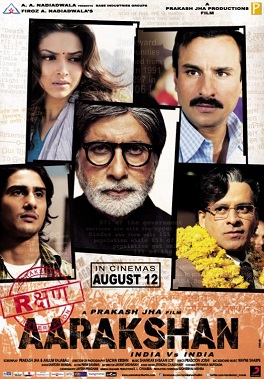
I saw Aarakshan yesterday. It's a good movie, I would say. Not great from a purely artistic point of view. Good acting and dialogues. But some out of place songs. A gradually increasing portion of drama as the story progressed. There were even moments when one felt that probably the story has started draggingand had lost the crispness. But definitely overall the movie scores well in the way it deals with an inflammable topic in a sensitive way while communicating the maker's point of view rather clearly. Or may be it's actually the viewer's (my) view interpreted by him (me) as the maker's view. The climax resembles the Anna Hazare movement in its look. That adds an appeal to the experience of watching the movie, though rather coincidentally.
The way the storyline gradually drifts away from the issue of reservation and casteism to that of education wasn't accidental I am sure. In fact, it makes a very strong point: the issue of reservation and casteism are really not central to the woes of the Indian society. The central issue is that of education. The evils of casteism can't be mitigated by reservations. Not because the idea of reservations in itself is evil. It is not. But because, its correct implementation is probably impossible in presence of too many stakeholders in the game. It's impossible to prevent people from misusing it. In fact, it's not just reservation policies which are misused by politicians but the overall combination of reservations and class-struggle.
There were some dialogues which probably carried the maker's take on the matter. Once, the hero asks the question regarding why we don't have ITS (Indian Teaching Services) as we have IAS and IFS? There was one more where his wife asks why, instead of wasting so much money on reservations at higher education and job, government doesn't invest all its crores on improving the primary education system.
The way the hero deals with the overall situation in the movie was obviously very dramatic appropriate for a movie. But the message was valid for the real world. The key lies in making education accessible to everyone irrespective of their background.
I would like to add the following points from my side:
An idea worth considering for the government of India would be to have a kind of mandatory education service for all post-graduates of the country. If you aren't in teaching and you hold a post graduate degree you must devote x years (May be 1 or 2 years) of your professional life to education. Countries like Israel and Korea have successfully implemented compulsory military services in their country. I feel, it's practical to implement something similar for education.
The other thing, though slightly in a broader interest, is that education must be partially freed from being widely perceived as a professional training. Education is about life, not profession. It should be seen as a vehicle of sharpening thoughts and knowledge which are general tools for leading a better life, of which professional advantage is a small subset. But, let's leave all this to a separate discussion.
