Translate

Pages

Showing posts with label Education. Show all posts

Thursday, September 03, 2015

Essence of Learning

(Look below for my summarisation)

"Now, you see, you don't do this thing a bit better than you did a fortnight ago, and I'll tell you what's the reason. You want to learn accounts--that's well and good. But you think all you need do to learn accounts is to come to me and do sums for an hour or so, two or three times a-week; and no sooner do you get your caps on and turn out of doors again than you sweep the whole thing clean out of your mind. You go whistling about, and take no more care what you're thinking of than if your heads were gutters for any rubbish to swill through that happened to be in the way; and if you get a good notion in 'em,it's pretty soon washed out again. You think knowledge is to be got cheap--you'll come and pay Bartle Massey sixpence a-week, and he'll make you clever at figures without your taking any trouble. But knowledge isn't to be got with paying sixpence, let me tell you. If you're to know figures, you must turn 'em over in your heads and keep your thoughts fixed on 'em. There's nothing you can't turn into a sum, for there's nothing but what's got number in it--even a fool. You may say to  yourselves, 'I'm one fool, and Jack's another; if my fool's head weighed four pound, and Jack's three pound three ounces and three quarters, how many pennyweights heavier would my head be than Jack's?' A man that had got his heart in learning figures would make sums for himself and work 'em in his head. When he sat at his shoe making, he'd count his stitches by fives, and then put a price on his stitches, say half a farthing, and then see how much money he could get in an hour; and then ask himself how much money he'd get in a day at that rate; and then how much ten workmen would get working three, or twenty, or a hundred years at that rate--and all the while his needle would be going just as fast as if he left his head empty for the devil to dance in. But the long and the short of it is--I'll have nobody in my night-school that doesn't strive to learn what he comes to learn, as hard as if he was striving to get out of a dark hole into broad daylight. I'll send no man away because he's stupid: if Billy Taft, the idiot, wanted to learn anything, I'd not refuse to teach him. But I'll not throw away good knowledge on people who think they can get it by the six penn'orth, and carry it away with 'em as they would an ounce of snuff. So never come to me again, if youcan't show that you've been working with your own heads, instead of thinking that you can pay for mine to work for you. That's the last word I've got to say to you."

 
- Bartle Massey, School teacher, Adam Bede by George Elliot
 
In short:
 
  1. You can't learn by just paying money.
  2. Learning happens when you think of it outside the class.
  3. You must look actively for situations where you can apply your learning.
  4. No teacher can do the learning part on behalf of the student.

Can't make a more relevant statement than this one written nearly one and a half century ago. 

Tuesday, February 12, 2013

Vinoba Bhave's Thoughts on Education

In brief ...

I summarise some of Acharya Vinoba Bhave's thoughts on education (named Nai Talim). I find its strengths in education's well-grounded and practical nature and it being treated as an ennobling agent, both traits missing in any explicit terms in present day mainstream education. I however have doubts about the practicality of such a way. It results in a society which, though internally developed, is vulnerable to external attacks and desertion by its weaker and/or ambitious members. It also seems to undermine the importance of intense intellectual pursuits like abstract science, philosophy or arts. It is hard to imagine that something like Nai Talim (an abstract concept of significant intellect) itself could emerge from such a system.


Nai Talim

I recently came across a very interesting take on education while going through a compilation of Acharya Vinoba Bhave's thoughts on education. I purchased the book for Rs. 35 at Bapu Kuti in Sevagram. The concepts are given the name Nai Talim (new learning). The concept and the term originated from Mahatma Gandhi. In gist, here are a few points which come up repeatedly as salient:

  • It talks predominantly about rural education in India.
  • The education is craft-based.
  • Work and learning can't be separated. This is called integrated learning.
  • Obsessive pursuit of knowledge isn't advocated. A pragmatic approach is proposed where knowledge is used as a tool of improving life.
  • Distinction between intellectual work and labour work is discouraged.
  • Overall personality and character development is emphasised.

Tones of spiritualism, socialism and non-violence are mixed at all times in the explanation of the concept. The model of development seems to weigh self-reliance and organic growth over speed of development or modernisation.

Praise

In spirit, I find myself partial to this way of learning, living and developing. I find the following as the strengths:

Education as a Value Add to Life. Over-specialisation seems to be a bane of our current way of educating our children. Students spend all their learning years gaining an expertise which is useful in a setting which isn't native to him. For example, after more than 20 years of devoted effort, all I seem to know is to work on a computer. Through a series of technological world events, computers are now placed centrally in our lives. Yet, I don't see anything natural or fundamental in this situation. How well am I educated to continue leading a meaningful, satisfied and dignified life if some of the key material aspects of my work are altered, for example, say, computer disappear?

This has several implications. Firstly, it makes me vulnerable to social and technological changes on which I have no control, and which may be centred so far away from me that I have no way to feel connected to them. Secondly, it tends to drain away my faith in education. Most students struggle for all their academic years to identify practical motivations for the activity they spend most of their waking hours in: studying. Some keep an eye on the next examination. Some have the target of getting into a top university. Some vie for a high paying job. Some of a respectable degree. All these are extrinsic and artificial motivations for doing something we aren't convinced about the real use of. Most of our learning (training) happens for the service of a complex world we have no clue about.

I feel, in the least, my education must equip me to apply my thoughts to the improvement of my own life directly. My training should enable me to solve problems of physical, analytical, emotional, social, economic and ethical nature. Nai talim seems to address that.

Education as an Ennobler. Education, as we have it today, doesn't seem to ennoble anyone. It should. In fact, this objective should be given as much importance as, if not more than, intellectual development. More educated people aren't necessarily less selfish, less corrupt, more courageous or less violent. They should be. This is dealt with in the Nai Talim.

Critique

However, I also have some doubts which render the practicality of such a system like Nai Talim questionable.

1. Vulerability. Firstly, this concept seems to be in line with an age-old Indian tradition of learning. We all know of its merits. It rightly keeps our attention away from blind materialism and focuses on inner development of people, which is what development really is. The model results in a peaceful, harmonious, robust and sustainable society, at least in theory. In a world where all civilisations, nations and races are prepared to honour, if not follow, this way of living and learning, no problems will arise. However, in a world comprising of other methods of learning and development, this way appears very vulnerable. This vulnerability has more than one forms.

1.1 External Vulnerability. Consider yourself an educated and elevated society of people leading a peaceful life in harmony with their surroundings. Any expansion is done only when bidden by necessity. So, visible signs of modernisation and technology aren't many. The real development is of course in the people: they are nobler, less aggressive, and in general happier. All hunky-dory! In comes a bellicose element: an external invader, an imperialist, a mining magnate. He is spiritually bankrupt, but has made immense strides in material development. And to drive his world at its ever increasing pace, he needs all sorts of fuels: minerals, wood, cheap labour, sex workers. He gives a damn about your inner peace and spiritual elevation; he isn't educated to believe that such things can exist. All he cares about is your mines, forests, your healthy youth and your attractive women. How do you stop him? Your military capabilities never progressed, because you never needed them so far. So, he tramples on you, kills you, destroys your monuments, burns your scriptures, rules over you for centuries, turns your lot into an intellectual and cultural morgue. He even uses his influence to convince the world that this was the barbaric tribe he was here to civilise.

A method like Nai Talim doesn't provide any protection against this effect. And we know that this form of attact happens: colonialism, atrocities on tribal villages in India and, if you will allow my including a fictional case, invasion of humans on Pandora in the film Avatar.

1.2 Internal Vulnerability. Here's another form of the vulnerability. Whatever you might say, your spiritual way of living is a bit dull, a bit slow, even boring. To enjoy it itself requires certain degree of training and orientation. On the other hand, that bellicose invader, that imperialist, makes sure to flash before everyone every evidence that his people lead an exciting life, materially fulfilled, intellectually free. He erects billboards showing beautiful models loving men due to something they wear, or possess, even though, both the beautiful model and that man posed because they got paid for it; and probably they actually hate each other in their lives. He tells stories about his most brilliant scientists. The reality may be that the scientist invented his stuff because his government wanted to bomb another nation. The scientist may have been a parasite plagearising on others' work. Or he may have been a homosexual recluse who killed himself after leading a life of unbearable persecution. But the stories told would  be of their towering scientific accomplishments as if they were all a result of an irrepressible creative urge. For a society with statistically significant population, there is bound to be a section of the population which would be swayed by this propaganda. Some will leave because they think material and sexual fulfilment is more easily available elsewhere. Some will leave because they think it's more cool to design a nuclear bomb than to till the soil. Even if you have answers to the first form of vulnerability, it's this second form which deals a deathblow to the idea of a harmonious, self contained society, because it brings forth a very important and fundamental characteristic of large collection of humans: they can never all be the same.

1.3 Way Back to Aggressiveness. And if the state tries to intervene to mitigate any of the above vulnerabilities, either through protectionist acts, strong military or iron-fisted law and order, what we have is not a spiritual society, but an equally aggressive state which is a breeding ground of inefficiency, corruption and eventually revolution.

2. Contradiction. There's one final negative factor, which I wouldn't even call a vulnerability. It's something else, something more. It's that such a way of education seems to address a large majority of people for whom imposed knowledge is an unbearable burden. For them, connecting every piece of knowledge gained with a practical experience has the potential of phenomenally increasing the outreach of education. However, there's a minority which would pursue knowledge and learning out of sheer nature. A good many of these would probably be having only one healthy organ in their body: their brain. Restricting the domain on which they are supposed to apply their thoughts would probably be okay. But to declare that mere thinking or pursuit of knowledge is of no value if not accompanied by craft based activity would paralyse these people, because, by nature, these people are probably good in only that. And it's not just about rendering these intellectual lot useless. I don't care much about sophisticated technology. But abstract mathematics and philosophy, astronomy, art, ..., I am yet to see how dedicated, passionate pursuit of such subjects would ever develop in a Nai Talim like environment. I even say the Vinoba himself falls in this category. Not in the sense that he wasn't any good in any crafts, but in the sense that many of his visions are based on his ability (and keenness) to use abstractions which he didn't need to develop as a part of his craft.

In conclusion, dedicated intellectual work of the most abstract kind are integral to the development of any society, not just the aggressive and bellicose ones, but even those which Acharyaji envisioned. This is because the concept of a large society, as large as a nation, doesn't emerge naturally from a tribal outlook that something like Nai Talim seems to advocate, but from man's inherent ability and nature to create abstractions.

Related:

Thursday, January 10, 2013

Limits of Education


Education is popularly compared with the glow of a lamp. A lamp lights another without going out itself. Thus spreads the light of learning.

I have seen many ways in which the above doesn't happen. Here are two of them:

One: Your being educated doesn't mean a dime to anyone.

If a friend comes back from a visit to a new place, we become eager to hear from him stories of his experiences there: what he saw, the people he met, what he ate, where all he went. We ask him to share his photos and so on. If someone visits a new restaurant, we ask him about his experience with the food and services there. But if someone comes from an educational journey, why is there so much silence around it? Quite surprisingly, I find the culture of sharing one's deepest and most insightful experiences with the near and dear ones completely missing around us. That's because we relate education and learning with achievements, not experiences. If something is treated as an experience, it pleases all when we share it with others. But when everyone looks at the same thing as an achievement, you must keep quiet about it, lest your sharing any of your thoughts gets construed as bragging. This way, your old friends, your loved ones distance themselves from you fearing you would make unsolicited display of your knowledge and learning to them.

The other one: I feel, is the more serious one. It's the inability of education to reach inward, towards the soul. Here's another long-remembered Sanskrit couplet for you:


विद्या ददाति विनयं , विनायाद्याती प्रातताम 

पात्रताद्धनमाप्नोति धनाद्धर्म ततस्सुखम 


(Education gives humility, humility gives deservingness. From deservingness comes wealth. Weath allows you to do good conduct. And that's happiness.)


I don't feel, education today is designed to give us humility. Just the opposite. It makes us more and more heavy with pride that we can't handle. Our ego, our primal competitive nature to be called the number one, to stay ahead in some or the other competition, finds its expression in our education. Lamentably, this fact gets corroborated in umpteen cases where people, otherwise well recognised as scholars, can't stand others of their creed. Look at the politics in the top academic departments of the country, for instance. How many instances of friendliness, leave alone deep friendship, do you see flourishing among the PhD students or professors of intellectual groups of stellar status? Hardly any? Thousand different things come in their way of sharing amicability: professional rivalry, intellectual rivalry, conflict of principles...While so-called ignorant people would succeed to make up for their differences easily, intellectuals part ways on the slightest of excuses, and nothing can then bring them back together to share the earlier relation.

If our education is making us more and more intolerant, irritable, self-centred and narrow-minded, why on earth would we want others to get educated like us? This education, which doesn't teach us to look at it as a joyful experience but a toilsomely gained achievement, is like a disease. If it makes us forget to love and share, to be happy, to live, it's better to remain uneducated. Instead of spreading light, it draws out what light we naturally have in our souls, and leaves darkness there. Such an education can be shown off to others to make them jealous. It can't be used to make us one bit happier.

Is there a way to become learned which doesn't erect walls: between the learned and unlearned; and between the learned and learned?

Related:

Saturday, August 27, 2011

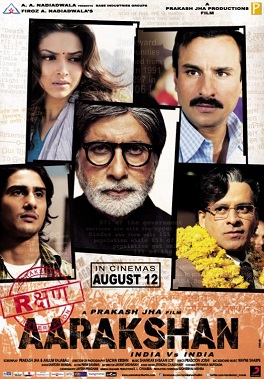
Aarakshan


I saw Aarakshan yesterday. It's a good movie, I would say. Not great from a purely artistic point of view. Good acting and dialogues. But some out of place songs. A gradually increasing portion of drama as the story progressed. There were even moments when one felt that probably the story has started draggingand had lost the crispness. But definitely overall the movie scores well in the way it deals with an inflammable topic in a sensitive way while communicating the maker's point of view rather clearly. Or may be it's actually the viewer's (my) view interpreted by him (me) as the maker's view. The climax resembles the Anna Hazare movement in its look. That adds an appeal to the experience of watching the movie, though rather coincidentally.

The way the storyline gradually drifts away from the issue of reservation and casteism to that of education wasn't accidental I am sure. In fact, it makes a very strong point: the issue of reservation and casteism are really not central to the woes of the Indian society. The central issue is that of education. The evils of casteism can't be mitigated by reservations. Not because the idea of reservations in itself is evil. It is not. But because, its correct implementation is probably impossible in presence of too many stakeholders in the game. It's impossible to prevent people from misusing it. In fact, it's not just reservation policies which are misused by politicians but the overall combination of reservations and class-struggle.

There were some dialogues which probably carried the maker's take on the matter. Once, the hero asks the question regarding why we don't have ITS (Indian Teaching Services) as we have IAS and IFS? There was one more where his wife asks why, instead of wasting so much money on reservations at higher education and job, government doesn't invest all its crores on improving the primary education system.

The way the hero deals with the overall situation in the movie was obviously very dramatic appropriate for a movie. But the message was valid for the real world. The key lies in making education accessible to everyone irrespective of their background.

I would like to add the following points from my side:

An idea worth considering for the government of India would be to have a kind of mandatory education service for all post-graduates of the country. If you aren't in teaching and you hold a post graduate degree you must devote x years (May be 1 or 2 years) of your professional life to education. Countries like Israel and Korea have successfully implemented compulsory military services in their country. I feel, it's practical to implement something similar for education.

The other thing, though slightly in a broader interest, is that education must be partially freed from being widely perceived as a professional training. Education is about life, not profession. It should be seen as a vehicle of sharpening thoughts and knowledge which are general tools for leading a better life, of which professional advantage is a small subset. But, let's leave all this to a separate discussion.

Thursday, August 06, 2009

Flexibility in Education -- A Thought for Future

As I see my child growing day by day, it's a vivid experience tracking his progress. There are things he is quick to learn -- babbling, meditating on something, relishing food .... There are things in which he seems to be falling back when compared with his peers (other kids born within a span of a few weeks) -- grabbing things, turning on his tummy, sitting up etc. Comparisons are always being made. Wherever there seems to be a backlog, it tends to trigger negative thoughts. Elder and experienced people are quick to settle that matter by saying, "Hey! All children are different. He'll learn. Eventually. Let him go at his own pace."

For some months now, I have been turning the pages of books on probability models. Fortunately, my job affords me chances to go back to textbooks and learn things I never tried, or had tried but had given up or was made to give up. Probability used to occupy a part of our mathematics curriculum every year after 9th standard for all the years that had a mathematics paper. I think I was fairly good in probability then, but wasn't exceptional. I learned it to a certain extent that was possible for me during those math courses. After those courses, I hardly ever got a chance to study probability until recently. There were other friends of mine who didn't show an initial aptitude towards probability. They got a few years to demonstrate a growth in their aptitude. Most of them ended at the same level where they had started. They never studied probability after that. Unlike me, they will never study it again.

Perhaps, to a large extent, that's a thankful thing. We ought to be spared of having to struggle with the same set of subjects forever even though we show no inclination or necessity to learn them. There should definitely be a quick and efficient method in place to identify the natural gifts of a child, and propel him in that direction with all resources possible. But there is another side to it. We don't develop our aptitude for certain subjects at the same time. Each child develops his own way of learning. Certain subjects which appeared like Greek in my adolescence now appear easier to grasp when I pick them up after a while. I can upfront think of a few reasons: one is experience which prepares us to look at the subject from another angle. Another is the fact that over years, we develop techniques of thinking and reasoning. Arguments which might have appeared exotic to me when I was 18 now appear quite mundane to me.

Children pick up life-skills at various paces, in different order. Most of them finally arrive. It's not more probable that a child learning to walk early is not more probable to become more athletic than his peer who learns to walk later. An early talker isn't more likely to become an orator than the one who learns to speak a little later. Nature doesn't put us in rigid curricula where we learn our subject along with our peers at a predesignated period of our life; in which we don't get another chance to learn once we miss the first few.

It would be good to learn our subjects in a slightly more flexible way too. If I don't understand probability in my 9th grade, can I take it in my 11th? If, during my 5th grade, I show a strong propensity towards literary skills, can my curriculum be enriched with language and literature subjects, scheduling my other subjects for a later coverage? If before that I show a prodigal aptitude for literature, I may simply be spared of doing my science courses and allowed to grow in my natural order at a much accelerated pace. If I flunk math due to bad performance in some of the modules, can I be allowed to move on, keeping those modules for a repeat visit at a later point in my student-life?

In short, I am talking about flexibility. The tyranny of perpetual comparison with peers will be broken. The growth of the child will be with the direct intent of making him an employable citizen depending on his aptitude. The child will get an almost unlimited opportunity to learn subjects in a customised order. Moreover, there will be possible to maintain a much finer grained profile of the student's strengths. For example, currently it's impossible to know if a student of commerce had, at one point in time, shown exceptional calibre in problems of graph theory. Then, such profiling will be possible. Straight-jackets of science, commerce and art streams are outdated and rotten. This system will allow each student for designing his own stream. Students will seek absolute excellence. Competence (being good in something) will not confused with competiveness (winning games and wars).

Looking closely, it's hardly a revolutionary idea. I see subdued forms of it in the current system of education, particularly in higher education. To implement this idea in all its glory, we need a much more developed way of assessing a child's progress. It may be expensive to implement as it will obviously call for more attention to be given to the individual growth of each student.

May be, something of this sort will work out for a future society. Your inputs please! Particularly, as to how this proposed system could be broken.