Translate

Pages

Thursday, September 27, 2012

Welcome to BMTC


After 11 years of evading it, I am getting to explore BMTC buses in all their glory. AC volvos with 55 rupees tickets for 25 kms. Arterial roads: Electronic City, Majestic, Malleswaram, Whitefield... Rattling blue ones joining far-flung rural nooks and crannies crawling on bumpy pot-holed roads with 10 rupees tickets for 30 kms. Attibele, Jigni, Hoskote, Kodi-Farm, Uttarahalli... Upscale, ear-plugged, perfumed, nose-upturned co-passengers. Talkative, noisy co-passengers, smelling of sweat and dust, eager to help. I salute BMTC for creating this burgeoning network of buses. It's an experience! They have continued to make it possible to travel long distances without spending half your salary on petrol.

I find the drivers and conductors extremely polite and helpful in general. I never knew that there are so many buses in Bangalore, and that there are so many people to travel in them. The enormity of this crowd is humbling! Everyone working so hard! Trying to get somewhere. Millions. And yet, everyone struggling to keep his head above the sea of insignificance which seems to keep rising all the time.

Once you figure out the routes, it seems to be a very economical and eco-friendly way of commuting. It takes a bit longer. Well, much longer in many cases. But city driving is stressful, a time wasted completely. Owning a car isn't a big deal anymore; but being chauffeur driven isn't affordable now, nor ever is going to be, for most of us. Not to mention the fatigue driving creates affecting the quality of the time after the drive. On the contrary, the time in a bus is a time to unplug yourself, work, think, rest, catch up with friends over phone, mail, chat...

I seem to have conquered my fear of buses after a long struggle. And I am profiting from it. I don't have anything to say to those who have given up on public transport like they have given up on voting, or on the whole concept of 'a greater good'. But if anyone has been hesitating to take his or her first step, waiting for a positive word to come from somewhere, here you have it from me. Try BMTC (or whichever is the local bus service of your city). It may turn out to be practical in your case too!


Thursday, August 16, 2012

An Ode to Mediocrity


Consider any quality: Physical, intellectual, emotional, economic, social, spiritual. Create any grading scale of that quality that you feel suitable. Start placing the members of the human population at various grades. You are well likely to end up with a bell-curve. And where will you find yourself? Well, if you are somewhat like me, I'm sure it will be somewhere close that crowded median. Repeat the exercise with another virtue. Again, most likely, you will be loafing around close to the median.
Again, if you are like me and every other mediocre person, every single day or your life, you aspire – no, agonise – to break free of your mediocrity. You too, at least sometimes, dream of being a star.
Stars are those who once, at least once, become the best in something. Their glitter may fade after a period – brief or long. Rajesh Khanna was a star. He shone bright for a while, and faded away into oblivion, to come back briefly once more to the limelight when he died. But we have others like Gandhi, Einstein, Vinci, Tolstoy etc. whom people will probably never tire of talking about. Their stardom may go. With time, they may even get surpassed by someone else in their achievements. But the stories of their achievements endure well beyond the relatively brief period of their stardom. These are legends.
Legends are legends because they somehow end up doing something which changes the world. But you don't need to change the world to be a star. You don't need to invent a medicine for AIDS. You don't need to sacrifice your life for the freedom of your nation. You don't need to reveal to the world the metaphysical secret behind their living and dying. You just need to take something – however trivial, however insignificant, however irrelevant to the current concerns of people – and become good at it. You have to be so good that you become a benchmark in that. The importance of your achievement isn't in the choice of what you have done, but to what extent you went in perfecting your ability to do it. A person who has trained himself all his life to swim as fast as anyone can – which will hardly ever mean anything for the alleviation of one man's misery – becomes a Michael Phelps. Someone specialising in painting horses, naked dieties, and erotic scenes involving them becomes a reverred as well as controversial artist. There seem to be seemingly an infinite number of things to choose from to achieve your stardom.
And yet, stars would probably make a meagre 0.00000001% (I typed a string of zeros that just looked long enough; don't read too much into it) of the population. Legends make up a vanishingly tinier fraction of that. Rest of populations constitutes of wannabes and losers.
Then why on Earth, like me, does every mediocre person perhaps wants to become a star, knowing full well that, by the very definition of the term, stars will always constitute a minuscule part of the population? Logically speaking, the probability of success in becoming one is that much small for all of us. But still we keep trying and trying and trying.
Trying endlessly is one thing. But we go beyond that. We hate ourselves, our lives, everything until we get stardom in at least something. We call ourselves mediocres, losers. The wish to be a star has probably brought out the best in a bunch of people. But for the remaining teeming millions, it makes life a hellish business.
The world is fully justified in celebrating its stars, in worshipping its heroes. Because heroes line the limits to which humans are capable of going in the infinite space of activities. But it's a sheer tragedy that the remaining population, which does the very important task of filling up the space in between these boundaries, frets and whines about getting there at the boundary at least once, to get a photo taken of themselves in that moment of stardom, and to think of that brief moment as the summary of their life. How much more stupid could humanity get?!
How can 70-80 years of living be about vying for a moment of glory that mostly doesn't come? And even if it does, what value does it really have if earned through mere suffering, not just of the self, but of innumerable others trying uselessly to clinche that moment. That moment becomes precious, often not by its intrinsic value, but by the very fact that most won't get it. Just as gold is considered more valuable than iron because very few have it. I don't fully understand the logic behind considering something valuable merely because it's rare. And yet, I know, that's what we humans keep doing.
Tell me, isn't it a huge, colossal mistake? I know, humanity has been committing it since ever, and is probably cursed genetically to continue committing it forever. Yet, I don't think Phelps could have made it if swimming hadn't given him a day to day sense of well-being. I can't imagine M. F. Hussain churning out so many paintings till the last day of his long life without each painting giving him the pleasure of having said something of his own. Phelps' best laps can't be his medal-winning ones. Hussain's best paintings may never have been sold.
Feeling of worth is a very private feeling. Experience of beauty is a very solitary experience. It doesn't get displayed to a clapping audience; it can't be auctioned to rich bidders. And those moments of beauty are the blessings we all humans have got, whether we are stars or mediocres. The privilege to create is afforded to every one of us. That privilege is available each and every moment of our life. The principle output of that creation is the experience of creating. Not how it changes the world, or how people clap, or how much it is sold for. The reason for an act of creation is fulfilled much before it ever comes before any audience, at the very moment of its happening. And that fulfilment doesn't depend on whether you are a star or a mediocre. It just asks you: did you feel the joy? Did you feel it enough?
The thought of being mediocre is a liberating one in a sense. It frees you from the pressure of trying to be the best, the first, the quickest. We know that the burden of changing the world is not on our shoulders. Being mediocre, you can just focus on what you like doing, and enjoy yourself. What the world wants to make out of your work is purely their worry. From your perspective, it's at best a side effect of your actions. Beyond the condition where the world perceives it practically worth their while to let you exist, I don't think you owe anything to it. Your life is yours to live. Your strengths are yours to use; your frailties are yours to fight.
Also, every one of us isn't born to paint a Mona Lisa, to discover the laws of motion. OK, if fixing that broken tap in your house is the best thing you can do at the moment, why not do it and feel as happy? That's your contribution to making the world a better place (and for sure, for your wife this contribution will count more than Newton's laws of motion). So, why be judgemental?
In short: you think you are a mediocre? Good! Happy Independence Day!

Relevant Posts:
Something I wrote exactly a year ago seems relevant in an uncanny way!

Tuesday, July 24, 2012

Getting Rid of Stale Relations


We are shifting house next weekend. Shilpi has been toiling night and day cleaning and packing. It's inspiring -- to put it mildly -- to see her do it so methodically. Sorting, packing, labelling. One particular thing she has been doing is both heart wrenching and overwhelming in its importance. She has been ruthlessly rejecting a lot of stuff that we had been carrying around only because of their emotion value: old notes, paper reprints, letters, cards, magazines, old clothes, pram, cradle etc. Our shifting will be simpler and lighter. Our new house will be more empty. If we decide to get new things to fill that emptiness -- good; if not -- even better.

Hm. What else can be thrown out, to make moving about and moving on easier?

I have been blessed to have got a large number of friends. But that's not been without hurts. I have met plenty of imposters who have simply occupied a space in my memory, and decided to go their own ways. Friendships which never happened don't hurt. I prefer strangers who meet you for a short while and go their own ways with no false promises. But there are those who would swear by their friendship if I met them. But to meet them, or get in touch, it would take me every ounce of my being. There are those from whom I have never heard, not with a single exception. And yet, when I have done the harder job of travelling long miles, negotiating complex schedules, to reach them, their only input to the relation has been an eloquent description of how much they treasure their friendship with me. They won't reply to my mails. They would never call. They would quietly visit my city and go without even calling. I would come to know of it through facebook. Change of jobs, birth and bereavement -- every major happening in their lives, I come to know from the grapevine, from the social networking sites. In some cases, I have even had friends moving in and living in the same city for years together, without bothering to communicate. Any voice raised on this matter would be quickly silenced with unquestionable excuse of busy-ness.

I too have decided to cut some of this crap out from my life. Crap that sits in my heart in the form of friendships and relations which have just occupied a corner of my memories without being a source of any gratification. 

In the end of the day, it's a thankless job to be seen as that harmless and patient friend who will always be there for you whether you care or not, year after year. Sometimes, even I would like to speak my mind, without thinking too much about my tone. Without gulping the very gist of my emotion in order to be politically correct. Last weekend, I liberated an imposter who had been swearing by my friendship for 13 years, but for sure had no place for me in his thoughts.

I feel happy and light! And please, don't ask me if I am counting you as one of them, just because you haven't been writing to me every week. :) I think, if you know me, you know me to do better than that. And yes. One advice. Preserve your friendships. But only the true ones. Send out Good-bye cards to the imposters. And live with light heart with space for new friendships.

Sunday, July 22, 2012

Ageing Meaningfully


The episode about the aging people in Satyamev Jayate touched upon many issues relevant to us all. Our changing attitude towards the aging people, the lifestyle changes resulting in more and more limited bandwidth to think about aging parents, the need to handle the fact that life expectancy in our country is on a rise etc. Hearteningly the episode had a very positive feel about it. More than talking about how the younger people should take care of the old, it dwelled a lot on how the older people can find a new meaning in their lives in the mature years. There were umpteem examples shown. A Dada-Dadi park in Mumbai where senior people meet, have fun, workout and involve in socially relevant activities. An old age home in Delhi whose residents actively participate in the running of a school in the same compound. An 80+ man going for a second marriage. A 90+ man climbing mountains etc. Two senior women from rural UP doing amazing things in shooting inspiring youngsters to try their hands in the sport. Amazing! I feel these people are setting such wonderful example for us all! They should be given Arjuna Award. They are the true sports-people.


If we look around , we all will find many such inspiring cases in our own neighbourhood. My wife has recently made acquaintance with an elderly lady in our locality here. She takes time out to teach Kannada to North Indians, and Hindi to South Indians. She organises satsangs for the elderly population of our apartment complex, and summer activity sessions for children in the building. She has this interesting hobby of honey culture, and has many interesting facts to share about the medicinal qualities of wild honey. She speaks with tremendous positive energy and enthusiasm. Outwardly, she is just like any other senior person in the complex; but in reality, she is always bubbling to do something good in the lives that surround her. Quite in contrast to most other much younger ladies in our complex who meet up in the play area in the evenings, mostly to show off their new accessories, or to vent bitter thoughts about their mothers-in-law. All in all, a simply adorable and inspiring character!

Why should the latter years of one's life be filled with loneliness, idleness, disease, poverty, helplessness and self-pity? The experience and wisdom gained through the entire life, isn't that a very potent tool for continuing to live a meaningful life post retirement?

Yet, in most cases, including in my own family, we haven't been setting the best of examples. For example, there's plenty of socially relevant stuff to do around our place back in Nagpur. There are these slums nearby, with loads of social issues plaguing them. There are kids to teach. Women to be empowered. Men to emancipated from alcoholism. Sanitation to be improved. There's our colony premises to improve and beautify. The colony, with its 100+ families, needs elaborate management to become an interesting and vibrant residential area. There are new things to learn. There's plenty of opportunity to engage in group workouts. Most importantly, more than half of them have recently retired people, similarly aged as my parents, with all the time in the world to take up new challenges. Barring a few, most appear to be in tolerably good health. However, nothing happens! Our colony is an awfully lifeless place. Bushes and weeds grow in the park which was meant for children to play. Roads await alms from the Gram Panchayat for repairs, while funds from the colony treasury are squandered. Obviously, the slums surrounding our colony have seen no perceptible change in all these years as benefit of being located in the neighbourhood of a relatively better off colony.

I have tried suggesting to my parents and other elders about exploring outside the four walls of the house for business, occupation and meaning. However, my attempt hasn't been met with much acceptance. In particular, on being approached on this matter, my mother talks about her self-professed ignorance about matters beyond domestic. My father spews bitterness for Panchayat and neighbours, but steadfastly refuses to try doing anything positive in the matter.

What prevents senior people from getting up and taking a step towards making their senior years more eventful? It's not failing health for most; nor sapping energy. It's the inability to question the way they have led their lives so far. How have they lived their lives? By toiling and slogging for such 'noble' reasons as family welfare. For them, the singlemost reason for having worked hard all their lives is the well-being of their families. The man earns; the woman looks after the household. The side-effect of this attitude is that they never discover any other reason to work hard all their long lives. Once the children grow up and become self-dependent, they see no reason to continue working. To start all over again looking for a new reason to work requires revisiting the very reason for work. It can't be family welfare. Then? Some of them try to look at it as a way to pass time. Some simply just continue doing it as a means of subsistence. The only way most people in our country – particularly in the service class – deal with work is just by putting up with it.

The idea of enjoying one's occupation is alien for most of our lower middle class. Most people, even in the younger generation, would look at you with incredulity if you talked about spending most of one's energy in things one enjoys, as if the thought is a blasphemy against the ideal of sacrificing one's interests for one's family. For people who have pretty much lived out their lives not taking their interests and passions seriously, it's a huge challenge to ponder over them now in the twilight hours. All gloomy thoughts of curtains coming down before they would ever start probably paralyses them. Perhaps, the thought of starting to live life on a completely new philosophy which pretty much trashes away the ones they had followed all their lives is like nullifying the entire past. The attachment to one's past, particularly when it's so long and rich, may drive one to committing such a folly of not letting in the future.

Past is gone, dead – however prolonged; future is alive – however brief. It's illogical to cling to a corpse and shirk a living thing. Moreover, it's normal for humans to encounter events which nullify years of earning, whether material, intellectual or emotional. Such events aren't necessarily tragic. Often they are windows to a brighter view of life and world. So, questioning thoughts, emotions and ideals which we have kept for years, should be an acceptable and regular thing to do, particularly if that opens doors to a better life and self. May be one has spent his entire life giving preference to self-sacrifice over self-fulfilment. Why can't that change in the mature years if it's found to be a folly?

I would appreciate inputs on how senior members of the family can be motivated and mobilised to take a renewed interest in life, to have courage to question the past ways of living and start afresh, to have the faith that life needn't ever be turned into a few more leftover morsels to be thrown into the bin, but to its last moment can stand for something meaningful and divine.

Sunday, July 15, 2012

Scientist or Engineer

During my first year in engineering, I was quite distressed by the way we were being taught how to solve differential equations. Just the method : all that CFs and PIs. And then how polynomials got constructed by replacing the differentials (d/dx) by D's. And then you could treat them as polynomials in D, factorise them, and solve the monomials by integration. There wasn't even a hint given as to why it was to be done that way. It wasn't absolutely the first instance when no one seemed to be concerned about telling us why we were doing something, but this was the first time that I remember when I felt that I would probably not be able find the answer to my 'why's without the help of the teacher. I asked a more toned down question in the class that wouldn't make it appear as if I was questioning the very method of teaching. That question got killed by the teacher without much difficulty. My 'why', however, remained unanswered.

There was a discussion between classmates after the lecture where I got a more open atmosphere to voice my doubt. One of my friends reprimanded me, 'If you are so concerned about maths, why didn't you do a math degree? You are here to become an engineer. You are supposed to be a user of maths. Just use it. Don't get lost in its details.' I found his stand a fairly matured one for our age. It had a point of view that I had never considered. In my opinion, I considered myself no different from a science student. My friend seemed to say that there was already too much engineering to learn. We would eventually have to stop at some point of granularity. My friend seemed to have found out where he would stop. I hadn't. I felt respectful about him for this feat. I couldn't, however, figure how I would use this approach to my benefit. There came a spate of topics during our engineering studies that got told to us like revelations of a mystic: Fourier analysis, Laplace transforms, z-transforms etc. Just use them and don't ask questions about their internal mechanics. The bag of doubts I carried by the end of my undergraduate studies had grown quite heavy! I would look at many of my friends with a sense of envy when I found that they were superbly proficient in many an engineering tool they had no clue about the concepts of. They would top university exams while I would struggle to pass; they would learn several things while they were fashionable -- they were tech savvy, while I would struggle with the simple ideas they seemed to be based upon. I didn't know how to stop the claws of curiosity from gnawing at my heart, and yet I had no clue how I could quench it.

I really don't want to go on and on. Dale Carnegie said that you should start your talk -- or whatever -- with a story to hold the attention of the audience. So frankly, the above was a cheap trick I played to hold your attention till I got to the point. And my point is nothing. Just a few questions. What's this thing about engineering and science? I understand that there's just too much to understand and learn. Knowing all of them isn't either useful or possible. Then? Where do we stop? Is it a good idea to be absolutely utilitarian in such things? As long as you can work out the solution of a differential equations, is it OK not to understand how the solution works? As long as you can compute the poles and zeros of the control system you are designing, is it OK not to bother what really these poles and zeros really are?

I don't understand this topic. It's a big muddle in my head. But I understand that it's an awfully important topic to talk about. I wish someone better qualified than me would write on this subject. I would definitely like to read it, without the lure of a story as an opener.

Monday, June 25, 2012

Mr. Parker at the Parking Lot

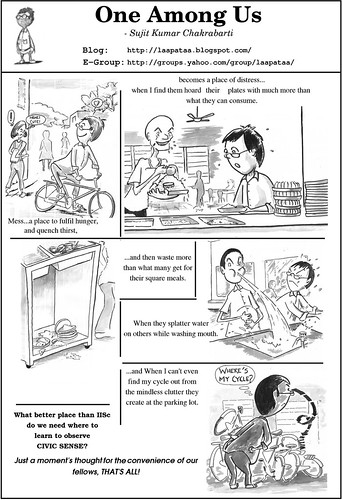
I met a Mr. Parker in the ITPL parking lot who was in the process of parking his bike so as to block the exit for many other parked bikes. When I pointed this out to him, he said that for him to park his bike properly, they shouldn't have parked their bikes badly. I just got the time to ask him who he thought 'they' were, to which he just shrugged and walked away.

I smiled to myself. For the first time in this kind of a situation, my blood didn't boil. I didn't feel a wave of frustration hit me for not being able to do what I must. I just felt, I did the right thing, and I am fine.
 
Probably, I am coming to terms with reality without growing cynical. Tomorrow, if I meet another Mr. Parker at the parking, I will probably say the same thing, and won't feel frustrated and humiliated if he just walks away pretending not to care. I feel it's a great victory!


Wednesday, June 20, 2012

A Weekend in Wayanad


Last weekend, we travelled to Wayanad. I just want to jot down a few highlights of this very memorable trip.
On our way to Wayanad

Weather
We were lucky in more than a way. As per weather forecasts, it was already time for the monsoon to have arrived there. This would mean a difficult drive, and a more or less indoor time there as monsoon rains in Kerala means downpour that makes it impossible to venture outdoors and have fun. We (particularly I) aren't great outdoor enthusiasts anyway. We were OK with the idea of simply lazing around indoors. Sipping at tea and staring at the rain wasn't a depressing idea for me at all. So, we took the risk. However, monsoon got delayed by those many days; we got our share of outdoor fun.

Route
While going, we chose the following route: Bangalore-Mysore-Hunsoor-Nagarhoil-Kutta-Kartikulam-Varnam.
While returning, we chose the following route: Varnam-Kabini-Mysore-Bangalore.

Wild Elephant sited
While going, we started early in the morning, 5 AM. It took us about 7 and a half hours to reach Varnam, inclusive of all our breaks. While coming, we travelled during the day, drove across Mysore, and hit Bangalore when the office traffic was peaking. This added about an hour and a half to our journey. Moreover, a 15 km stretch near Kabini is very broken. Unless you have a big vehicle, it's good not to try this route. It was a mistake for us!

Both ways, we passed through Rajiv Gandhi Reserve Forest. We were rewarded with sightings of deers, monkeys and wild elephants.

Places we saw


Thirunelli Temple. Supposed to be very ancient temple located in the midst of mountains of Brahmagiri. The trip was enjoyable due to many other factors than the temple itself: the beautiful scenaries around, the pleasant weather, the walk down to the Paapnashini river, and of course the drive itself.

On the Way to Paanashini river
A word of caution for non-hindus. No entry for you into the temple premises! Also, to those males who aren't particularly comfortable showing off their bare torsos. To enter the main chamber of the temple, you must take off your shirt and undershirt. I was neither curious enough to see the diety nor brave enough to expose myself to the chill in the air to venture that. So, if you wish to know what was there in the main chamber, ask Shilpi.

I have found the custom of disallowing visitors on the basis of their community still being practiced in certain temples in India in general and in Kerala in particular. This is not at all forward looking. Had I not sighted that board asking non-Hindus to stay out, my enthusiasm in admiring the heritage status of the temple would have been far higher.

Entrance to Iruppu Falls
Iruppu Falls. Must say it was a beautiful water fall. The glory is subdued at that particular part of the year though. The walk up to the spot is about a kilometre. Not for you unless you enjoy at least a modest level of fitness. Also, while walking up (and down) it's a good idea to keep close the middle of the pathway. The place is infested with leeches. I saw at least 2 people doing blood donation to the parasites. But just in case that sounds fearsome, rest assured. Leeches can cause you no grievous harm. It's just the sight of blood and the repulsive idea of bloodsucking which sounds bad. Otherwise, you needn't worry too much about them.

Raft Ferrying People to/from Kuruvadweep
Kuruva island. It's a small delta on the Kabini river where some local tribes inhabit. You take this raft to the island, walk around a bit and enjoy yourself. We couldn't do it as we reached there at about 3.45 PM, about 15 minutes too late to get the last raft ferrying people to and from the island.


Valmeekam Art Museum. Almost adjacent to the island is this nice cute art museum maintained by  some local people. In there are a bunch of interesting sculptures done in terracotta clay mostly depicting emotions related to love, family, sex, spirituality etc. I found them very expressive. A must visit for the artistically inclined.


Varnam Homestay


Varnam Homestay


Paddy Fields

Neighbouring Village House


About Wayanad, and about the spots listed above, you will get plenty to read on the Web. I think, where I can add meaningfully here is to tell you about Varnam, the homestay we spent our 2 days in. The place was highly recommended by one of my friends. We skipped all R and D and decided to go there. And now, I will highly recommend this place to you.

Neighbouring Scenic Beauty
All of Wayanad is green. So, it's probably redundant to say that Varnam is situated in the middle of greenery clad hills. There are excellent roads connecting it to wherever else you would like to go.  The place is full of all amenities that you would look for in search of a restful time out of your home. You could talk a walk to the nearby pa
ddy fields, or the villages around. Of course, if you are a person who expects room-services, heated swimming pools, pool tables and pubs, this isn't a place for you. But if you get delighted by the sight of a lovely courtyard surrounded by a many homegrown vegetation, rabbits, and cute domesticated dog; if a homely look and personal treatment is what soothes your nerves, then head straight to Varnam.

Varghese Family
But the most important aspect of Varnam is the family which runs it: Mr. Varghese runs Varnam from this place which once was his ancestral house. And Mrs. Beena Varghese who is there to make you comfortable in all ways: excellent food with a personal touch. Mr. Varghese is a police officer in the nearby town and interacting with him itself was rewarding in many ways. While he speaks, he draws from his vast experience of the rustic ways of local inhabitants, complemented with an interesting and tasteful awareness of very urban and globalised mannerisms. His personality exuded the simplicity, comeliness and candour of a village farmer on the one hand; and the sophistication of very well-exposed and learned individual on the other. My wife and I agreed that the family, in their 5 years of running the homestay which largely serves visitors from abroad, have expanded their knowledge about people with admirable sharpness. It was a joy interacting with the family while sharing our very sumptuous meals with them.

So, please visit Wayanad, and choose Varnam!

More photos here.

Wednesday, June 06, 2012

The Day the School Reopens

Today, Vigyan's school reopened. Shilpi and I went and dropped him at his school. On the way, there are many other schools. Most have reopened today. So, the roads of Whitefield were swarming with tiny-tots being escorted to their schools by their parents.

Curiosity and apprehension in their eyes: what a beautiful mix that is.

Some schools have introduced uniforms. The kids, all wear wonderfully colourful uniforms. Only kids would agree to wear such colours!

No wonder, my mind turns back to those golden years of childhood with a touch of fondness and nostalgia! Particularly to that day when school would open for the new session. Of course, my memory doesn't take me take far back (in fact, I started going to school only when I was 4.).

  • I remember how the school uniform used to be purposely a bit oversized in the beginning of the session so that they would last our growth till the end of the year.
  • Smells last longer in memory than sight and sound. The smell of the newly stitched clothes. The smell of the new books and notebooks! Most heavenly! The musty, dusty smell of a classroom opened after 2 months. The moist smell on the blackboard just wiped clean in the morning. Sometimes, the smell would be of paint. Black paint. The board would look pitch black, and the first chalk mark made by the teacher during the first period would leave a scar on my heart.
  • Our friends would all look a bit bigger. For the friendly interactions to come upto speed after the break would take a few minutes and no more.
  • The most intense feeling was about the contents of the new years curriculum. The new stories in the Hindi and English books. The intensity of my feeling when I graduated from arithmetic to algebra, linear equations, polynomials, proofs, congruence and similarity, trigonometry...Whether would we be able to live up to them!

Wonderful day!

What's your piece of memory related to the school reopening day?

Saturday, June 02, 2012

How Should We Dine at a Food Court?

The other day, we had our dinner in Phoenix Mall food court. Vigyan found a playmate in a similarly sized kid named 'Pepsi' whose parents (of course Panjabis; who could name their kid so interestingly) sat on an adjacent table. What a joy it was to see the 2 kids play! Their comfort and intimacy was like they had known each other for ever. When the dinner got over, we smiled at the other couple and came back. But the kids never even said bye! Vigyan never mentioned Pepsi after that.

We contemplated afterwards if we could imitate these kids sometime. Next time we go for dinner to a food court, could we just join another family regardless of whether we know them or not? Or may be we could invite them over to our table? Could we just chit chat about things we all love, never bothering to really judge each other? Could we share our food, time and thoughts without asking them who they are, where they stay, where they work, what they do etc.? And then, after finishing the dinner, could we just get up and go? No exchange of phone numbers, no visiting cards, no email id, no promises to find them out on the web. Just get up and go. And forget about them!

How would it be? I wonder!

Wednesday, May 30, 2012

Balancing between Conservation and Consumption

The Elusive Line
I remember, with a sense of luxury, that when I was in Roorkee for my masters, I used to bathe 4 times a day during summer. It used to get hot and humid. And water was in plenty, the geographical belt being in the proximity of Ganges. Having been brought up in a family where wasting anything -- water, electricity, money, time, food, words -- would meet strong reprimand, I often would wonder if it was right to bathe 4 times a day. Somewhere, I had come across one of those articles (with a photograph) of women in Rajasthan walking miles for a potful of water that was all they would have to meet the needs of the entire family for the next couple of days. My trips to the bathroom would be accompanied with pictures of those ladies floating in my mind. Those baths were a relief from the summer, I would say. But they happened with a sense of guilt.

With many words about the inconvenient truth of climate change and pollution being spoken all the time these days, no act of resource consumption remain guilt free for me. Taking out the car, sitting in an air-conditioned office, taking a flight instead of a train, travelling in an AC compartment instead of sleeper class -- I do all of them; and I do them all always with a pinch of guilt.

There are some people very good at never giving this issue a thought. For example, someone once suggested an ingenious method of getting a steam bath at home to my wife: Turn on the water heater in bathroom. Let the shower run. After 5 minutes, the whole bathroom gets filled with a thick clowd of steam. No second thoughts given to wasting 50-100 litres of well-heated water. Offsprings of rich people would obviously be born into conditions where consumption per person is high. Their upbringing would preclude the possibility of their ever coming across the possibility of a life that subsists on less resources without necessarily losing any of its essential value. However, interestingly, we see many people from very modest economic background, upgrading themselves beautifully as their financial condition looks up. For them, the only reason for consuming less could be the unaffordability of higher levels of consumption. Of course, you would travel in a plane if given a choice. Of course, you would prefer a car to a 2-wheeler, if you could. Of course, you would never again visit your old mess if you could afford a 5-star meal.

And then there are people who take the other extreme view where any consumption is viewed as a sin. At the pinnacle, there are Jain Digambars who do not wear clothes. And, in our history, particularly in the oriental society, we have umpteem examples of people who have hailed the virtue of simple living and high thinking: Sages who stayed in ashramas; fakirs and Gurus like Guru Nanak, Kabir, Sai Baba; philanthropists like Baba Amte; Leaders like Gandhi; business people like JRD Tata, Jamnalal Bajaj and so on.

It doesn't seem to be the case that there is any strong correlation between the value of an individual in the society to which of the above two extremes he is closer to. There are valuable personalities who led an affluent life; and there are always those who consume like blackholes without ever creating anything of value in their lives. Similarly, there are luminous figures who led simple lives and changed the world; and there are those who, by worrying and fretting -- and most importantly lecturing and bullying -- about little matters of consumption and conservation, only manage to be obnoxious.

Where does judicious consumption end and wasteful consummerism begin? Honestly, I don't know. I will list a few notions which I have used at various points. But I am all too conscious of their short-comings too. A general canonical solution is indeed elusive.

***
Optimisation
Probably, you would have no difficulty in appreciating that a resource assumed to be renewable and unlimited takes not much time to turn into a non-renewable and limited resource. It all depends on the demand and consumption. For example, computer memory and processor cycles, drinking water, habitable space, road/pipeline/communication channel capacity, etc. All of them start off at some point being perceived as abundant, inexhaustible resources. But humans have a superior knack of running out of resources.

Agent Smith (Matrix, 1999) once says:
I'd like to share a revelation that I've had during my time here. It came to me when I tried to classify your species and I realized that you're not actually mammals. Every mammal on this planet instinctively develops a natural equilibrium with the surrounding environment but you humans do not. You move to an area and you multiply and multiply until every natural resource is consumed and the only way you can survive is to spread to another area. There is another organism on this planet that follows the same pattern. Do you know what it is? A virus. Human beings are a disease, a cancer of this planet. You're a plague and we are the cure.

Therefore, a seemingly judicious policy would be to consider every resource as limited upfront, and start optimising rightaway.


However, this approach doesn't provide such a straightforward solution, even theoretically. Any act of optimisation is actually an act of trade-off. Optimising on one resource may result in higher consumption of some other. And while one may be toiling to optimise parameters like space, time or material resources, one may be losing out on more abstract parameters. For example, in software engineering, they ask you not to worry too much about optimal implementations.

"The First Rule of Program Optimization: Don't do it. The Second Rule of Program Optimization (for experts only!): Don't do it yet."  — Michael A. Jackson

Instead, the general best practice is to write it in a clean, intuitive and maintainable way. A day to day example: One may work hard to minimise water wastage at home. However, not consuming enough water and not maintaining cleanliness in toilets may be both a bad idea from health point of view. It is often hard to predict which parameter will assume greater importance at what point. The optimal solution of today may waste a much more precious resource of tomorrow.

A Sustainable Life
One notion that may be helpful in drawing the above distinction between conservation and wastefulness is that of an environmentally sustainable life. The wish is to bring one's consumption to the level which every single human being of the planet can afford, without sending the environment to dogs. Many vices prevent me from lowering my consumptions.  I am lazy (hence, I often prefer the lift to the staircases). I am spoilt for physical comforts (hence, often I pick the car and not the 2-wheeler or public transport even when I am travelling alone). I am somewhat impatient when it comes to spending time travelling, particularly with the knowledge that the travel time is eating into an already sqeezed vacation (and thus often end up flying instead of travelling by train). These team up to make me behave like any of the spoilt brats at times. Conquering these may well result in a drastic reduction in the consumption of physical resources. Vanity, which is one of the lesser reasons for me, thankfully, probably is the biggest cause in most cases for which people consume, and consume to the levels that jars others' eyes.

However, who defines what a sustainable life is? The 7 billion+ population of this planet isn't my creation for sure. The headcount is continuously on the rise. That leaves less and less resources on my plate every passing day.

Don't Question the Purpose; Just Don't Waste Blatantly
The current social etiquette is: believe in matters of environmental conservation and such stuff in principle, but don't question anyone personally on his specific consumption behaviour. For instance, even when you are having a very animated discussion about rising pollution etc., it is not quite OK to say, 'OK You! stop using your car,' or 'why do you always leave your computer ON while leaving office?' So, the idea is that we go with the assumption that people are in general aware of issues and care for it. Hence, they shouldn't be nitpicked on individual instances.

The only problem with the above assumption, which seems to be affording respectability to everyone by saying that they all care, is that it's not a valid assumption. The whole of western style of growth stands testimony to this. With our little individual acts of carelessness, we have together managed to create an environmental situation of unprecedented magnitude. Simply because we are so large in number.

Perhaps, we hope that by voting for a cleaner environment, and by electing governments who swear by a greener planet, we can forever continue to live our day to day life without having to change anything drastically. We continue to consume wastefully: fly around when a ground travel would do; go on expensive ecologically disastrous eco-tours when a stroll in the neighbourhood would be just as relaxing; continue to shop in the supermarket store when the vegetables in the local market are more fresh. And then we hope these governments will come out with a scheme that will solve the problem with one sweep of a magic wand. It sometimes happens. For example, introducing CNG in Delhi seems to have drastically reduced the pollution levels in the city. But these are rare instances. These government policies, these sweep of magic wands: they are like tiny little occassional sprints of a hare which can do little to defeat the slow and steady progress of the turtle of our daily habits.

The above approach, therefore, can no longer pass off as a moderate approach to bringing about a positive change. It's most surely a sign of our collective inability to face the fact that we are too addicted to a particular way of living; and are too timid, too tentative to boldly explore the possibility of living another way.

Select Your Line, but Don't Change it
Much toilsome discussions would often lead us to give up on them, and disperse with one final request: 'OK guys! Do what you like. But don't change what you like.' It would land any discussion in grave trouble if we try pushing anything of the following points:
  • There should be no indulgence. Strictly austere life is the only correct life. Difficulty: Few would pass this strict test. Eventually, there would be no one left to discuss this topic except a tiny population of strict disciplinarians. Anyway, nobody cares about them.
  • There should be a fixed standard on how much indulgence one should be permitted. Difficulty: To come up with a fixed number would create wars. And to come up with a formula would be incredibly complex.
  • No one tells others about how much to consume. Difficulty: This is as good as saying that this discussion is meaningless.

Instead, we may accept the fact that all of us are susceptible to varying degrees of temptation. Let us allow each of us a degree of indulgence. That degree is determined by the self at some early stage. Once done, no changes are allowed unless passed through strict audits.

The merit of the above idea is that it is self-implementable. The determination of the consumption value is done by the self. Audits on its changes could also be done by the self. The undoing is the seriously high amount of integrity required by the person to implement this. Another undoing is that there are so many in the large population who have no idea how much they should put this value at for themselves. With exposure, they may find a strong need to alter the value. For example, a person raised in a remote village, to start with, may be perfectly comfortable with the idea of walking a couple of miles a day for his daily activities. However, if he happens to do well in his life, migrates to a big city and starts mixing in a society of car owners, walking a few miles every day to office would subject him to various pressures he wouldn't be able to foresee in his initial circumstances. Similarly, a person brought up in affluent conditions may start with a thought that he would limit his annual vacation duration to foriegn tourist locales to a month. However, on coming face to face with the real world, he may find even that way too luxurious.

So, occassional alterations on this limit may be necessary. But then, the point of confusion now shifts to the formula that should be applied to determine the flexibility to be allowed in changing this value.  Also, at least how ocassional should these changes be? Do we allow another level of flexibility (i.e. flexibility in defining the level of flexibility)? Further and further added levels of flexibility in this way would eventually make this policy indistinguishable from the policy of no one telling others how much to consume, won't it?
***
None of us is out-and-out a hero: we all do wasteful things notwithstanding concerns for conservation every once in a while. We call it indulgence. Similarly, none of us is out-and-out a villain: Each one of us feels a pang of concern/fear/discomfort from sights of wastefulness or prospects of collective disaster, at least sometimes. We differ from each in the amount of indulgence we need for ourselves on an ongoing basis.

One extreme stand would be to say, for all of us, any kind of austerity measure derives from the unaffordability of consumerism. The other extreme would be disallow any indulgence. We, in weaving this discussion, are obviously looking for a middle path. And that, like a lot of such discussions, may lead us to say that finally it all rests with the individuals. That may sound disappointing after all this effort; the whole discussion may itself appear vacuous in that case. But probably we should resist the temptation to conclude it that way. Philosophical stands must originate from a faith, but those based on reason. Philosophy itself goes with the faith that there's reconciliation possible between the two: that, in some sense or the other, is the grand challenge of many branch of philosophy. Not being able to achieve exactly that -- a solution that has eluded us for thousands of years -- should come as no surprise. But engaging in discussions on the subject is definitely an indispensible step towards the achieving goal, if not in the general case of the entire population, then at least in the specific case of our own personal life.

Tuesday, May 29, 2012

Bump!

About 2 months back, a taxi bumped my (stationary) car from behind. I couldn't do anything to get my damages back from the guy. After much deliberations on when/where how to get my damaged car bumper repaired/replaced, I got it done last Saturday. It costed me 9K. Today, within 48 hours of the repair, another taxi bumped my (stationary) car from behind. I am back with a damaged bumper. Of course, today too, I couldn't get any repayment from the driver. Do I need to tell how I feel right now?

I feel like...I will...I will...I will...I will write a blog post on this! Can't do anything else!

Monday, May 07, 2012

One Thing Good About Being a Celebrity

Came across two instances of the power of being a celebrity yesterday.

First. Aamir Khan's Satyamev Jayate on Star Plus which is to be aired every Sunday at 11 AM starting yesterday. The programme deals with social issues plagueing India. The first episode yesterday was about female foeticide. It presented data and analysis pertaining to the issue bringing forth its scale, nature and causes. It introduced some victims and some people who have been doing something to solve the problem. It ended with a couple of action points identified for the makers of the programme as well as the viewers. Thoroughly researched. Aamir Khan has spent nearly a decade or more to build a special philanthropic image for himself, from doing movies like Rang De Basanti, Taare Zameen Par, 3 Idiots, Mangal Pande, and even Dil Chahta Hai. Also campaigns like Atithi Devo Bhava. And in this programme, he brings its force together to hit the viewer's consciousness really hard. Commendable effort!

I hope to be treated with enlightening and moving accounts on many more social issues in the coming weeks. It will be an hour of weekly respite for the TV and its viewers from unending series of mindless soaps, abusive and phony reality shows, sensationalist news coverage, sexualised sports. While this programme is on air, I will give up my abstinence from TV. It's like we are back to our good old Doordarshan days when the ill-endowed documentaries used to be rich with one thing: sincerity.

My wishlist of issues for Satyamev Jayate:
  1. Environment
  2. Education
  3. Corruption
  4. Analysis of India Shining

Second. I came across this other one while flipping through the channels during a commercial break during the above programme. I don't remember which channel. Nor what programme. But there was Salman Khan talking to a phenomenally obese 18 year old girl giving her advices about being healthy and stuff. Not so impactfully presented, nor dealing with an 'apparently' social issue. But I feel that it's an equally widespread problem: this problem of unhealthy lifestyle. The cost of bad health due to lifestyle issues must be second to none on the society.

These celebrities aren't saying something no one else has said. Just that their position as celebrities gives them this unique chance to be listened to and taken seriously. I am happy they are finding it right to use their status for saying something really meaningful.

PS: Heard it that Aamir Khan is getting 3 crores for each episode of Satyamev Jayate. If he continues doing the kind of job he did in the first episode, I think he deserves every paisa of it.

Thursday, April 26, 2012

The Fallacy of Influencing Others

I grew up with ambitions of 'making it big' in many ways. I wanted to be a scientist whose inventions would change the world in the way those of James Watt and Addison did. I wanted to be a teacher under whose tutelage scores of youngsters would imbibe my own ideology and knowledge structure. I always wanted to 'move up the value chain', always wanted to do stuff with bigger impact factor. I wanted to be the man whose achievements (and even the obituary, literally) would feature in the front page!

The realisation of my littleness has most joltingly hit me when I learned to observe how little the various aspects of me, my life, my achievements, my strengths, my insights etc. mean to others. Let me cite a very little example. I have always made it a point to shutdown my computer before leaving office. Very simple reason of saving energy. After all arguments about how ineffective my little move would be in saving the world, I eventually reached the conclusion that it costs me nothing to do it anyway. So, I made it a practice. I routinely kept sharing my thoughts with my colleagues -- people with whom I have always shared great rapport and respect -- and very politely kept requesting them to adopt the simple practice. In spite of all initial resistances falling apart, and in theory accepting my argument, I found not a single person changing his habit! It was a phenomenally frustrating experience. It made me acutely aware of how little the power of argumentation and logic is in front of long-standing habits and attitudes.

My daily life is filled with innumerable experiences of the above kind. I have failed routinely in influencing people through model behaviour. People are exceptionally resistent to change even when you present a flawless example of a triumphant best practice. A large portion of the population doesn't even have faith in the idea that thoughts can be used to tune important behaviour.

I always thought that I was well aware that people take offense if you put your virtues on naked display. Even staking claim on such qualities as modesty, magnanimity, civic sense etc. is very dangerous and immediately invites defensive stance from the onlookers. Far from genuinely appreciating, people try to mock you, tag you as pedantic, or simply overlook the reality to protect themselves from an exposition to questions on themselves. Therefore, I try being polite, even meek, when I realise that my behaviour may make people feel defensive. And yet, I have received stone-cold response to any suggestion of improvement, however little they might be, from every quarter -- strangers, colleagues, elders and youngsters...even family and friends. I have felt poisonous bitterness on how little of my most prized insights, I have ever been able to even mention to people who really matter to me very much. Transferring those insights in effect remains a distant dream in such circumstances.

The Two Types of Virtues

Here, we are talking about two types of virtues. One are selfish ones, while the other are the altruistic types. Just to give a sense of completeness, virtues are benefitial characteristics. If the beneficiary is the self, the virtue is selfish. If the beneficiary is someone else, it is altruistic.

Some examples of selfish virtues are : Being fit, being intelligent, being rich, being knowledgeable, being good-looking etc. Everyone want these virtues maximally. If you see someone else having it more than you, you may love or hate that person, but definitely would like to get ahead of the person in terms of possessing that virtue if possible.

Altruistic virtues: honesty, integrity, hardworkingness, truthfulness, helpfulness...They are tricky ones. People don't necessarily want them. If someone has one such virtue in some amount, he tends to look down on those who seem to have less of it, and tends to consider those who seem to have more of it as pedantic, sometimes overbearing, and sometimes even vain. And the trickiest part of it is that people always hate you for showing these virtues off. Showing off your wealth, or beauty, or one of those selfish virtues, can be pardonable. But to show off you your honesty or magnaminity is unpardonable. Here showing off doesn't merely mean boasting. Even practicing the virtue may be interpreted as showoff. I remember an incident long time back when a gentleman was visiting me in IISc. A professor passed by on a bicycle. I proudly pointed this out to them. To this, this gentleman reacted like, ‘You know, people will always show off their simplicity.’ I was shocked! I asked him why being a professor (read 'intellectual'), who had probably given up a lot in his life much lesser beings had continued enjoying, was expected to be so modest even about his simplicity? I wondered, if you are allowed to show off money, beauty, power, influence, fame, why you aren’t allowed to show off your simplicity!


A very interesting distinction between selfish and altruistic virtues is the proportion of destiny and decision in them. The amount in which you have any of the selfish virtues could largely be due to destiny. For example, how beautiful you are isn't significantly in your own hands. Nor your intelligence or richness. On the other hand, how much of any altruistic virtue you possess appears to be predominantly a matter of decision or choice. For example, how honest a person is is completely dependent on the way he conducts himself volitionally. Whether apparently volitional acts are indeed volitional or are puppets of our genetic makeup is best left to a deeper analysis in the purview of the problem of freewill.

Why Altruistic Virtues are Hard to Imbibe
Why is it so difficult to influence people to observe higher standards of ethics than they presently do? Ethical behaviour is tied to altruistic virtues. And, as mentioned above, the amount in which one has any of those virtues is a matter of decision, not fate. People, particularly adults, find it harder to be caught erring in matters of decision than in matters of destiny. If someone is richer than me, I may envy him, idolise him, may want or not want to be like him. May even want to kill him for money or envy. But in the end, I will take solace in the fact that richness after all is significantly a matter of fate. However, if I find someone behaving more honestly than me, accepting his level of honesty to be a better thing than my level of honesty is equivalent to accepting my mistake in the decision as to how honest I would want to be. The blame of not having enough of that virtue squarely falls on me, my conscious self. You see my point?!

The other reason why people seem to resist accepting ethical superiority in other and accepting ethical lessons from them is because altruism seems closely tied with ego manifested as vanity and pride. Recall the above incident of the gentleman reacting to a professor's simplicity as a sign of his vanity. The reaction was almost a reflex action. Even before conscious analysis sets into motion, we start interpreting, as if by reflex, any altruism in excess to what we have as show off. The behaviour, though may appear strange, is explanable. Ethical behaviour doesn't lend itself to simple explanations of reward and punishment. A lot more than simple cost-benefit analysis goes on when we behave ethically. Therefore, unless we find an ethical stand natively present in us, we react in a puzzled way to any of its appearance. The easiest thing to attribute ethical behaviour (in excess to ours) is to vanity and ego. There may be some truth in that; hence it can't be outright dismissed as absurd. But, it's hard to verify its truth; hence, it should be looked at with scepticism.

Understanding Altruism
Let's give a moment's thought about why be altruistic at all. Perhaps, it will show some ways to bring down the some part of the resistence people (we) show for accepting ethical lessons; and will hopefully help reconcile with the part nothing can be done about.

Above, we mentioned the connection between altruism and ego. There definitely is a part that ego plays in altruistic behaviour. A clear proof of that is seen in children. Most of the 'good' things they initially do, e.g. sharing toys or being gentle with fellows, is all to escape punishment or gain appreciation. A slight bit of honest introspection will indeed reveal (at least it does to me) that many of the altruistic acts we do even when we grow up are still due to our need to be appreciated. An excessive craving for appreciation may lead us to behave altruistically to the extreme, by self-sacrificial acts, even extending to self-destruction.

But again, to attribute all altruism to ego is clearly a mistake. First of all, as many studies show beyond doubt, altruism has survival benefits. And hence, as a genetic trait, it has survived and succeeded. People who are altruistic may be genetically predisposed to behave that way. So, to try and explain away altruistic behaviour completely on the basis of ego boost and vanity would be a mistake.

From a more psychological perspective, altruism is also a matter of faith. We all have our faiths about ourselves, the world we live in and the relation between the two. I consider my example. I like to believe that I live in a world that is, like me (as I think of myself), something good, even divine. Being altruistic gives me a feeling of belongingness. It re-inforces my faith in life and its meaningfulness. I live with a hope that the world can be that good place that it inherently is; and an act that takes it even a tiny step towards it is hugely re-assuring to me. I truly believe that this line of thought is devoid of vanity. Probably, like vanity, it again models altruism as an inherently selfish act. But, in the process, we don't lose any of the beauty that we associate with altruism, because it is devoid of vanity.

Conclusion
Propagation of ethics is hindered by many causes. Two cited above are what I can see. There could be more. The knee-jerk resistence that people display to the idea of true altruism, by attributing it completely to vanity, has its roots in lack of awareness and thought; hence, can be debunked through arguments pointing out other causes of altruism. However, the other type of resistence, the one arising from the resistence to accepting one's mistake in making ethical (0r any) decisions, is a deeper one. I don't see any clear way to deal with this natural problem. I don't know how much of our overall resistence to ethical lessons we feel due to which of the above two causes. I tend to believe that the latter one has a larger share. And that significantly dampens my optimism about there ever being invented a method of imparting ethical improvements on people which is manifold more effective than any that exists.