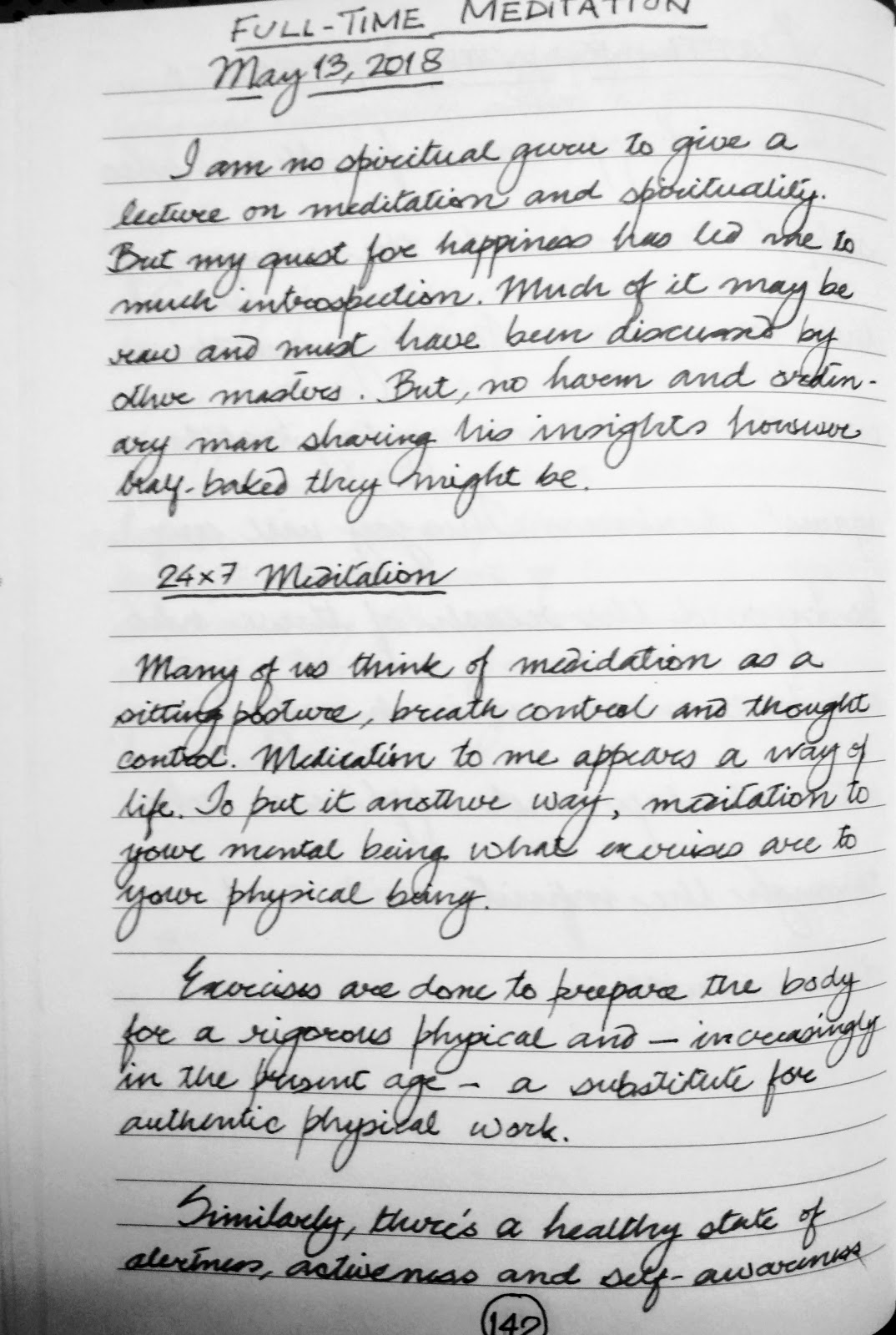
Sunday, May 13, 2018
Saturday, July 29, 2017
Respect and Reverence
Respect makes you observe the person, opens you to allowing fundamental changes in yourself through close observation of the person, criticising the person and disagreeing with him. Reverence makes you do either or both of the following:
- follow a person with blind faith, which essentially amounts to expecting to enjoy benefits from the moral standards of the other person without necessarily having to follow them yourself
- makes you merely worship him, which is the same as closing yourself from answering for deviating, in the garb of false humility, from the standards (followed by the object of your reverence) which you know you should follow.
The side-effects of confusing reverence with respect may be more serious than meets the eye directly. One of the most glaring examples is that of spiritual gurus.
Reverence is based on a radical maxim that deepest insights -- typically spiritual in nature -- can be imbibed from outside of oneself, somewhat similar in principle to a company which tries to grow and flourish by acquiring another company. Spiritual growth, as per me, can happen only organically, through self-discovery.
Spiritual gurus often start their onslaught by saying that following them will lead to strengthening of your spiritual energies, which will then lead to great strides in spiritual growth. However, this often leads to a life full of rituals, all in the name of spiritual practices. The promised spiritual growth, which by definition, is very elusive and immeasurable, never happens. Instead, the person is drawn further away from people with habits and beliefs not aligned with the ways prescribed by the guru. This alienations starts at a social and behavioural level, proceeds through being intellectual alienation, and ends up by snapping emotional connection with anyone or any group which disagrees or dissents. This is the first step in the direction of radicalisation and intolerance.
The succour comes from the fact that disciples of the guru, going through similar experiences, are drawn closer and closer to each other. It is based on agreement in habits and ways of daily life, but eventually grows into alignment in beliefs and thoughts. This creates intellectual ghettos -- a bunch of disciples who are guaranteed to never disagree with the majority, and with overflowing eagerness to see their guru's statements proving to be true. The force which drives these people is infinite, inexplicable reverence for a so-called guide. External references are accepted only to the extent that they don't fall foul with whatever has been said by the guru. Such interactions between disciples can only create superstitions and pseudo-science: stories of air-travel and nuclear warfare being invented in India, astrology, energy fields around human bodies etc. etc. etc. Any inferences and conclusions drawn in interactions happening within such ghettos is intellectually mimed and very predictable. The basic standards of critical analysis, debates and scepticism are hardly met to allow any serious debate, and give no intellectual credence to these agreements.
These disciples keep reassuring each other that they continue to be the mild and modest people as they were; that no radicalisation has happened. And yet, here you have created, a fertile ground for raising an army of faithful ferocious soldiers who will use everything in their reach -- weapons or words -- to stamp out any voice of disagreements which dare question the absolute authority of the guru.
In short: Respect. Don't Revere.
Saturday, April 29, 2017
A Citizen's Contribution to a Sustainable Planet
The reality of human caused climate change has passed the stage when denying its presence would give any real solace. It's happening and humans are responsible for whatever will unfold upon our future generations because of it. The lasting solutions to these problems – if they ever come – must be spearheaded by governments. However, governments are constrained by other more immediate problems to deal with: economic development, education, health, national security, not to mention elections and vote banks. Individuals, on the other hand, are free to apply practices of sustainability quite directly. For them, the problem is that of replicating the benefits: how do I convince people around me to adapt these methods? Or how's it going to help if only I do it while most others continue living callously? Many of us have the tenacity to work towards a sustainable model of life at an individual level, but can't find the will to spread the word.
Anyway, parking the above very real and difficult issues, let's see what changes an urban citizen can bring about in his life to approach a more sustainable lifestyle. It turns out the steps are concrete, doable, have multiple benenfits, cost little or nothing, and immediately becomes examples for willing others to replicate – eschewing the need for explicit activism.
Reduce Vehicular Pollution. Vehicles contribute significantly to atmospheric pollution. Individuals can reassess their part in this major evil. Office commute is probably the single biggest reason why we travel on road everyday. We should ask ourselves if we are being considerate to sustainability in our choice of our mode of daily commute. For example, cars are a good choice if you have to travel a long distance, and there are at least 3-4 people travelling the same way. However, if our workplace is within a few kilometres of our residence, if we are reasonably fit, and if there is no one else to travel along with us, there seems to be no justification to travel by car. There are several other alternatives: car pooling, public transport, 2-wheeler and so on. For those willing to go a step further, walking and bicycling are not just eco-friendly, but also good for your health. For longer journeys, consider travelling on land instead of air if possible.
Water conservation. Water tables are plummetting around us. Water bodies which used to be a pride of our city's landscape have been gradually consumed by greed and corruption of the real-estate sector. Most apartment complexes in the city are now at the mercy of water tanker suppliers – which is much less a business than a ferocious mafia. Unavailability of pottable water has been quoted as one of prime reasons for possibly turning Bangalore into an uninhabitable city in the next one decade, as predicted by some experts. There are a hundred things through the day that we can do to conserve water. Bathing from a bucket instead of shower. Using RO filter reject water for mopping, cleaning and flush. Immediately repairing tap leaks. Ask your apartment management to ensure perfect maintenance of the sewage treatement plant (STP), organic waste converter (OWC) and rainwater harvesting system. Also, working towards having a centralised RO plant for supplying drinking water to the whole apartment complex would result in thousands of litres of water being saved everyday.
Waste management. Our cities are drowning in filth. Choked drains. Overflowing landfills. Polluted lakes and rivers. Contaminated ground water. Much of this filth emerges from our homes. What can we do to stop contributing to this hellish affair? Following the well-known mantra of reduce, reuse, recycle is a good starting point. We should start segregating waste at its source, so that only the most unprocessable of domestic waste ends up in landfills. Avoid plastic use (e.g. carry your own bag to grocery shops). Use printing judiciously at office. Encourage your apartment complex management to spend resources in keeping their STP and OWC in working condition.
Cut Down on Consumption. There's a lot of stigma around the topic of leading a simple life, these days. Never have people shown such fierce unity in anything as in voicing their right to consume blindly. However, the arithmetic of consumption and pollution is a straightforward one. Binge shopping, eating or any type of consumption has an environmental cost which we are not paying, but somebody else surely is, or will. Our addiction to electronic devices, AC and other electrical appliances are feeding off the thermal power plants, which are major contributors to carbon emission. Our seers and visionaries have cautioned against a life of greed and consumption for thousands of years. Our generation has now enough evidences to know that our seers were never as correct in any other matter. Cutting down on blind consumerism is no more a moral stand in our age; realities of climate change have turned this into plain common sense.
Debates on how governments and leaders should play a central role in shaping an environmentally sustainable society will continue. But consider the following: every bill or law enforced by government bodies will have to be implemented on the ground by citizens through daily practices and processes, whether willingly or under the whip. With a bit of awareness, it's not difficult to understand what those practices should be. Why can't we not go ahead and do them ourselves? At our apartment complex, we have implemented waste segregation entirely as a voluntary initiative; and it has worked. At an individual level, I and my family have been following most, if not all, of the above practices. And I am there to testify that this hasn't dealt a blow on the quality of our lives. These are not sacrifices, but just the right things to do. That 'nobody understands' is honestly a very lame excuse to keep following the herd marching towards the precipice. Let's get rid of our resistance to change, and embrace sustainability as the way of life. Let's not just leave a liveable planet for our children; but also teach them how to leave one for their children in turn.
The article was published in Deccan Herald on April 21, 2017. Here's the link.
Wednesday, March 08, 2017
Good Wishes and a Rejoinder on Women's Day
Girls! Keep up the good work! And consider us all in it together.
Rejoinder
A few requests:
- Consider us your allies.
- Ask for help. We mayn't not always know how to, but we do want to. We don't judge.
- Don't keep saying "Men won't understand what it is to be a woman in this men's world." First of all, we didn't make this world. Why is it relevant to make a point like, 'Tum nahi samjhoge Rahul, Kucch Kuchh Hota Hai?' Secondly, why won't we understand? The real social disease is 'discrimination'; there's nothing so unique about discrimination against women, that in spirit, only they can understand it. We all have been victim of very severe forms of discrimination in a variety of ways: caste, economic, national, racial ... We mayn't get it exactly, but we do get it. Enough to be useful in helping remove it. No point belabouring the point.
- And just to top it up, please do acknowledge that the suffering that women face is one of the many kinds of sufferings, all of which are quite severe. Certain amount of activism is good to generate social anti-bodies against atrocities. But to weed out the root cause requires intellectual analysis. Some of us should also give serious thought on what the social (or probably biological) processes and structures are which lead to all kinds of discriminatory practices (gender related practices being one of them) to get mainstream acceptance over time? Once you are done with your day's activism, I invite you to an evening tea with me to mull over such questions: Why not a Dalit Day, Tribalman's Day, Negro Day, Poor Person's Day, Senior Person's Day, Physically Challenged Person's Day etc. All these classes have suffered discrimination and inhuman atrocities of comparable order as women have?
In short, let it not be an all-girl's party. Let us boys in too and work alongside you.
Monday, January 30, 2017
Humanely Treating Our Domestic Helps
The other day, Sadiqa, our domestic help, came to work even though her daughter was terribly ill. That day, she did her work against continual requests from Shilpi to let it be and go back home. All the time struggling against a torrent of tears, she just said: "I would drop everything but finish your work, Didi!"
We can't put a value on the contribution of our housemaids in simplifying our day-to-day lives. And often, the sort of trust, love, honesty and sacrifice displayed by them is hard to explain. In our country, the overall terms of employment of these people is fundamentally unfair, as they are tuned to keep them in perpetual penury. It's a hidden form of bondage or slavery or serfdom where there are no visible ropes to bind them, no physical whips to crack. But there's a craftily designed social system which keeps them subjugated.
My heart bleeds to hear stories of atrocities meted out on domestic helps everyday. Of course, the newspapers are full of news of housemaids being raped and murdered (often the other way round too). Leaving alone such extreme cases, many people treat them like machines or beasts of burden. Here are some of the horror stories we have heard about how people treat the domestic helps, often right in our current neighbourhood:
- Continuous haggling about salary. People driving SUVs to office and women splurging tens of thousands on online shopping just to stay on the top of fashion trends make a very ugly sight haggling with poor people for a mere few hundreds a month.
- No leaves. Most people here has a five-day working week, and feel guiltlessly entitled to a cushy salary from that much productivity. However, they raise hell when the domestic help asks for a leave. Illness, personal emergency, rain and snow, festivals, national holidays -- nothing is a valid grounds for asking for a leave. Such false sense of entitlement; such double-standards!
- Tasks beyond the terms of employment. Often, domestic helps are made to run to get grocery, chop vegetables, clean meat or fish, cook, massage the ladies, dusting and cleaning -- all things beyond what they are employed for, and without being compensated.
- Mountain piles of vessels to clean. Shouldn't we be thinking a bit when adding one vessel over another about how it would be if we were to clean them? The tiny gesture of wetting the vessels would reduce the effort of cleaning them by an order. But, few people seem to have the sensitivity to do so.
- Unsegregated waste. Waste segregation is mandatory in our complex. It's the residents' responsibility to segregate waste properly and put them in the current bins. However, there are people who drop all garbage on the floor in a wanton manner leaving it for the domestic help to collect them while cleaning the floor. The housemaid is forced to segregate them before tossing them into the bins. How much more sickening could someone get?!
We move about claiming to be well-educated people, God fearing people, socially aware people. But we treat our domestic helps, who are often more a family than employees, with such inhuman unfairness! Our hypocrisy is nauseating!
Tuesday, December 06, 2016
Fighting Judgemental Behaviour
Judgemental behaviour means all actions and attitudes demonstrating a preconceived opinion about a person or a group. Have you ever been witness to statements phrased in some way, but seeming to mean the following?
- You are an expatriate? So, you are a gold-digger and don't love your country.
- You are a Non-vegetarian? So you are cruel.
- You are busy and successful? You must be an over-ambitious, haughty and selfish person who neglects his family, friends and relations.
- You are poor? You must be a moron.
- You are an Asian or African? You must have come here to take away my job.
- You don't dress like me? You must be a slut/un-modern person.
I confess, some of the above are from my own experiences: I was bullied by my peers in my childhood for my (premature) intellectual inclinations. I have been a target of direct and indirect verbal attacks from some of my relatives who have construed my choice of career (and moving away from my native town) etc. as my selfishness or ambitiousness. My holding a PhD has been unfairly treated as being equivalent to my being an 'academic' (read un-practical), conceited and arrogant person. I have been judged as un-smart for not dressing up in a particular way! The list goes on. Whenever such remarks were made at me, there's been one thing common in all of them: they have never confronted me; they never gave me a chance to defend my case. All these remarks were made behind my back, or in the garb of casual social jokes, or as indirect insinuations. My attempt to confront and seek clarifications mostly have gone vain: they simply didn't reply, blocked me, laughed asking me not to take a joke personally, so on and so forth.
Such opinions are formed on shaky and unrealistic grounds (insecurity, jealousy, pseudo-science, family sob stories, cheap literature and movies etc.). They take shape before or in absence of adequate interaction with the concerned person or group. They are closely associated with personal or collective ego, and hence, often dictate a person's/group's behaviour long after he/she/they have been proven wrong. For example, a person who has been mistreating economically disadvantaged people as inferiors will find it very humiliating when he has to treat them as his equals.
Judgemental attitude leads to bitter, unfair behaviour, sarcastic and blaming statements, discriminatory and damning attitude. The concerned person feels the presence of judgementalism but feels helpless against it, because such behaviour is often indirect, seemingly casual and brief. The consequences of judgemental behaviour are severe, leading to broken relations and shattered self-esteem. It often leads to feeling of guilt which can't be pinned down to anything in particular. In the extreme case, such behaviour leads to class discriminations and racism.
We always battle against judgements: as perpetrators as well as victims. Both predicaments lead to sorrow. How do we fight judgementalism?
For Victims
- It is impossible to make everyone happy. Consider this case as a casualty.
- Know the truth. Know well that what's being said about you isn't probably correct. Look at yourself in your entirety and understand that an opinion of the kind must arise from a viewpoint which is accidentally or deliberately not considering you in your full-dimensions.
- Empathise. Judgemental people are mostly battling against some insecurity, guilty feeling or jealousy. By passing judgements, they are trying to hide their own weakness by turning the spotlight on you. They are internally in pain. Feel their pain, and forgive.
- Take no nonsense. Fight against unfair show of judgemental behaviour. Most judgemental behaviour comes veiled in indirect insinuations and sarcastic remarks. Confronting them means taking a risk of being put in a silly spot by the statement 'this is not about you!' or 'I was just kidding!' The judgemental person wants to keep the option of continuing to hurt you by not being confronted. Confront him/her. Either the person will cower down, or he/she will lash back with all his/her venom. Fight back. Make it clear that what they think of you is their business, but how they behave with you needs to be acceptable.
When we are judging
- Are you not guilty of exactly the same thing which you are charging the other person of?
- Are you above all those vices you find so hateful in the other person?
- Have you given the other person a fair opportunity to know that he/she is being judged?
- Have you given the other person a fair opportunity to put forth his/her side?
- Have you considered all aspects of the other person's life and personality before passing a judgement?
- What is your actual reason for taking a narrow view of a person's position? Is it indeed your 'personal view' as you might want to put it? Or does it arise from an unwillingness to look at the matter critically and holistically?
- Think of how many good experiences are hidden in the treasure-house of a beautiful relation. Every single person and a relation with such a person is a potential source of these beautiful experiences. You mayn't have the bandwidth to develop a great relation with everyone around you. But to gnaw away at an already existing or a potential relation with your own hands is nothing but stupid.
There are big problems which big people solve: climate change, corruption, diseases and illiteracy. Who will solve those little problems which chip away silently at the lives of millions -- billions? These are ordinary problems, hurting ordinary people. They have to be solved by ordinary people like us. Judgemental attitude is one such problem. It's seen in every family, every friend circle, every work place -- every day. We all do it; we all fall victim to it. Both ways, we all suffer. Let's go over the above points, and try and throw away this little epidemic of a bug out of our lives.
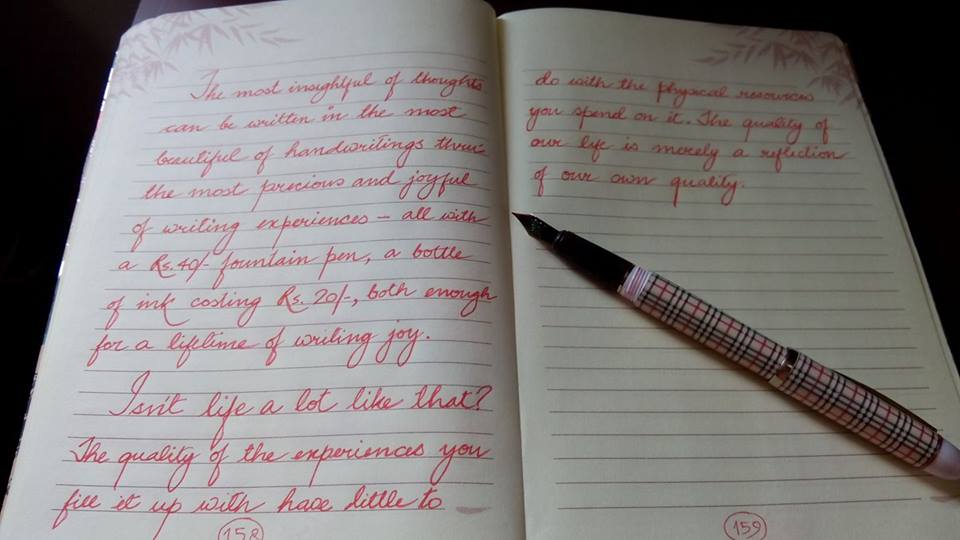
Fountain Pen and the Life
The most insightful of thoughts can be written in the most beautiful of handwritings thru' the most precious and joyful of writing experiences -- all with a Rs. 40/- fountain pen, a bottle of ink costing Rs. 20/-, both enough for a lifetime of writing joy.
Isn't life a lot like that? The quality of the experiences you fill it up with have little to do with the physical resources you spend on it. The quality of our life is merely a reflection of our own quality.
Thursday, October 27, 2016
(Foreign) Travel Best Practices
Below, I share a few observations and insights about the do's and don'ts of travelling, particularly travelling to other countries.
I start with a few disclaimers. One, I don't want to pass even a covert message that I am some kind of a professional globe-trotter who has hordes of knowledge about what works and what doesn't when you are travelling. Two, this post is not meant to be a compendium of travelling tips. These are a few of the observations very specific from my experience. Three, what I say below applies to people who are travelling for business or tourism; but may be not to those who are emigrating. Four, this is aligned to Indians travelling abroad, but may apply well to others.
Avoiding Goof-ups
One of the things which can mar a travel like nothing else are moments of anxiety. Delays, missed flights, lost luggage, passport, documents, money, getting stranded in an unknown/strange/dangerous place ... these are all best avoided. What can we do to avoid them.
Prepare/plan early. Preparing a foreign travel is very complex. Arranging funds, tickets, visa are the most important aspects of this preparation. Air tickets are much cheaper if purchased early. Finding out about the visa application process for the country of visit will help save last moment trepidations. It's always good to get in touch with someone in the circle who has either travelled or has stayed in the concerned country. Several finer details like the best way to travel inland, best hotels, places to visit etc. are best got from a person who has gone through the whole thing, rather than just browsing the Internet. Early bookings save money, but come with committing to a plan. Beyond a point, too fine grained a plan could backfire in several ways. First, it definitely rules out certain possibilities. Second, it may suffer over-fitting problem, in the sense that too much detailing makes it brittle. Such over-fitted plans may crumble if one of the components of it fails. As an example, there was a delay in our Bangalore-Heathrow flight. My colleagues had booked their onward train tickets for a train leaving within 3 hours of the original landing time of the flight. Obviously, they missed their train. In the process, they lost several hundred pounds.
Hence, it's more a matter of trade-off. Save money and last minute anxiety by planning early. But keep it sufficiently flexible for the novelty and fault-tolerance aspect. To be precise, I would say, it would be a good idea to make all the major bookings (e.g. long haul flights, and multi-night hotel bookings) early, and leave out the finer details (e.g. how will I spend my weekend in XYZ?) to later research.
Be connected. While travelling to a new place, it's good to know someone who stays there. Have their contact details with yourself, and share yours with them. Let's also accept that travelling abroad is expensive, and if we are to book hotels for every night we stay there, it would drill a hole in our pockets. Staying for a night or two at a friend's place is not merely a trick to save money. It provides a much needed window to catch up. And yes, don't forget to ask them clearly about their convenience and willingness to host you. Try and not be a burden.
Have backup plans. Identifying components of a plan which can fail, and providing backup options, is also a part of good planning. For example, if a flight/train gets cancelled, and you get stranded in a city, it would be good if there's someone in the city who would be ready to give shelter for the night, or you have enough foreign currency with you to be able to rent a hotel room.
Single-process. In airports, railway stations, buses, etc. it's best to avoid haste. Getting hassled and hasty is a very effective preparation to drop something (e.g. money, passport, credit card), or forget something (hotel room key inside your hotel room). I typically go very slow, and take my time to satisfy myself that I am done with doing one thing, before proceeding to the next. For example, if I decide to take coffee at the airport, I sit and have it in peace, and then proceed to security checking. Similarly, at the ticket counters, ATMs etc., I handle my things in a completely single threaded manner: tickets, travel card, cash, luggage. Remembering the 5S principle (of 'a place for everything and everything in its place') is a great idea. Of course, this means that I slow things down, and have to make up for the time by starting earlier than others. This, to me, never seems like a bad idea. I also am conscious that this sometimes comes across as clumsy and irritates bystanders. I consciously avoid feeling agitated by annoyed stares from strangers in such situations.
Your Attitude
Meeting with foreigners outside one's own country is sometimes a source of anxiety. How should we behave with foreigners, particularly when we aren't in the safety of our own country whose methods and means are well-known to us? I have found the following very helpful.
Pride. Wear your cultural pride on your sleeves. We know of many problems in our country. There's no harm talking about them. But there's a thin line between being critical, and being downright disparaging. Being reasonably knowledgeable about one's own country and culture earns you respect. People seem to find India particularly interesting. So, it's nice to be able to help others with interesting bits of information. But there's no need to fake knowledge. On a related note, don't accept outright racist or discriminatory behaviour. But, don't raise hell if you merely suspect discrimination. Be forgiving to involuntary mistakes.
Curiosity and respect for other cultures. Equally important is not to put up a jingoistic face. Some of the most engaging exchanges with foreigners happen when they compare notes about their countries and cultures in a pleasant and scholarly manner. There should be a sense of equality and mutual respect in conversations between people from different geographies and cultures.
Things which always work. There are certain attitudes which always work (at least in my knowledge), regardless of culture and geography. A happy and smiling demeanour is way more effective and impressive than immaculate dressing and stylish mannerisms. Politeness, helpfulness, honesty are culture neutral attitudes which will always earn you respect and acceptance. If you are a guest to someone, appreciating their hospitality is a very right thing to do. Good work ethics like punctuality, keeping of appointments, concern for quality are always good in any professional setting.
Trying to fit in. Trying to blindly imitate someone's dressing style, mannerism and accent is useless and disgraceful. A decent, clean dress is good enough for almost any place. It doesn't make sense to be overly concerned about appropriate dressing beyond a point. Of course, if the climate demands a particular way of dressing, by all means, you should be flexible to change your dressing style. Also, reasonable degree of cleanliness and personal hygiene is important. Avoiding smelly clothes, leaving the bathroom clean after use, are more of little gestures of courtesy to people around you than anything. Similarly, faking accent is a useless ploy. Instead, if you are a good and articulate communicator, you are going to be miles ahead of anyone who breaks his head in sounding like an American or a British. In short, while we all are humans and are fundamentally similar, we should celebrate our little variations and try not to be apologetic about being different from others at a surface level.
Things to avoid
Certain things which are less of a concern in our (and in one's own) country may be more seriously taken elsewhere. It's good to be careful and conservative on such things. Avoid giving frank opinions on religion, sex and politics until an environment of trust has been developed. Don't take photos of strangers if possible. Never post the photos of people, particularly when seen in a family setting, on social networks, unless with express permission. Be careful in your exhibition of affection to people. In India, touching a person of opposite sex affectionately still raises eyebrows, but doing so with a child is acceptable in general. Elsewhere (where women are an empowered lot, and children are more vulnerable), the scenario seems quite the opposite. A shake of hands -- whether it's a person of the opposite sex, a child, or an elder -- to express any form of warmth is quite safe in most cases. Going anyway beyond this should be done after sufficient evidence of its acceptability.
Staying out of the way of dangerous/illegal behaviour, e.g. getting excessively drunk, driving without license or training, drugs, visits to prostitutes, trying to carry illegal/prohibited substances through the ports etc. is definitely a good suggestion.
Site-seeing
In my opinion, the most fascinating aspect of any place are its people and their lives. Ask yourself the question: what's unique about the place? Prior reading and conversation with locals gives you a true idea, and helps you shape in your mind what it is about that place that you would really like to learn and experience: its art forms, food, history, geography? Merely standing in front of a monument and clicking a photo is one of stupidest ways of wasting your time and money. Sorry, my personal opinion. In my recent visit to UK, I deliberately avoided London, though I passed twice through it. London is a major hub, and I anticipate several occasions in future to visit it. Instead, I chose to get up and close with the British countryside, its town-life and its history and culture. I had drives and walks in the wild fields and hills. I walked miles on the pavements of York. I spent time in the living rooms of British people, both recent immigrants and long-term settlers. I couldn't be any happier with my decision.
In summary, I would say that while travelling it's a good idea to try and maximise experience and enjoyment, staying within safe limits. A visit to a new place, whether within the country or outside, should be a source of personal enrichment, rather than a tick on a map, and matter of show-off. And this happens through taking a genuine interest in the place and its people, rather than posing for photographs before famous places.
Tuesday, August 30, 2016
Oppressors and Common People
What enables oppressors to show such unity? Look at mafia, terrorists, smugglers, corrupt politicians, businessmen, imperialists. They all are hand-in-glove when involved in something vile. Somehow, their teams are extremely strong, despite being much smaller than the number of people they oppress. It's got to do with the common urges which drive them to do what they do. Greed, ambition, anger, fear, ego, vanity etc. are very potent motivators and unifiers.
On the other hand, common people never seem to come together? Because most people are cowards. They would rather hide behind their busy life etc. than come out in the open and speak out. They fear unpleasantness and messing it up with the 'important' and 'influential'. They would sometimes even turn against the very people who are trying to stand for them, just to avoid being marked as an agent of change in the existing social order. And agents of change are a set of creatures oppressors hate the most, and go to any length to get them out of their way.
The dominating emotion among the masses is fear. And here's another way fear works: as a paralyser, which is exactly the opposite of how it works on the oppressors.
The oppressors often hold positions of influence, and once in a while do their bit to keep the system going. This could easily be construed as a service to the common man. But it's a delusion. A parasite needs the host to remain alive to be able to suck its blood. An intelligent parasite will go to the extreme of helping its host survive when it's about to die, because if the host dies, the parasite can't survive either. An intelligent parasite will also want to keep its victim deluded that it is actually a helpful guest, who should be allowed to suck its host's blood once in a while as a payback for its services. British, when they were here, also built bridges and buildings, apart from looting the people in immeasurable proportions. And even to this day, we punish ourselves by saying that their coming to our land did us a lot of good, whereas the reality is they kept sucking our lifeblood for two centuries, and left us scarred for centuries to come.
The common man -- lazy, ignorant, fearful -- is happy to lead a subjugated life as long as the oppressors keep them away from the need to understand things and take things in their own hands. They are afraid to take responsibility, to fail, to deal with the discomfort of understanding and learning. When the common man stands up to say something, he cowers back down after seeing the menacing look in the eyes of the oppressor which seems to say: 'Speak, and I will drop everything.'
An oppressor -- a social parasite -- will do everything in his means to keep the masses deluded about the true nature of its relation with the oppressor. One of the most potent ways to do this is to keep the masses divided. Mass ignorance is a great ally of the oppressor. People who are divided can easily be dealt with by a handful of oppressors. When the voices of the people come together, it is a beacon of death for the oppressors. Hence, it's a universal characteristic of the oppressor to try and kill communication. A group of sufferers is a formidable force. A lonely sufferer is puny in comparison. He is so afraid and lacking in confidence that his voice can be silenced for ever with a rap on his knuckles.
I now gradually realise why Netaji and Gandhiji were such great leaders. Because they could make millions of cowards come out on the streets and take up a gun or fill jails. Respect!
Wednesday, July 13, 2016
The Evil World of Advertisements
If we were to believe the TV commercials, the biggest problem plaguing our Earth are dry and dull hair and oily/lifeless skin of women. The world will be all happy and satiated if you could solve these problems with all those shampoos, conditioners, fairness creams etc. which by the way are biggest scientific invention ever. Problems which come close to the above in their severity are:
- Your not having that one perfect party dress/jewellery which they are selling on their website.
- That child in your house who's waiting to turn into the next Einstein or Tendulkar by consuming that health product with a 100 nutrients.
In this day of rising feminism, it's surprising how they get away by saying that:
- inner glow of your skin is not a result of a healthy body and mind but can come by an external application of a cream
- 'taking care' of yourself doesn't mean empowering yourself with knowledge strength and confidence and spreading message of equality, but making your body hair your most nagging concern while going out with boys.
- being a good mother is not teaching your student fundamental life skills but making him drink a health supplement.
I really feel that these commercials are destroying what little good our feminist friends are doing to help women of this world stand up for themselves. One of my good friends, who was doing some life-changing work in advertisements, and since has taken to the debased profession of being a professional artist, had but one thing to say about her past profession: PURE EVIL!
Monday, June 20, 2016
Thoughts on Father's Day
My father excelled as a father.
- He allowed me to become what I had the potential to be.
- He gave me all the advices he had, good or bad, but to his best capabilities.
- He supported me materially while I needed his support.
I failed as a son.
- I left them back there in Nagpur 'to make it big in life.'
- 'I am not beside them' when they are ageing and getting afflicted with diseases.
- I have turned into a doting husband, father and a good person 'without staying a doting son.'
I am indeed a doting father, and yesterday on the Father's Day, if I related to that day, it was as a father more than as a son. And here are a few things I can say about how I plan to be a good father:
- I will allow you to become what you have the potential to be.
- I will give you the material support.
- I will always be with you morally.
- The gist of my love for you is that I will always want you to be happy, wise and successful.
- I will show my emotions to you.
- I will not pretend to you to be stronger, wiser, richer, more liberal than I actually am.
- I will not appeal to my authority to make you behave in a particular way.
- I will lead a life of my own to the last day. I will be true to myself as much as to you.
- I will not behave well just because I want you to behave well.
- I will not make my fatherhood appear as a sacrifice for you.
- I will not expect purchased gifts from you.
- I will not expect you to be by my side in my old age.
- I will feel happy when you become a good husband, father and person, because that's what you are here to be.
- I will celebrate the fact that you are an individual who is not the same as me.
All I will every expect from you is to know that I love you from the bottom of my heart. My love for you is not because I have played a role in your being born, but because I have closely observed you grow into a person from a little bundle in my arms on January 24, 2009.
Please just give this much. Please never ever doubt that I love you and want nothing else from you!
Wednesday, February 10, 2016
Doing Research in India
It is an uphill journey for a researcher working in India in many ways. One of the cited reasons talks about lack of resources or of top researchers who can really do game-changing research. I find that to be the least of the reasons.
First of all, let me try and define what I consider to be a normal researcher's career goals. There are these dreams to be a top researcher whose work is cited in every conversation happening in a particular area of scholarship. This is a very lofty dream. It will not be fructified for most of us. Aiming for that just like that is a prescription for depression and disappointment. Instead, a more realistic goal is find a valid groove for oneself in the research ecosystem. That groove may be big or small -- that's secondary. It should provide a continual opportunity to think and work, to contribute, to communicate. Fame, recognition and riches may come, but as happy side-effects. The main product being a sustainable opportunity to work and produce, all while leading a reasonably happy life.
I know, there are subjectivity and loose ends in the above description. But that's Okay! As long as it shifts the focus from lofty and unrealistic dreams of greatness to realistic goals of day to day satisfaction and fulfilment. And one of the first hurdles to building fruitful research career in India is related with unrealistic goals. Please don't get me wrong in that I am trying to persuade you to give up your dreams. But dreams should arise out of your deep understanding about some problems, and an irresistible wish to solve it; it shouldn't arise out of images of heroic achievement flashed over the media. This only leads to vacuous ambitions, unrelated with the immediately surrounding reality. Work whose only meaning is associated with the fulfilment of an ambition, whether materialistic or otherwise, is by definition a chore, and can never give happiness.
So, if a person opts to do research in India with his or her expectations placed correctly, is it a cakewalk? No! So, what other problems? A list of some of the important problems in my view are presented in my cartoon that appeared today in Club SciWri, reproduced here:
The Strong Links
- Talent. High talent density is made highly probable among Indian researchers by the sheer amount of competition they surmount before ending up in any prestigious graduate school. I am fully aware of the caveats in this assumption, though.
- Motivation. The dampening influences which will be discussed below start playing out much before a student steps into a graduate school. If, in spite of them all, a student makes it to the doorsteps of a higher research degree, he/she has proved at least one point, that he/she is highly motivated.
The Weak Links
- Unrealistic Goals. The first weak link that saps much of a young starry eyed researcher's energies are his ignorance about what research involves. He starts off at a high note thinking he can pull it off only on the basis of his intelligence, knowledge, hard work and what not. Disillusionment sets in when he finds that these qualities barely enable him to make any dent.
- Communication. Most of us hardly ever start at working on our communication skills. Those of us who do start hardly ever graduate beyond thinking of it as good English and confidence and all that. Communication is a much deeper skill. It has its roots in a practice of thinking with clarity, ability to sense lack in clarity, and seeking clarity by acquiring information through the means of listening, reading, guessing and imagining.
- Selling Skills. My PhD got over before I got over the feeling that no one cares about my research. This lack of confidence sits so deep in our soul that we are never able to utter a single word about our work to others with an honest fervour. Yes, many of us pick up styles from here and there by noticing 'what sells'. But, to a trained eye, they look artificial and disgusting. The marketability that arises out of a calm and peaceful confidence in the meaningfulness of our work is widely lacking in us. This again has a lot to do with the fact that we start our journey by setting unrealistic goals.
- Collaboration Ecosystem. A sense of deep mistrust pervades the Indian research scenario. Industries think researchers just want to talk crap. Researchers and academicians think that industries only care about money and short term goals. Both cling to their IPs like ... I don't know ... which is that animal which clings?! Yes. They cling to their IPs. And they sign such watertight MoUs that it chokes the life out of any effort. Funding agencies wait endlessly before releasing the first cheque. And they play safe by funding well known candidates. Institutes over commit, thinking that the money will take its own sweet time to flow in, if ever it flows in; so we might as well write ten other proposals. Institutes hesitate to share students, equipments, information ... unless shown businesslike incentives. What are they afraid of? Hard earned status? Disappointment on working with a bogus partner? I don't know. But, there's something in the air that prevents us from collaborating with each other. And collaborate we must, if we want to exist at all.
- Financial Stability. Finally, the whole process of doing a PhD simply stops making sense when it fails to get us a commensurately paying job. 5-6 years appear like a sunk investment of precious youth and avenues of securing financial stability when it doesn't even give us a foothold in the market. If a PhD student in India decides to live off Government stipend, in a bachelor hostel, eating subsidised mess food, he can easily be fooled into thinking of himself as a king. If he thinks of letting the other aspects of his life move on in a normal way -- getting married, investing, owning a house -- he will wake up to his real penury. This financially unstable condition is the cause of many a casualty.
The Stumbling Blocks
- Lab Politics. The stresses generated primarily by the above sources hits the individuals so hard so as to cause the internal environment of most labs to become completely toxic. Lab-mates, who should be working closely with each other (without it being forced by the supervisor), should take interest in each others work, evade each others' eyes, hide their data, lie to and about each other. Essentially, the broken collaboration ecosystem invades the very home of research -- the lab. What these labs end up being are pressure cookers with stressed out and lonely souls afraid of their inmates. It creates a terrible prospect for the work that can be expected to come out of such places. No wonder, much of the research that comes out of Indian labs is toothless.
- Social Pressures. All the above topped up with social pressures deals a deadly blow to the Indian researcher's will to put in that extra amount of effort which will tip the balance favourably for him.
- Get married.
- Support your family.
- Finish fast.
- IISc? What's that? Tell me one great invention that came out that place! Why didn't you do it abroad?
- Dress like a human being, you geek! Smile. Attend the party... Be, or at least look, more like us all.
An Indian research student functions in presence of continuous squabble created by his relatives, friends and immediate society. Many wickets fall under these Yorkers; any vessels are sunk by this torrent.
So, there you go. If you are contemplating taking up a research career here, please consider taking help of the above points in doing a bit of soul searching. For God's sake, start with realistic goals. There's a lot of ways in which a PhD can contribute to nation building in India. These ways mayn't quite look like those idolised by science books, magazines and journals. Preparing a society that has forgotten the faith in deductive reasoning and knowledge to start using systematic thinking for finding its way up, is challenging enough. This may need us to drop our ivory tower images of a scientist and get down on the field and get our hands a bit dirty.
Thursday, September 03, 2015
Essence of Learning
(Look below for my summarisation)
"Now, you see, you don't do this thing a bit better than you did a fortnight ago, and I'll tell you what's the reason. You want to learn accounts--that's well and good. But you think all you need do to learn accounts is to come to me and do sums for an hour or so, two or three times a-week; and no sooner do you get your caps on and turn out of doors again than you sweep the whole thing clean out of your mind. You go whistling about, and take no more care what you're thinking of than if your heads were gutters for any rubbish to swill through that happened to be in the way; and if you get a good notion in 'em,it's pretty soon washed out again. You think knowledge is to be got cheap--you'll come and pay Bartle Massey sixpence a-week, and he'll make you clever at figures without your taking any trouble. But knowledge isn't to be got with paying sixpence, let me tell you. If you're to know figures, you must turn 'em over in your heads and keep your thoughts fixed on 'em. There's nothing you can't turn into a sum, for there's nothing but what's got number in it--even a fool. You may say to yourselves, 'I'm one fool, and Jack's another; if my fool's head weighed four pound, and Jack's three pound three ounces and three quarters, how many pennyweights heavier would my head be than Jack's?' A man that had got his heart in learning figures would make sums for himself and work 'em in his head. When he sat at his shoe making, he'd count his stitches by fives, and then put a price on his stitches, say half a farthing, and then see how much money he could get in an hour; and then ask himself how much money he'd get in a day at that rate; and then how much ten workmen would get working three, or twenty, or a hundred years at that rate--and all the while his needle would be going just as fast as if he left his head empty for the devil to dance in. But the long and the short of it is--I'll have nobody in my night-school that doesn't strive to learn what he comes to learn, as hard as if he was striving to get out of a dark hole into broad daylight. I'll send no man away because he's stupid: if Billy Taft, the idiot, wanted to learn anything, I'd not refuse to teach him. But I'll not throw away good knowledge on people who think they can get it by the six penn'orth, and carry it away with 'em as they would an ounce of snuff. So never come to me again, if youcan't show that you've been working with your own heads, instead of thinking that you can pay for mine to work for you. That's the last word I've got to say to you."
- Bartle Massey, School teacher, Adam Bede by George Elliot
In short:
You can't learn by just paying money.Learning happens when you think of it outside the class.You must look actively for situations where you can apply your learning.No teacher can do the learning part on behalf of the student.
Can't make a more relevant statement than this one written nearly one and a half century ago.
Subscribe to:
Posts (Atom)