Translate

Pages

Showing posts with label politician. Show all posts

Tuesday, August 30, 2016

Oppressors and Common People

What enables oppressors to show such unity? Look at mafia, terrorists, smugglers, corrupt politicians, businessmen, imperialists. They all are hand-in-glove when involved in something vile. Somehow, their teams are extremely strong, despite being much smaller than the number of people they oppress. It's got to do with the common urges which drive them to do what they do. Greed, ambition, anger, fear, ego, vanity etc. are very potent motivators and unifiers.

On the other hand, common people never seem to come together? Because most people are cowards. They would rather hide behind their busy life etc. than come out in the open and speak out. They fear unpleasantness and messing it up with the 'important' and 'influential'. They would sometimes even turn against the very people who are trying to stand for them, just to avoid being marked as an agent of change in the existing social order. And agents of change are a set of creatures oppressors hate the most, and go to any length to get them out of their way.

The dominating emotion among the masses is fear. And here's another way fear works: as a paralyser, which is exactly the opposite of how it works on the oppressors. 

The oppressors often hold positions of influence, and once in a while do their bit to keep the system going. This could easily be construed as a service to the common man. But it's a delusion. A parasite needs the host to remain alive to be able to suck its blood. An intelligent parasite will go to the extreme of helping its host survive when it's about to die, because if the host dies, the parasite can't survive either. An intelligent parasite will also want to keep its victim deluded that it is actually a helpful guest, who should be allowed to suck its host's blood once in a while as a payback for its services. British, when they were here, also built bridges and buildings, apart from looting the people in immeasurable proportions. And even to this day, we punish ourselves by saying that their coming to our land did us a lot of good, whereas the reality is they kept sucking our lifeblood for two centuries, and left us scarred for centuries to come.

The common man -- lazy, ignorant, fearful -- is happy to lead a subjugated life as long as the oppressors keep them away from the need to understand things and take things in their own hands. They are afraid to take responsibility, to fail, to deal with the discomfort of understanding and learning. When the common man stands up to say something, he cowers back down after seeing the menacing look in the eyes of the oppressor which seems to say: 'Speak, and I will drop everything.'

An oppressor -- a social parasite -- will do everything in his means to keep the masses deluded about the true nature of its relation with the oppressor. One of the most potent ways to do this is to keep the masses divided. Mass ignorance is a great ally of the oppressor. People who are divided can easily be dealt with by a handful of oppressors. When the voices of the people come together, it is a beacon of death for the oppressors. Hence, it's a universal characteristic of the oppressor to try and kill communication. A group of sufferers is a formidable force. A lonely sufferer is puny in comparison. He is so afraid and lacking in confidence that his voice can be silenced for ever with a rap on his knuckles.

I now gradually realise why Netaji and Gandhiji were such great leaders. Because they could make millions of cowards come out on the streets and take up a gun or fill jails. Respect!

Thursday, December 20, 2012

The Grand Unifying Theory of Crime and Punishment

A 23 year old girl was gang raped this Sunday night in Delhi. She was brutally beaten and thrown off the bus, in which 6 people raped her. She was brought to the Safdarjang Hospital in a critical state where her condition has deteriorated since then. She has been in coma. Her infected intestines have been all but removed through surgery. There are speculations as to whether she'll survive. Probably, we don't even dare to start speculating how her life will be if she survives.

India is enraged. There are demonstrations. There's a flurry of activity on the Web condemning the heinous act, demanding strict punishment to the perpetrators. Blogs. Facebook posts. Petitions. Demands: Fast track court. Extended sentence. Death by hanging. Death by starving...

Since a day or two, I have got entangled in a discussion (on facebook) where, in the current state, I am shamefully defending myself against rude remarks by one of the members in the discussion. Reason: she thinks that such harsh punishments as castration, gallows etc. should be meted out to the perpetrators. I expressed my disagreement, though only after ample expression to my own agony about whatever has happened, whatever is happening. I had to face the charge of sharing a camaraderie with the criminals. What a shame! I want to join hands with everyone in the world to express my disgust and anger about how we treat our women. But look at what I am wasting my energies in: in refuting comments from another person agonised like me, the harshness towards me that shows in her comments towards me being entirely founded on a genuine distress. A distress we all feel. Equally!

Rather accidentally, this very thing probably summarises what I came here to say. Whenever something disturbing happens, we get enraged. We start throwing our rage about. We, the perennial idol worshippers, catch someone to empty our rage on, an effigy to burn. When there's a bomb-blast, we want to throw out all Muslims from India. For increasing crimes in South India, South Indians want to bash up North Indians. When there's rampant corruption, we point our fingers at politicians. There's a technical name of this behaviour: Racism!

When the fact that women aren't treated well in our country reveals through such horrendous incidents, we quickly find another race to persecute: Males.

Nothing happens. Terrorists keep bombing our cities. Muggers keep making our streets less and less safe to walk on. Our women keep getting treated worse and worse. After a few days, we forget. We move on. A bit more benumbed. A bit more de-sensitised. A bit more cynical and hopeless.

Nothing will happen. Keep thrashing about. Keep screaming at the top of your voice. Keep calling any person with any single attribute matching the perpetrator, a traitor and an accomplice. Spend yourself out. Appease your conscience that you did your bit. But nothing will happen.

Nothing will help. But through a process that entails the realisation that criminals grow from amongst us. They are dangerously similar to us. We create them. We feed them. They breed from amongst us.

That criminal is in us. That part of us which makes us first think of nipping away our yet unborn girl-child. It's that person in us which takes the morsel out from our daughter's mouth -- the pencil out from our girl's hand -- and gives it to the son. The criminals takes birth, grows stronger, when we attribute someone's lack in mathematical aptitude to her being a girl. It happens when women think that having food after their husband is what exemplifies their womanhood. It happens when a woman finds it beyond her will and ability to hold meaningful conversations, solve hard problems, build things. It happens when a dad demands dowry for his son's marriage, and another dad agrees to give dowry for his daughter's marriage. It happens when a man finds it OK to screw around with various women before marriage -- and sometimes after marriage -- and wishes to marry a village virgin who remains oblivious of his escapades, and true to him. It happens when a woman thinks that it's unwomanly for her to talk and care about anything beyond the subjects of her family, apparels and accessories, or it's her prerogative to talk depravingly about her mom-in-law or daughter-in-law. It happens when curves of the body of a stranger women we see in the bus, train, office or market, look more interesting to us than the expression of purpose, ambition, worry, attachment, and every other human emotion that shows on her face. It happens every time anyone -- a man or a woman -- does anything to put the fact of someone's being a man or a woman before that of their being a human being.

Sorry. But nothing will happen. Not at least today. nor tomorrow. Human civilisation wasn't built in a day. Nothing of consequence and beauty has ever been erected in a day. A safe and secure society, where the beasts in our minds have been carefully bound and leashed, and only the elevated, intellectual aspects of us find open expression -- a society of that kind is a thing of beauty. It's not a natural phenomenon; in fact far far from it. It's that one tiny little point of stability that lies hidden between an infinite space of instability. It can't exist by itself. It has to be imaginatively dreamt, creatively conceptualised, carefully built, patiently maintained over hot, blazing days, and has to be watched over through long wakeful nights. And if we allow ourselves to pass into a slumber, to gradually drift away from that point of stability -- the way we seem to have done today -- we can't wake up one day and wish away the reality with a loud roar of rage. Our rage can't warp the space. It can't blow away, like a mist, the night we spent sleeping. 

We have only one choice: to start walking back. A step at a time. Slowly. Without protest. Saving our energies to make good the resurrection of the old order, and not squander it in beating our fists on our chests like frustrated apes. And one input that we can't avoid giving to this only restorative act: time.

We can leave the question of whether noodles cause promiscuity to qualified medical researchers. We can allow our psychologists to deal with the grand issue of whether excessive fraternisation between the sexes instigates criminal thoughts. We, the ordinary mortals, the dull-wits of highest order, aren't capable of dealing with such technical topics. We should just try to educate ourselves of one single, simple rule. A rule that is agnostic to the concept of sexes and sexual crimes, about races and racism, about economies and class conflicts, about nations and wars. A rule that is the constituent atom of every man-made structure that has stood against the dissipative forces of nature. That rule is the rule of respecting each other's right to live with respect. There's but one rule here. Only one rule to be followed. Only one rule that can ever be broken. All crimes in this world are instances of this one rule being broken: taking bribes, breaking a traffic law, teasing a woman, or littering the public places, or polluting the environment.

A man who will refrain from attacking a woman from the fear of castration or lynching can't be stopped from going back home and abusing his wife or daughter who, he is sure, will keep quiet because they love him. But a man -- or a woman -- who passes each act of his or her through the acid test of respect and justice will create a more beautiful world with every thought articulated, every word spoken, every move made.

I, the non-specialist in rape-cases, the one born to the cursed race of males -- I, the idiot who has nothing but his little common-sense to hang on to in this age of chaos, rage, cynicism and hopelessness -- I, the poor human being, rest my case.

Related:

With All Respect, No Apologies!

Saturday, August 27, 2011

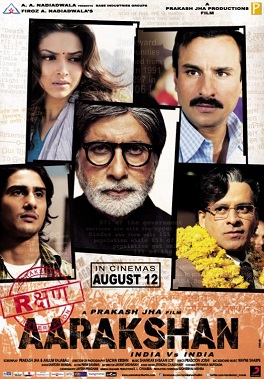
Aarakshan


I saw Aarakshan yesterday. It's a good movie, I would say. Not great from a purely artistic point of view. Good acting and dialogues. But some out of place songs. A gradually increasing portion of drama as the story progressed. There were even moments when one felt that probably the story has started draggingand had lost the crispness. But definitely overall the movie scores well in the way it deals with an inflammable topic in a sensitive way while communicating the maker's point of view rather clearly. Or may be it's actually the viewer's (my) view interpreted by him (me) as the maker's view. The climax resembles the Anna Hazare movement in its look. That adds an appeal to the experience of watching the movie, though rather coincidentally.

The way the storyline gradually drifts away from the issue of reservation and casteism to that of education wasn't accidental I am sure. In fact, it makes a very strong point: the issue of reservation and casteism are really not central to the woes of the Indian society. The central issue is that of education. The evils of casteism can't be mitigated by reservations. Not because the idea of reservations in itself is evil. It is not. But because, its correct implementation is probably impossible in presence of too many stakeholders in the game. It's impossible to prevent people from misusing it. In fact, it's not just reservation policies which are misused by politicians but the overall combination of reservations and class-struggle.

There were some dialogues which probably carried the maker's take on the matter. Once, the hero asks the question regarding why we don't have ITS (Indian Teaching Services) as we have IAS and IFS? There was one more where his wife asks why, instead of wasting so much money on reservations at higher education and job, government doesn't invest all its crores on improving the primary education system.

The way the hero deals with the overall situation in the movie was obviously very dramatic appropriate for a movie. But the message was valid for the real world. The key lies in making education accessible to everyone irrespective of their background.

I would like to add the following points from my side:

An idea worth considering for the government of India would be to have a kind of mandatory education service for all post-graduates of the country. If you aren't in teaching and you hold a post graduate degree you must devote x years (May be 1 or 2 years) of your professional life to education. Countries like Israel and Korea have successfully implemented compulsory military services in their country. I feel, it's practical to implement something similar for education.

The other thing, though slightly in a broader interest, is that education must be partially freed from being widely perceived as a professional training. Education is about life, not profession. It should be seen as a vehicle of sharpening thoughts and knowledge which are general tools for leading a better life, of which professional advantage is a small subset. But, let's leave all this to a separate discussion.

Friday, June 03, 2011

The Hunger-Strike Approach

Baba Ramdeo's decision to go for hunger-strike against corruption and the Government's unprompt response to the resolutions made following the Anna Hazare strike is ... well ... striking!

I definitely appreciate the Yoga guru's concern to contribute in yet another way to the society's ills apart from bodily or mental ones. Probably, lots of people have pointed fingers at him on the point that his trying to change his role like this is uncalled for. While I would say that the point shouldn't be ignored, I feel it's someone's fundamental right to decide to do whatever he wishes within the limits of Law.

However, there's a deeper, more long term, concern. What is corruption for these people? Black money in Swiss Banks? Politicians misusing their powers? Bureaucrats taking bribes? What will happen if these instances of corruption are removed overnight? Nothing! Thousands others will come to take their places.

Corruption, like education, poverty, unemployment, is a deep rooted social disease which can't be solved with a revolution. It will require a deep, sustained process of cleansing that has to happen over a protracted period of time. Oversimplifying it and presenting it to the community as if it's something outside them is misleading. I don't even know if it will result in more harm than good.

One point in favour of this is, of course, if the initiators realise that these revolutionary events may mark a start of a national movement. May be, it will awaken the people to stand up when they see corruption being practiced in their field of vision. Hope it happens.

Meanwhile, I would plainly say that I find it unbecoming of Baba Ramdeo talking of gallows for corrupt politicians.

Thursday, August 19, 2010

Reply; Don't Forward

I don't ever forward chain mails. I delete most of them. To some, which have meaningful contents, I find replying to the sender a more meaningful thing to do, than forwarding it to many. Some reasons are:
- Down the recipient tree, the seriousness of the thought about the issue discussed in the mail is diluted to near zero-concentration.
- I think, getting a reply to a casually sent mail suddenly makes you take the contents more seriously. Particularly, it's a prove that someone read the mail seriously.
- Throwing the matter back up into the recipient tree has a larger chance of meeting more sincere audience than down below.

An Example
Please read on for an example of a reply I wrote to a problem we all feel about.

For a change I pressed the reply button.

I agree with the idea of this mail, i.e. stopping the squandering of public money would help. But, I do wish to add a bit to this view. Even if the figures are authentic, saying that all this money would make the life livable for crores of poor people may be over-optimistic. Poverty and deprivation aren't mere lack of material resources. They are more deep rooted. Merely by diverting money from the plentiful to the deprived is not a solution to this problem. It won't take any time to turn those crores into worse demons than our few thousand politicians are if only they had money and power.

I feel, there's no evil in providing good facilities to public servants, provided they do their job. If they misuse the resources, it's a pity and they should be prevented from doing so. Not so much to save those resources (or money) but because that money symbolises the trust and respect that public places on these people. These people must exhibit very high work ethics so this trust is justified. But the problem of low work ethic is not limited to only politicians. It's a larger problem which pervades the society. Merely by replacing a person in a position of power and influence is not a solution; nor will diverting resources to other sectors of the population answer this huge issue.

Very unfortunately, problems of ethical poverty are deep rooted, probably a consequence of centuries of oppression. They have taken time to set in. They will most probably take time to go away. Probably, we may have to wait until the complete generation infected with this virus fades away giving place to a newer, more ethical, generation. I am rather doubtful about how much success, attempts to accelerate the pace of this social reformation will meet.

To end this, I want to thank you for the mail. I don't find forwarding it to an endless number of thoughtless, emotional junta (almost all of whom will probably rid themselves of their responsibility by forwarding it to some more people) of much use. Instead, replying to the more thoughtful audience in this group, along with my 2 paisa thoughts will probably matter more.

Thanks and regards,
Sujit
- Hide quoted text -


On 19 August 2010 12:17, ... wrote:


Politician's drama

mail of the week…
Natak


Mr. Rahul Gandhi do this work just for an hour....without media.
Then tell us what you got...
If you really want to Change our India....No need to show us.....
We will follow you......Definitely.


“K
arunaaNidhi Fasting

First time in the world history fasting only 4 hours and that too with an AC …….
This is the comedy of the year 2009….
Fastingstarts after breakfast and ending before lunch. Interesting one!!

Dont forget to forward this mail, We have to show these type of drama's to everyone


stop this....................grow up to be an indian


Govt. Concessions for a Member of Parliament (MP)

Monthly Salary
: 12,000

Expense for Constitution per month
: 10,000

Office expenditure per month
: 14,000

Traveling concession (Rs. 8 per km)
: 48,000
( eg.For a visit from kerala to Delhi & return: 6000 km)

Daily DA TA during parliament meets
:500/day

Charge for 1 class (A/C) in train: Free (For any number of times)

(All over India )


Charge for Business Class in flights
: Free for 40 trips / year (With wife or P.A .)

Rent for MP hostel at Delhi
: Free

Electricity costs at home
: Free up to 50,000 units

Local phone call charge
: Free up to 1 ,70,000 calls.

TOTAL expense for a MP
[having no qualification] per year : 32,00,000 [ i.e. 2.66 lakh/month]

TOTAL expense for 5 years
: 1,60,00,000

For 534 MPs, the expense for 5 years :

8,54,40,00,000 (nearly 855 crores)


AND THE PRIME MINISTER IS ASKING THE HIGHLY QUALIFIED, OUT PERFORMING CEOs TO CUT DOWN THEIR SALARIES.....


This is how all our tax money is been swallowed and price hike on our regular commodities.......
And this is the present condition of our country:

The image
http://news.bbc.co.uk/olmedia/85000/images/_89378_india_poverty_child_by_river_300.jpg
http://weblogs.nrc.nl/weblog/wereld/wp-content/uploads/indian_poor.jpg
855 crores could make their life livable !!

Think of the great democracy we have.............
PLEASE FORWARD THIS MESSAGE TO ALL
REAL CITIZENS OF INDIA .....
but,

STILL Proud to be INDIAN


I
know hitting a delete button is easier..........bt.......try 2 press fwd button 2 make people aware of it!