Translate

Pages

Wednesday, May 30, 2012

Balancing between Conservation and Consumption

The Elusive Line
I remember, with a sense of luxury, that when I was in Roorkee for my masters, I used to bathe 4 times a day during summer. It used to get hot and humid. And water was in plenty, the geographical belt being in the proximity of Ganges. Having been brought up in a family where wasting anything -- water, electricity, money, time, food, words -- would meet strong reprimand, I often would wonder if it was right to bathe 4 times a day. Somewhere, I had come across one of those articles (with a photograph) of women in Rajasthan walking miles for a potful of water that was all they would have to meet the needs of the entire family for the next couple of days. My trips to the bathroom would be accompanied with pictures of those ladies floating in my mind. Those baths were a relief from the summer, I would say. But they happened with a sense of guilt.

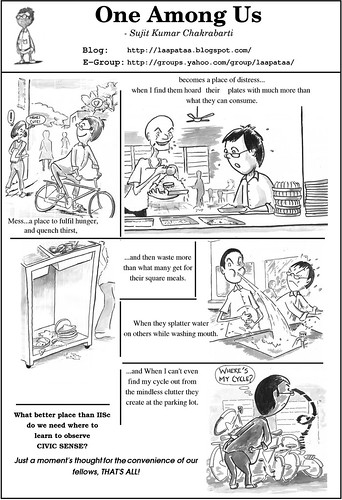
With many words about the inconvenient truth of climate change and pollution being spoken all the time these days, no act of resource consumption remain guilt free for me. Taking out the car, sitting in an air-conditioned office, taking a flight instead of a train, travelling in an AC compartment instead of sleeper class -- I do all of them; and I do them all always with a pinch of guilt.

There are some people very good at never giving this issue a thought. For example, someone once suggested an ingenious method of getting a steam bath at home to my wife: Turn on the water heater in bathroom. Let the shower run. After 5 minutes, the whole bathroom gets filled with a thick clowd of steam. No second thoughts given to wasting 50-100 litres of well-heated water. Offsprings of rich people would obviously be born into conditions where consumption per person is high. Their upbringing would preclude the possibility of their ever coming across the possibility of a life that subsists on less resources without necessarily losing any of its essential value. However, interestingly, we see many people from very modest economic background, upgrading themselves beautifully as their financial condition looks up. For them, the only reason for consuming less could be the unaffordability of higher levels of consumption. Of course, you would travel in a plane if given a choice. Of course, you would prefer a car to a 2-wheeler, if you could. Of course, you would never again visit your old mess if you could afford a 5-star meal.

And then there are people who take the other extreme view where any consumption is viewed as a sin. At the pinnacle, there are Jain Digambars who do not wear clothes. And, in our history, particularly in the oriental society, we have umpteem examples of people who have hailed the virtue of simple living and high thinking: Sages who stayed in ashramas; fakirs and Gurus like Guru Nanak, Kabir, Sai Baba; philanthropists like Baba Amte; Leaders like Gandhi; business people like JRD Tata, Jamnalal Bajaj and so on.

It doesn't seem to be the case that there is any strong correlation between the value of an individual in the society to which of the above two extremes he is closer to. There are valuable personalities who led an affluent life; and there are always those who consume like blackholes without ever creating anything of value in their lives. Similarly, there are luminous figures who led simple lives and changed the world; and there are those who, by worrying and fretting -- and most importantly lecturing and bullying -- about little matters of consumption and conservation, only manage to be obnoxious.

Where does judicious consumption end and wasteful consummerism begin? Honestly, I don't know. I will list a few notions which I have used at various points. But I am all too conscious of their short-comings too. A general canonical solution is indeed elusive.

***
Optimisation
Probably, you would have no difficulty in appreciating that a resource assumed to be renewable and unlimited takes not much time to turn into a non-renewable and limited resource. It all depends on the demand and consumption. For example, computer memory and processor cycles, drinking water, habitable space, road/pipeline/communication channel capacity, etc. All of them start off at some point being perceived as abundant, inexhaustible resources. But humans have a superior knack of running out of resources.

Agent Smith (Matrix, 1999) once says:
I'd like to share a revelation that I've had during my time here. It came to me when I tried to classify your species and I realized that you're not actually mammals. Every mammal on this planet instinctively develops a natural equilibrium with the surrounding environment but you humans do not. You move to an area and you multiply and multiply until every natural resource is consumed and the only way you can survive is to spread to another area. There is another organism on this planet that follows the same pattern. Do you know what it is? A virus. Human beings are a disease, a cancer of this planet. You're a plague and we are the cure.

Therefore, a seemingly judicious policy would be to consider every resource as limited upfront, and start optimising rightaway.


However, this approach doesn't provide such a straightforward solution, even theoretically. Any act of optimisation is actually an act of trade-off. Optimising on one resource may result in higher consumption of some other. And while one may be toiling to optimise parameters like space, time or material resources, one may be losing out on more abstract parameters. For example, in software engineering, they ask you not to worry too much about optimal implementations.

"The First Rule of Program Optimization: Don't do it. The Second Rule of Program Optimization (for experts only!): Don't do it yet."  — Michael A. Jackson

Instead, the general best practice is to write it in a clean, intuitive and maintainable way. A day to day example: One may work hard to minimise water wastage at home. However, not consuming enough water and not maintaining cleanliness in toilets may be both a bad idea from health point of view. It is often hard to predict which parameter will assume greater importance at what point. The optimal solution of today may waste a much more precious resource of tomorrow.

A Sustainable Life
One notion that may be helpful in drawing the above distinction between conservation and wastefulness is that of an environmentally sustainable life. The wish is to bring one's consumption to the level which every single human being of the planet can afford, without sending the environment to dogs. Many vices prevent me from lowering my consumptions.  I am lazy (hence, I often prefer the lift to the staircases). I am spoilt for physical comforts (hence, often I pick the car and not the 2-wheeler or public transport even when I am travelling alone). I am somewhat impatient when it comes to spending time travelling, particularly with the knowledge that the travel time is eating into an already sqeezed vacation (and thus often end up flying instead of travelling by train). These team up to make me behave like any of the spoilt brats at times. Conquering these may well result in a drastic reduction in the consumption of physical resources. Vanity, which is one of the lesser reasons for me, thankfully, probably is the biggest cause in most cases for which people consume, and consume to the levels that jars others' eyes.

However, who defines what a sustainable life is? The 7 billion+ population of this planet isn't my creation for sure. The headcount is continuously on the rise. That leaves less and less resources on my plate every passing day.

Don't Question the Purpose; Just Don't Waste Blatantly
The current social etiquette is: believe in matters of environmental conservation and such stuff in principle, but don't question anyone personally on his specific consumption behaviour. For instance, even when you are having a very animated discussion about rising pollution etc., it is not quite OK to say, 'OK You! stop using your car,' or 'why do you always leave your computer ON while leaving office?' So, the idea is that we go with the assumption that people are in general aware of issues and care for it. Hence, they shouldn't be nitpicked on individual instances.

The only problem with the above assumption, which seems to be affording respectability to everyone by saying that they all care, is that it's not a valid assumption. The whole of western style of growth stands testimony to this. With our little individual acts of carelessness, we have together managed to create an environmental situation of unprecedented magnitude. Simply because we are so large in number.

Perhaps, we hope that by voting for a cleaner environment, and by electing governments who swear by a greener planet, we can forever continue to live our day to day life without having to change anything drastically. We continue to consume wastefully: fly around when a ground travel would do; go on expensive ecologically disastrous eco-tours when a stroll in the neighbourhood would be just as relaxing; continue to shop in the supermarket store when the vegetables in the local market are more fresh. And then we hope these governments will come out with a scheme that will solve the problem with one sweep of a magic wand. It sometimes happens. For example, introducing CNG in Delhi seems to have drastically reduced the pollution levels in the city. But these are rare instances. These government policies, these sweep of magic wands: they are like tiny little occassional sprints of a hare which can do little to defeat the slow and steady progress of the turtle of our daily habits.

The above approach, therefore, can no longer pass off as a moderate approach to bringing about a positive change. It's most surely a sign of our collective inability to face the fact that we are too addicted to a particular way of living; and are too timid, too tentative to boldly explore the possibility of living another way.

Select Your Line, but Don't Change it
Much toilsome discussions would often lead us to give up on them, and disperse with one final request: 'OK guys! Do what you like. But don't change what you like.' It would land any discussion in grave trouble if we try pushing anything of the following points:
  • There should be no indulgence. Strictly austere life is the only correct life. Difficulty: Few would pass this strict test. Eventually, there would be no one left to discuss this topic except a tiny population of strict disciplinarians. Anyway, nobody cares about them.
  • There should be a fixed standard on how much indulgence one should be permitted. Difficulty: To come up with a fixed number would create wars. And to come up with a formula would be incredibly complex.
  • No one tells others about how much to consume. Difficulty: This is as good as saying that this discussion is meaningless.

Instead, we may accept the fact that all of us are susceptible to varying degrees of temptation. Let us allow each of us a degree of indulgence. That degree is determined by the self at some early stage. Once done, no changes are allowed unless passed through strict audits.

The merit of the above idea is that it is self-implementable. The determination of the consumption value is done by the self. Audits on its changes could also be done by the self. The undoing is the seriously high amount of integrity required by the person to implement this. Another undoing is that there are so many in the large population who have no idea how much they should put this value at for themselves. With exposure, they may find a strong need to alter the value. For example, a person raised in a remote village, to start with, may be perfectly comfortable with the idea of walking a couple of miles a day for his daily activities. However, if he happens to do well in his life, migrates to a big city and starts mixing in a society of car owners, walking a few miles every day to office would subject him to various pressures he wouldn't be able to foresee in his initial circumstances. Similarly, a person brought up in affluent conditions may start with a thought that he would limit his annual vacation duration to foriegn tourist locales to a month. However, on coming face to face with the real world, he may find even that way too luxurious.

So, occassional alterations on this limit may be necessary. But then, the point of confusion now shifts to the formula that should be applied to determine the flexibility to be allowed in changing this value.  Also, at least how ocassional should these changes be? Do we allow another level of flexibility (i.e. flexibility in defining the level of flexibility)? Further and further added levels of flexibility in this way would eventually make this policy indistinguishable from the policy of no one telling others how much to consume, won't it?
***
None of us is out-and-out a hero: we all do wasteful things notwithstanding concerns for conservation every once in a while. We call it indulgence. Similarly, none of us is out-and-out a villain: Each one of us feels a pang of concern/fear/discomfort from sights of wastefulness or prospects of collective disaster, at least sometimes. We differ from each in the amount of indulgence we need for ourselves on an ongoing basis.

One extreme stand would be to say, for all of us, any kind of austerity measure derives from the unaffordability of consumerism. The other extreme would be disallow any indulgence. We, in weaving this discussion, are obviously looking for a middle path. And that, like a lot of such discussions, may lead us to say that finally it all rests with the individuals. That may sound disappointing after all this effort; the whole discussion may itself appear vacuous in that case. But probably we should resist the temptation to conclude it that way. Philosophical stands must originate from a faith, but those based on reason. Philosophy itself goes with the faith that there's reconciliation possible between the two: that, in some sense or the other, is the grand challenge of many branch of philosophy. Not being able to achieve exactly that -- a solution that has eluded us for thousands of years -- should come as no surprise. But engaging in discussions on the subject is definitely an indispensible step towards the achieving goal, if not in the general case of the entire population, then at least in the specific case of our own personal life.

Tuesday, May 29, 2012

Bump!

About 2 months back, a taxi bumped my (stationary) car from behind. I couldn't do anything to get my damages back from the guy. After much deliberations on when/where how to get my damaged car bumper repaired/replaced, I got it done last Saturday. It costed me 9K. Today, within 48 hours of the repair, another taxi bumped my (stationary) car from behind. I am back with a damaged bumper. Of course, today too, I couldn't get any repayment from the driver. Do I need to tell how I feel right now?

I feel like...I will...I will...I will...I will write a blog post on this! Can't do anything else!

Monday, May 07, 2012

One Thing Good About Being a Celebrity

Came across two instances of the power of being a celebrity yesterday.

First. Aamir Khan's Satyamev Jayate on Star Plus which is to be aired every Sunday at 11 AM starting yesterday. The programme deals with social issues plagueing India. The first episode yesterday was about female foeticide. It presented data and analysis pertaining to the issue bringing forth its scale, nature and causes. It introduced some victims and some people who have been doing something to solve the problem. It ended with a couple of action points identified for the makers of the programme as well as the viewers. Thoroughly researched. Aamir Khan has spent nearly a decade or more to build a special philanthropic image for himself, from doing movies like Rang De Basanti, Taare Zameen Par, 3 Idiots, Mangal Pande, and even Dil Chahta Hai. Also campaigns like Atithi Devo Bhava. And in this programme, he brings its force together to hit the viewer's consciousness really hard. Commendable effort!

I hope to be treated with enlightening and moving accounts on many more social issues in the coming weeks. It will be an hour of weekly respite for the TV and its viewers from unending series of mindless soaps, abusive and phony reality shows, sensationalist news coverage, sexualised sports. While this programme is on air, I will give up my abstinence from TV. It's like we are back to our good old Doordarshan days when the ill-endowed documentaries used to be rich with one thing: sincerity.

My wishlist of issues for Satyamev Jayate:
  1. Environment
  2. Education
  3. Corruption
  4. Analysis of India Shining

Second. I came across this other one while flipping through the channels during a commercial break during the above programme. I don't remember which channel. Nor what programme. But there was Salman Khan talking to a phenomenally obese 18 year old girl giving her advices about being healthy and stuff. Not so impactfully presented, nor dealing with an 'apparently' social issue. But I feel that it's an equally widespread problem: this problem of unhealthy lifestyle. The cost of bad health due to lifestyle issues must be second to none on the society.

These celebrities aren't saying something no one else has said. Just that their position as celebrities gives them this unique chance to be listened to and taken seriously. I am happy they are finding it right to use their status for saying something really meaningful.

PS: Heard it that Aamir Khan is getting 3 crores for each episode of Satyamev Jayate. If he continues doing the kind of job he did in the first episode, I think he deserves every paisa of it.

Thursday, April 26, 2012

The Fallacy of Influencing Others

I grew up with ambitions of 'making it big' in many ways. I wanted to be a scientist whose inventions would change the world in the way those of James Watt and Addison did. I wanted to be a teacher under whose tutelage scores of youngsters would imbibe my own ideology and knowledge structure. I always wanted to 'move up the value chain', always wanted to do stuff with bigger impact factor. I wanted to be the man whose achievements (and even the obituary, literally) would feature in the front page!

The realisation of my littleness has most joltingly hit me when I learned to observe how little the various aspects of me, my life, my achievements, my strengths, my insights etc. mean to others. Let me cite a very little example. I have always made it a point to shutdown my computer before leaving office. Very simple reason of saving energy. After all arguments about how ineffective my little move would be in saving the world, I eventually reached the conclusion that it costs me nothing to do it anyway. So, I made it a practice. I routinely kept sharing my thoughts with my colleagues -- people with whom I have always shared great rapport and respect -- and very politely kept requesting them to adopt the simple practice. In spite of all initial resistances falling apart, and in theory accepting my argument, I found not a single person changing his habit! It was a phenomenally frustrating experience. It made me acutely aware of how little the power of argumentation and logic is in front of long-standing habits and attitudes.

My daily life is filled with innumerable experiences of the above kind. I have failed routinely in influencing people through model behaviour. People are exceptionally resistent to change even when you present a flawless example of a triumphant best practice. A large portion of the population doesn't even have faith in the idea that thoughts can be used to tune important behaviour.

I always thought that I was well aware that people take offense if you put your virtues on naked display. Even staking claim on such qualities as modesty, magnanimity, civic sense etc. is very dangerous and immediately invites defensive stance from the onlookers. Far from genuinely appreciating, people try to mock you, tag you as pedantic, or simply overlook the reality to protect themselves from an exposition to questions on themselves. Therefore, I try being polite, even meek, when I realise that my behaviour may make people feel defensive. And yet, I have received stone-cold response to any suggestion of improvement, however little they might be, from every quarter -- strangers, colleagues, elders and youngsters...even family and friends. I have felt poisonous bitterness on how little of my most prized insights, I have ever been able to even mention to people who really matter to me very much. Transferring those insights in effect remains a distant dream in such circumstances.

The Two Types of Virtues

Here, we are talking about two types of virtues. One are selfish ones, while the other are the altruistic types. Just to give a sense of completeness, virtues are benefitial characteristics. If the beneficiary is the self, the virtue is selfish. If the beneficiary is someone else, it is altruistic.

Some examples of selfish virtues are : Being fit, being intelligent, being rich, being knowledgeable, being good-looking etc. Everyone want these virtues maximally. If you see someone else having it more than you, you may love or hate that person, but definitely would like to get ahead of the person in terms of possessing that virtue if possible.

Altruistic virtues: honesty, integrity, hardworkingness, truthfulness, helpfulness...They are tricky ones. People don't necessarily want them. If someone has one such virtue in some amount, he tends to look down on those who seem to have less of it, and tends to consider those who seem to have more of it as pedantic, sometimes overbearing, and sometimes even vain. And the trickiest part of it is that people always hate you for showing these virtues off. Showing off your wealth, or beauty, or one of those selfish virtues, can be pardonable. But to show off you your honesty or magnaminity is unpardonable. Here showing off doesn't merely mean boasting. Even practicing the virtue may be interpreted as showoff. I remember an incident long time back when a gentleman was visiting me in IISc. A professor passed by on a bicycle. I proudly pointed this out to them. To this, this gentleman reacted like, ‘You know, people will always show off their simplicity.’ I was shocked! I asked him why being a professor (read 'intellectual'), who had probably given up a lot in his life much lesser beings had continued enjoying, was expected to be so modest even about his simplicity? I wondered, if you are allowed to show off money, beauty, power, influence, fame, why you aren’t allowed to show off your simplicity!


A very interesting distinction between selfish and altruistic virtues is the proportion of destiny and decision in them. The amount in which you have any of the selfish virtues could largely be due to destiny. For example, how beautiful you are isn't significantly in your own hands. Nor your intelligence or richness. On the other hand, how much of any altruistic virtue you possess appears to be predominantly a matter of decision or choice. For example, how honest a person is is completely dependent on the way he conducts himself volitionally. Whether apparently volitional acts are indeed volitional or are puppets of our genetic makeup is best left to a deeper analysis in the purview of the problem of freewill.

Why Altruistic Virtues are Hard to Imbibe
Why is it so difficult to influence people to observe higher standards of ethics than they presently do? Ethical behaviour is tied to altruistic virtues. And, as mentioned above, the amount in which one has any of those virtues is a matter of decision, not fate. People, particularly adults, find it harder to be caught erring in matters of decision than in matters of destiny. If someone is richer than me, I may envy him, idolise him, may want or not want to be like him. May even want to kill him for money or envy. But in the end, I will take solace in the fact that richness after all is significantly a matter of fate. However, if I find someone behaving more honestly than me, accepting his level of honesty to be a better thing than my level of honesty is equivalent to accepting my mistake in the decision as to how honest I would want to be. The blame of not having enough of that virtue squarely falls on me, my conscious self. You see my point?!

The other reason why people seem to resist accepting ethical superiority in other and accepting ethical lessons from them is because altruism seems closely tied with ego manifested as vanity and pride. Recall the above incident of the gentleman reacting to a professor's simplicity as a sign of his vanity. The reaction was almost a reflex action. Even before conscious analysis sets into motion, we start interpreting, as if by reflex, any altruism in excess to what we have as show off. The behaviour, though may appear strange, is explanable. Ethical behaviour doesn't lend itself to simple explanations of reward and punishment. A lot more than simple cost-benefit analysis goes on when we behave ethically. Therefore, unless we find an ethical stand natively present in us, we react in a puzzled way to any of its appearance. The easiest thing to attribute ethical behaviour (in excess to ours) is to vanity and ego. There may be some truth in that; hence it can't be outright dismissed as absurd. But, it's hard to verify its truth; hence, it should be looked at with scepticism.

Understanding Altruism
Let's give a moment's thought about why be altruistic at all. Perhaps, it will show some ways to bring down the some part of the resistence people (we) show for accepting ethical lessons; and will hopefully help reconcile with the part nothing can be done about.

Above, we mentioned the connection between altruism and ego. There definitely is a part that ego plays in altruistic behaviour. A clear proof of that is seen in children. Most of the 'good' things they initially do, e.g. sharing toys or being gentle with fellows, is all to escape punishment or gain appreciation. A slight bit of honest introspection will indeed reveal (at least it does to me) that many of the altruistic acts we do even when we grow up are still due to our need to be appreciated. An excessive craving for appreciation may lead us to behave altruistically to the extreme, by self-sacrificial acts, even extending to self-destruction.

But again, to attribute all altruism to ego is clearly a mistake. First of all, as many studies show beyond doubt, altruism has survival benefits. And hence, as a genetic trait, it has survived and succeeded. People who are altruistic may be genetically predisposed to behave that way. So, to try and explain away altruistic behaviour completely on the basis of ego boost and vanity would be a mistake.

From a more psychological perspective, altruism is also a matter of faith. We all have our faiths about ourselves, the world we live in and the relation between the two. I consider my example. I like to believe that I live in a world that is, like me (as I think of myself), something good, even divine. Being altruistic gives me a feeling of belongingness. It re-inforces my faith in life and its meaningfulness. I live with a hope that the world can be that good place that it inherently is; and an act that takes it even a tiny step towards it is hugely re-assuring to me. I truly believe that this line of thought is devoid of vanity. Probably, like vanity, it again models altruism as an inherently selfish act. But, in the process, we don't lose any of the beauty that we associate with altruism, because it is devoid of vanity.

Conclusion
Propagation of ethics is hindered by many causes. Two cited above are what I can see. There could be more. The knee-jerk resistence that people display to the idea of true altruism, by attributing it completely to vanity, has its roots in lack of awareness and thought; hence, can be debunked through arguments pointing out other causes of altruism. However, the other type of resistence, the one arising from the resistence to accepting one's mistake in making ethical (0r any) decisions, is a deeper one. I don't see any clear way to deal with this natural problem. I don't know how much of our overall resistence to ethical lessons we feel due to which of the above two causes. I tend to believe that the latter one has a larger share. And that significantly dampens my optimism about there ever being invented a method of imparting ethical improvements on people which is manifold more effective than any that exists.

Thursday, March 15, 2012

Embracing Chaos

Read a good piece in Zen Habits blog.

I think it goes a bit overboard in praising chaos and criticising planning. But I agree that being comfortable with some unpredictability in day to day life is very important for sustained happiness. We mustn't get too upset when things and people don't turn out to be exactly as per our expectations. As the article says: "We expect others to try to make us happy, to go out of their way to give us what we want. This is not why other people exist."

Let's open ourselves up to life so that it can spring it's own surprises on us. Not the ones we have been expecting. Because if you have been expecting a surprise, the only surprise you can get is not getting it!

Overall, a valuable piece.

Tuesday, February 07, 2012

Rapes and Woman Dressing

Abstract
While our society struggles with the evil of rape, its relation with what women wear is a subject of recurring debate. On the one hand, voices quoting womens' dresses as invitation to rape appears squarely unjust and directly targeting their freedom to lead their lives in their chosen ways. On the other hand, the way these vioces are being silenced in public fora doesn't appear driven with wisdom and open thinking, but with ostracism and a new sets of taboos replacing the old ones. What we need is a bunch of straight questions: Why do rapists rape? Why do women (or anyone) wear certain clothes? What, if any, is the relation between the two?
A bunch of honest answers would would be ideal. But, if not, at least a load of honest thinking will surely help.
I propose the following:
1) In investigating what exactly characterises acts of sexual violence, violence and not sex is the determining factor. It turns out that most sexual violence must be caused due to reasons unrelated with immodesty of clothes. 2) In trying to understand the reasons of choices of clothing, we identify several more reasons of dressing than mere sexual provocation. It is impossible by looking at the dress of a person why exactly she has worn that. That gives us a strong argument as to why violence doesn't figure as one of the logical responses to any kind of clothing. Another reason why violence is unacceptable is because of its indiscriminate and uncontrolled nature: there seems to be no relation between the set who the perpetrators of violence targets, and the one who get victimised. 3) We talk about vanity, which appears as one of the possible reasons of choice of clothes. We appreciate that vanity has a way of creating, in a statistical manner, a sense of envy, injustice and deprivation which then breeds violence in the dark recesses of the population. But this happens at a much broader context than clothing and sexual violence and it should treated in a like manner. Meanwhile, violence of any kind is unacceptable, a realisation that can be sustainably imbibed by the society only through education and openness of thoughts.

Many articles and news programmes on sexual crimes these days. On top of that, we have things like slutwalk. These discussions often are about whether women encourage sexual crimes by wearing provocative dresses. You either find an elderly gentleman or lady saying yes it does. Or you find a progressive looking lady (or a bunch of gullible looking youngsters, boys as well as girls) calling such attitude regressive and against womens' rights. It is particularly painful to see how the original theme of sexual crimes drops into the background, while the participants get busy in throwing reprimands on each other. I feel all the fieriness should be directed to actually stopping perpetrators of such crimes from doing their deeds. The point they often end up spending enormous energy in -- that of whether womens' dresses have anything to do with rapes -- is a matter of introspection, not fiery debates filled with name-calling.

I am prompted to try and understand a bit more about what may be going on in all this talk about eve-teasing, molestation and rape on the one hand and about women dressing on the other. I want to speak my 2 words too. But, I will try to be honest about the fact that I know hardly anything about this subject, and will try to build my thoughts ground up. If you see a fault in my line of thinking, I will be most obliged if you point that out. My stand, I honestly think, I will try to keep gender neutral. This article is just a small step from my side against lack of clarity in thinking and understanding and premature sentimentalism by people purported to be intellectuals.


What is rape?


Characterisation of Rape


Below, I list the main characteristics of rape (and its little sisters/brothers).

Sexual Act. The above understanding leaves out sex from the description. To me, rape isn't fundamentally a sexual offence in a sense more than that the act is a sexual. It's not any more a sexual offence than murder is a murderous offence. Or stealing is a stealing offense. For me, it's being a sexual offense is not a useful addition to the knowledge about it.
There's another reason why I think it's not a sexual offense. Rape is a very messy, dangerous and, I would say, ineffective method of dousing sexual urge. I feel, men and women are blessed with enough methods of quenching their sexual urge without having to deal with complications of being called a rapist or molester. The only reason why a person would prefer performing a sexual act with someone else rather than as an individual act is that it involves the beauty of pleasuring someone else. In addition, that pleasuring, opening up and surrender could be optionally used as a very effective method of expressing positive emotions like love and trust.
 If this aspect of mutual pleasure is not there, or is replaced by the entirely contrary aspect of paining someone else, the whole thing loses its point as a sexual act. Rape does exactly that. I don't know how it remains sexual in any way.
Violence. Much more, rape is an act of violence. The raped person is scared. Mortified. Unwilling. Humiliated. Not enjoying. Not involved. Sex, which is such a beautiful thing, gets smared in ugly colours for the victim, making her partly incapable for the life to enjoy it ever without a trace of ugliness. The rapist is forcing himself without regard to the willingness or welfare of the other. Is there any other fundamental aspect of rape that I am missing? Please tell me now! Because, I wish to understand why raping is so bad. I want to understand it without recourse to gender-ed ideas like modesty and honour. Is there anything that a woman loses in the act of rape apart from the fundamental right to refuse? If no, I think I fully understand rape, and why it's such a bad thing to do. Because, I know it's bad to do anything affecting someone else without regard to their willingness and welfare. It's criminal. For example, stealing or robbing or murder. Or supplying wrong information. With this thinking, rape is a criminal offense in the same cadre as all the above. Leave aside detectability. Leave aside the quantum of punishment. All I say is it's a crime. It should be prevented.


Common Theme

So, what's the common theme of rape? There seem to be so many various motivations. And there seem to be so many circumstances around the act, it's mind-boggling. There are incidents which are sudden and violent. There are those which are repetitive and incesttuous. And there are those interlaced with social aspects of hierarchy and domination. They all seem really very different things. No common treatment seems natural to them all. Though sex seems to attach a huge shock element to it, the primary characteristic of rape is violence, not sex.

 And therefore, I feel, this whole discussion can be ported to realm of violence, its causes, and ways to minimise it in the society. For most part in this article, I will do that, with minor references to rape as a special case of violence. In the end, I will try and map the general ideas discussed thus, to the special case of sexual violence.


Causes of Violence


Causes of violence

What are the various causes of violence, particularly of a sexual nature? Here's a small list:

Fetish. Oh OK! I remember. There are those stories of sadism and masochism. Some people do indeed derive sexual pleasure being inflicting and receiving pain. I can't comprehend it. I really can't. If one of you does identify with the idea, could you please analyse it for me?


Domination. Very normal men and women like role-playing of domination and submission in sex. Rapist probably lose the distinction between fantasy and reality. I can imagine that if it's possible for someone to enjoy the idea of domination in fantasy, it just requires an additional nudge of mental disbalance to extend the fantasy into reality.


Chauvinism. Subjecting someone to an act of sex without her consent is probably an ultimate source of feeling manly for some men. Some incidents of rape and molestation seem to support this where an attempt to prevent the perpetrators from committing an act of molestation or rape was followed by very violent reaction, as if the perpetrator was trying to re-inforce a suppressed urge to dominate a woman. An act of sexually violating someone is a very loud way of expressing dominance. And when someone came in the way, he or she was dealt with an amount of violence which exceeded the original. Rapes followed by murder aren't rare.

All the above motivations of rape seem to originate from fundamentally different sources. Among them, I can partially understand only the first -- violence. The other motivations -- sex and fetish -- seem very incomprehensible to me.


Revenge and Punishment.
One of the most relevant triggers of violence is revenge and punishment. Perpetrators of revenge and punishment pre-suppose the occurrance of injustice on the part of the other party. Whether the injustice has actually been done is another question. So is whether the person/group/class/community which this act of revenge purports to punish is the same as the one who actually becomes the victim of such acts.

Woman Dressing
Now, let's turn our attention to the other major part of our topic.

As I had mentioned earlier, not being a woman disqualifies me summarily to comment on why they do dress, leave alone talking about how they should dress etc. I won't commit that blunder for sure. Instead, I will try and talk about clothes in general. Even that would be a commendable feat for me because my personal attitude towards clothes, dressing and appearance is rather primitive. I really am ignorant of all the higher sensibilities that go into the decisions about prefering one way of dressing to another. I intend to put my ignorance to the best possible use, that is of working with the elementary ideas and building over them. In the worst case, even if I don't succeed in that, I hope that I 'll succeed to amuse you with my naivete.


Reasons for choice of appearance/clothes


I can imagine the following reasons for wearing clothes:
Protection from weather and other practical reasons. The original reason for starting to wear clothes must have been protection from weather. Different clothes for different weathers. Thereafter, the simplest reason is comfort. Then comes convenience, i.e. the clothes we wear shouldn't be an impediment to, if not an aid to, what we are currently doing.
Enhancing physical beauty. There are some of us (I think I drop out of this elite group) who think that clothes can enhance their looks; and this notion dictates their choices and tastes in clothing.


Uniform. I think, most of us wear clothes to identify ourselves with our people. This is done unconsciously, but probably accounts to the vast majority of choices made in clothings. When we are off to school, we wear the school uniform. Strict uniforms exist for factories, military, hospitals etc. At other places where uniforms aren't explicitly specified, clothes still are largely a uniform -- vehicle of identifying oneself with some fragment of society. You decide your clothing depending upon whether you wish to look traditional or modern, cool or intellectual, rich or simple. This reason for wearing clothes may appear obvious on the surface, but offers an important insight to the deep-rooted need in us to integrate with some notion of social group. We are continually conforming, however non-conforming we might consider ourselves to be. We trying to integrate into some group, while we are trying hard to break from another. In fact, the notion of clothes being a uniform, may hold the only logical key to the notion of proper dressing. On the one hand, when someone says that your dress is improper, he may just mean that you are dressing differently than most other members of a social group that he considers you to be a member of. On the other hand, when someone insists on wearing certain type of clothing, citing it as his personal style statement, his thinking already a captive of some notion (which isn't probably originally his own) of what statement his style makes. To end this, let me mention that the most natural choice of clothes, that of not making any choices, is already an act of conformance. In this case, we continue wearing the clothes we have always been wearing, or are given us, or we find most people wearing around us.

It's very important to understand that being social creatures, utilising clothes as uniforms is a small part of a large gamut of social acts we do which, if termed kindly, are democratic decisions, and, in slightly depraving terms, originate from the deep rooted herd mentality of humans. It doesn't need us to go into judgemental thinking to know that this characteristic is a reality for humans and explains the impetus behind most of the things most of us do, including the choices we make in our clothes.

Profession. People wear appearances almost entirely because of their profession. I am referring to people in the entertainment industry: actors and models. Entertainment industry is largely about appearances and what thoughts and emotions they evoke in the audience. Among the myriad things they have to present on the screen in order to do that, people and their appearances are definitely one of the important elements. In some sense, this reason of wearing clothes can be considered under uniform, particularly to explain why actors and actresses dress up in a certain way when making public appearances off screen. They are bound by their profession and the image they wish people to carry in their minds about themselves makes it imperative for them to appear in a certain way in public. The interesting point of distinction is, however, that the people -- the lay audience -- who define the social group they wish to be perceived as belonging to -- namely, heroes and heroines -- themselves don't belong to that group of people. This may appear as an orthogonal observation, but appears to me, as a very important and relevant one here. Hope I'll be able to elucidate how.

Vanity. We all are subject to this vice wherein we love showing off our assets -- be it hot bodies, intelligence, happiness, wealth, power, status or sophistication -- to people who don't or can't have it -- be it by owning it or consuming it. Vanity prompts us pull into the game innocent people who logically have nothing to do with our asset. But showing off evokes anger, frustration and envy in those people who logically shouldn't have cared less about our assets; and in turn creates an illusion of appreciation of the value of our asset. The anger and frustration stems as much from the absurdity of one's getting affected by things he doesn't want to be, as from his inability of having the object of desire. To some feeble minded, this absurd and random involvement becomes a justification for violence.


Probably, vanity is a very effective -- though insidious -- means of creating a popular consensus about the valuability of an asset. In that way, vanity works not only in enhancing the illusion of value of our assets in our own eyes, but in front of other unknown suitable consumers of it. A good marketing strategy. For example, consider the value of gold or diamond. Their value is all about the perception of their value, in spite of their uselessness as utilitarian objects. Even their aesthetic value comes entirely from their vain rarity. Mere rarity, or the improbability of a large number of people possessing them is the only basis of their value, in spite of the impossibility of their getting used for anything of direct value (barring in certain chemical processes or as a cutting tool).


About Physical Beauty

Types of physical beauty

We started our discussion about clothing for the specific reason of exploring if the choice of clothes does/may have a relevance to sexual crimes. The objective of wearing clothes for enhancing physical beauty seems to hold some hope of throwing some light in this direction. Therefore, let's spend a while in exchanging a word or two about physical beauty.

There seem to be the following types of beauty:
  • Longetivity. A long and healthy life means that as a partner the probability of the person's quitting midway due to death is low. That increases desirability.
  • Happiness. This means that time spent with such a partner will be of high quality. This also has some indirect bearing on possible longevity. Hence, it increases desirability.
  • Sexual health. This means that mating with such a person will be more fun. And/or this individual carries genetic traits which positively affect the fitness of the progeny.
Of the above sexual health is what interests us here. Why would one wish to enhance sexual beauty? I can think of the following reason:
  • Seeking sexual partner. Seeking sexual partner is a fundamental activity for every organism. It's no wonder we too do it. It's also no wonder that we instinctively employ everything we have with us to attract an appropriate partner for mating. Using physical appearance for that is obviously a part of it. Neither can I comprehend how it can be avoided, nor why it should be. Also, in this, I dare include all moves of beautification which are otherwise not expressly intended to attract members of opposite sex. If every reason to wish to physically beautify oneself isn't reducible to a deep biological urge to seek sexual partners, I would like to be enlightened on those.
An important observation about the above reason for choosing an attire or appearance is that it is a very practical, personal and innocent act of the satisfaction of a very fundamental requirement. However, it involves continual selection and rejection of partners. It happens at all levels of interaction, starting right at the moment a person becomes visible to the world in his or her attire.

Vanity and Violence
With the above material, we are now in a position to attempt connecting the two worlds of woman dressing and sexual crimes. The only connection that appears to be natural is vanity.

Vanity and violence are inseparably related. The prime reason why vanity seems to exist is to incite discontent and a feeling of deprivation in someone in an indirect way. Vanity, practiced at large, results in widespread feeling of deprivation. At a significant enough scale, these feelings turn pathological for a small minority, enough to cause widespread discord. Some important observations one can make about this complex phenomenon are:
  • Vanity isn't directed to a specific person or groups.
  • Effects of vanity surface only when it turns into a social practice. These ill-effects are widespread discontent, feeling of deprivation.
  • Within tolerable limits vanity outlines the social perception of valuability of things.
  • For some, the above feelings cross the tolerance limits and incite feelings of violence.
  • The people who get victimised from the acts of violence are mostly not people guilty of culpable vanity.
  • The acts of violence thus committed are indistinguishable, in terms of their consequences, from acts of violence done due to lesser reasons like greed, fear, enmity, insanity etc.

 Bringing it All Together

Rape is a crime of violence more than a crime of sex. People dress the way they do for many other other reasons than vanity. All those other reasons are innocent. Directing any criticism, leave alone violence, to people for their dressing is illogical I would say, simply because the minorness of vanity as one of the reasons of dressing.

Vanity manifests in our behaviour in many more devious forms than mere clothing. And vanity's at the root of a lot more violence than mere sexual. But all the violence that happens as a revenge of vanity ends up, more often than not, targetting people who aren't party to the evil. People filled with wrath against vanity often interprete innocent acts as acts of vanity.

Vanity is an evil. And so is the violence that's directed to its alleged perpetrators. However, both are inseparable parts of our civilisation. Some people will be vain. Social tensions will invariably result from them. There will be a segment of the society which will cross the ethical line and will commit acts of violence against people whom they suppose to be guilty of vanity, but most of whom will actually be innocent people. 

There will be good people who will ask their brethen to play safe, to act conservatively, to behave like the rest of the crowd, and so on, so that the elements belonging to those fringes of the society who have taken to violence in the name of avenging vanity don't notice them. I think, what they say is sensible and practical; not regressive. But they should know that such people who commit violence to avenge vanity constitute a minuscule portion of the population of perpetrators of violent. There exist other less pardonable causes of violence which have little to do with the above sentiment of vengeance. Crouching in the corner gives little security against that other kind of violence.

The Final Final Word


Relation between clothing and violence
I have tried to bring together the central idea of my thesis in the above figure. There are many reasons for clothing, only one of them being vanity. There are many reasons for (sexual) violence, only one of them being revenge and punishment. With this fact in mind, we should understand that conservative dressing doesn't do much in securing women against rapists. Violence will continue to be perpetrated as an outlet for chauvinism, domination and fetish. On the other hand, the unjustifiability of sexual violence multiplies because it inflicts itself indiscriminately to an innocent multitude whose reason for dressing doesn't have anything to do with social injustice and its perception.
Additionally, regardless of whether vanity is justified or not, and to what extent, people's choice of clothes can't deserve a violent treatment. Rape is a social evil, and must be fought with what might we have.

Monday, January 16, 2012

On Effort Reuse

When starting on preparing a new set of presentation slides, we often have 2 choices:

  1. To start with an empty set, and add old slides conservatively
  2. Twick an old set of slides to create a new one.

More and more, I find the first option a better one. Ideally, every presentation we make is essentially different from all its predecessors. If that doesn't happen to be the case with a particular presentation we intend to make, we should strongly review the justifiability of making it in the first place. So, once we decide on making the presentation, we should start with that point of novelty and build outward from it and add material as required. In the process, we may prefer to use material from earlier presentations.

The second option gives a feeling that we are reusing our earlier effort. But it puts severe mindblocks in thinking afresh. I inadvertantly tend to forcefit the new story into the old one. In the process, I sometimes completely lose track of the central point of the new presentation. And the worst thing to happen is when on stage I suddenly stumble on a slide I didn't expect to be there. The body language that moment speaks of the speaker's insincerity more than anything else. The audience doesn't view a presentation as a mass produced content from an intellectual factory. Every presentation should have an appearance of being hand-crafted for that particular audience.

The same holds for writeups and computer programs, to some extent.

Tuesday, January 03, 2012

Two Lessons Learned This Year

In my 2011 Balance Sheet Article, I have listed two lessons learned. I wish to explain a bit about them here.

Everything has cost
It's been a long standing issue with me to over-promise myself with too many things to do, and not being able to do many of them eventually. One of the reasons I have identified is my inability to schedule my tasks, i.e. apportion appropriate amount of time to all the intended tasks and then decide when to do them. I have a tendency not to accept that certain things, particularly those which I do not find very interesting or central to my interest, also need time. When we shift from one significant bit of task to another, there are many little things to be done. Take, for instance, the following scenario: I am deep into writing a report at, say, 4.45 PM. At 5 PM, I am supposed be in a meeting in which I am supposed to make a presentation to a remotely located audience. At 4.57 PM, I pull myself out of my reverie and rush to the meeting room. I, then, realise that I need to locate the set of slides to be shared on my computer. The desktop sharing application takes a while to come up. I realise that I also need to locate the conference line number and access code to start the call. When I eventually succeed in locating it, it takes a few number of attempts to establish the call. The projector and network connection also act bratty today. By the time the meeting gets going, it's well past 5.10 PM. Not an insignificant slippage considering that I had a mere half hour slot to present my stuff. Obviously, I rush through my slides, since I had kept ready material worth 40 minutes, and wanted others to know this too. Eventually, when I finish my presentation, not without encroaching into the next slot by a few minutes, I am frizzled and frustrated. No one asks me any question. Not so much much because they had understood everything, as because they are already getting impatient and eager about the next presentation. I missed an opportunity of making an effective presentation, even though I was thorough in my material and preparation.

My undoing was, as you may readily be able to see, in not accounting for the time it takes to wrap one task up and get into another. Preferably, I would have forced myself to close my report writing at some minimal logical point, somewhere around 4.50 PM. That way, I would not only have been physically ready to start my presentation punctually, I would also have felt mentally warmed up for the upcoming activity. That quality implication of the same aren't quite measurable, but definitely significant. The other thing I could have done was to prepare for 20-25 minutes. I could have comfortably glided through my slides, could have had time to take questions, and could have still been left with a couple of minutes for the co-ordinator to facilitate the transition into the next session.

Like in the above scenario, our day to day life is filled with these tasks which we consider as main or bonafide tasks; and there are those we consider as chores, often as distraction. For example, a researcher often considers paper-writing, making presentations, travels etc. as distraction to his main activity of research. The idea of prioritisation underlies this mentality, which is good. However, often it transforms into a wishful thinking wherein we assume that these tasks will somehow be done without our having to do them mindfully. Eventually, we end up allocating insufficient time to them. When we unwillingly get down to do them, the real magnitude and complexity of the task grows upon us like an avalanche. The chore ends up encroaching into the time we had mentally allocated to something more significant.

The biggest loss in such cases is the loss in the quality of the whole experience.
 

The first step towards correcting this habit lies in the topic of this section: to realise that everything has a cost, whether you like it or not. It wise to accept that there are certain activities that must somehow be done, and hence, must also be accounted for in the time budget.

Advantages:


Progress matters more than completion


Another distressing thing related to inability to achieve goals has been that no work ever seems to get over in time unless trivial. Time management principles teach you to break down the work into manageable tiny pieces. Firstly, this task by itself isn't trivial. And secondly, often, the number of these tiny pieces of tasks often starts multiplying like bacteria. In no time they go out of hand. No to-do lists seem to work in such cases. In all such cases, I have found it helpful -- at least in keeping stress down if not in really finishing the work -- to simply decide to progress a bit everytime I sit down to do the task. I try never to think about the end goal in the midst of those sessions. I just concentrate on making a progress.

The biggest advantage of this approach is that it has reduced the resistance to start.

There doesn't seem to be any disadvantage of this thinking. However, it appears that it works well only in cases where the task is such that every bit put into it amounts to a progress. This doesn't encompass the complete set of things we usually do. Particularly, in tasks involving creativity, e.g. research or artwork, which pretty much comprises almost the complete set of things I do, just sitting down to work doesn't mean there will be progress. The most important condition to progress is concentration, which takes time to build. If we break down a job involving 3 hours of work into fragments of half hour each, the number of fragments needed to finish the work would be much larger than 6. In fact, the number may even be infinite. That will be the case with tasks the size of whose atoms is 3 hours, no less. You can't break these activities into anything smaller. The buildup time of concentration in such task could be something like half an hour or an hour. If the individual times are half an hour, you are out of time by the time your concentration builds up. And then you close, and next time you start, you start all over again. It doesn't work!

Friday, December 30, 2011

2011 Balance Sheet

Plus
  1. Started staying close to office. less than half hour daily commute time.
  2. Started cycling to work and have continued.
  3. Reduced weight to less that 70 kg (from 73 kg) and stayed that way.
  4. Got rid of samosas and vadas in the evening snacks. Took to fruits and nuts. Have stayed that way.
  5. Have got into a healthy sleep habit. Have stayed that way.
  6. Spent much more time than before with family. Have felt very happy during the evening tea time with wife and child.
  7. Improved significantly in hardwork, discipline quotient.
  8. Got smarter in many domestic activities.
  9. Filed my taxes online myself.
  10. Travelled to USA.
  11. Kept a steady rate at writing and programming.
  12. Read a few really good books: Small is Beautiful, The Shadow Lines, Zen and the Art of Motorcycle Maintenance.
  13. Learned a bit about formal method techniques.
  14. Became much more fascinated with idea of sustainable living, Zen and minimalism.

Minus
  1. No publications. I am almost happy with the amount and quality of research I have done this year. But I have gone against my own policy that every once in a while there should be a short term deliverable. I have stayed with ideas and concepts for an over-extended period. Hope 2012 will bring most of them to fruition.
  2. Water colour painting didn't improve. I have felt quite discouraged with my lack of progress in this. I think I have found some leads and will try and work on them in the coming days.
  3. Concentration was insufficient. Though my ability to manage many little things improved significantly, I continue to feel that breakthroughs come through concentrated and continued effort. I haven't done so well in that front. Creating space with better organisation is fine. But to be able to use that space well is quite another. Must focus serious energy into this.
  4. Weakened contact with many friends even after trying really hard. This year, for the first time, I see the truth in that, beyond a point, spending excessive energy in maintaining friendships is a waste. Some friends have clung on. But many have drifted away. I also have started accepting that the large network of friends I have always boasted of is not so much a magical blessing, but largely due to ridiculous amount of energy I spend on maintaining it. Now, I agree that with growing age and life conditions, there has to be a natural evolution in relationships. Some new ones will emerge, but many many of them will have to give way. I feel sad about it. But unless I accept and internalise this, I will only pain myself more. Probably, wisdom lies in nurturing the surviving relations, because they have survived the hard struggle for existence, and in accepting with grace the demise of those which didn't.
  5. Weakened contact with extended family.
  6. Failed somewhat in personal organisation. I have tried hard to be better and better in this. But seems I am not good enough. My professional productivity speaks of this. My low self-satisfaction in handling my domestic matters speaks of it. Of course, the contradictory idea is that personal organisation can help only as a fine-tuning step. The major impact depends on the intensity of one's style of working. May be, organisation only helps in managing breadth, not depth. And most of the work I need to do require depth. Let's see.
  7. Couldn't sustain the Yoga habit


Lessons learned
Everything has cost
Progress matters more than completion

Overall score
fitter and happier than ever before.


Tuesday, December 27, 2011

The Forgotten Heroes

Our generation was brought up with very few career choices to pick from, particularly in middle class homes. Engineering and Medical studies were the only so called respectable careers possible. That in itself is so ludicrous and tragic! But worse still was the fact that both being based on science, the love of science that many of us developed was not a love but a compulsion for us all. Not one of us can make out if, even after having spent a lifetime in service of science, science would really have been our first love, had we had the choice to love something else.

No wonder people who don't take up science as a career seem to shun it like a disease. The essential nature of science -- that of asking questions, and using enquiries based on logic and experiments to find their answers -- is completely hidden from most. Instead, what has got ingrained in most of us is that science is what distinguishes the smart ones from the others. Therefore, those who didn't pursue science as a career for whatever reason develop a hatred for it. Who will be stupid enough to accept one's stupidity simply because they didn't become scientists (or technologists). For most, Science appears as a thing which intelligent people make a career out of, and in their spare time, use it to scare and demean others. Most people wish to have nothing with science unless it creates technologies which bring value in terms of entertainment, healthcare, comfort, lifestyle and convenience. That science is by itself a beautiful thing is never considered. And why would it be, when the way it is introduced into our lives is so ugly and distorted?

To some extent, intelligentsia in general, and scientists in particular, are also to blame for this predicament. Most of them carry the illusion that it's their tremendous intelligence which makes them what they are. However, if you look closely, scientists use pretty much the same set of skills which others use to accomplish their tasks. Intelligence is just one of the many properties of a scientist. And I don't see why it should be assumed that pursuing science requires any more brains that anything else? Similarly, the joys of pursuing science are very similar to that of pursuing any other activity. The elitism associated with science is also its greatest undoing.

TV is a potent medium which brings in front of us a wide choice personalities and lives which we and our children could treat as our role models. With the state of affairs as described above, TV channels find it unnecessary and uneconomical to give much of their time to talking about intellectuals, particularly scientists. Probably Discovery and Nat Geo do give some coverage. But I am not sure how close things there are to the spirit of science, with the element of sensationalism they induce. The effect of this on who our children will idolise, and in turn will want to be like, is disastrous I think. In general, mass media, being in the hands of people who are away from science, give a very skewed picture about the population crowding the world, and important things happening around. The people whose images are flashed are mostly movie-stars, sports-stars and politicians. Models. To some extent businessmen and artists. And these days, reality show starlets. But hardly ever intellectuals like scientists, engineers, doctors and authors get any coverage. Similarly, people are always perfectly up-to-date about the movies being released, the wars and protests (sans any indept understanding of the real issue behind them), what's the latest cream in the market which will help keep your skin glowing, how the dance item the starlet presented brought tears to the judge's eyes. Who cares about what interesting ideas researchers are dabbling with, what new secrets about the way the universe works they are trying to unravel, what beautiful thoughts an author is playing with to write his new novel, and what he is trying to say through his stories?

I feel our kids would have got a much more balanced picture of what all could be done with all the time available in a lifetime had there been less fear of science in the current generation; had people looked at it as another way of having fun and expressing oneself like various art forms and sports. In general, I wish we had known how to dissociated the notion of being intelligent with science and intellect. I wish we had identified science for what it is: being curious, asking questions and seeking their answers.

Monday, December 19, 2011

The Agnostic's Faith

Meaningfulness of life rests upon not our rationalities, but on some fundamental faith. I am firm that you need faith to find this life worth living.

I too have a faith. My faith is: I am good person.

People who love me know what I mean. People who hate me may think of it as the resounding substantiation of the hunch they have that I am probably an egotistic bastard. I think they are all right. Life's all about myself.

I believe that it's possible to approach a point where this fact is beyond doubt: for others (probably easier to achieve), and for myself (most difficult). Like all other faiths, my faith can't be proved or disproved. Like other un-enlightened creatures of different faiths, I too often waver on my faith, commit sacrileges, and then get back. Like other faith-fuls, what I never do is question my faith. Because, I don't find a way otherwise which would let me live with zeal and energy, and not get reduced to a passive vegetable waiting to be decayed or devoured. Believing in the beauty of life appears to me the only way of making life beautiful. Life may be an accident. But, whether it's going to be a beautiful accident or an ugly one is a choice. And this choice rests on one's faith, because rational thoughts can't resolve this issue.

My faith has another corollary: Everyone is a good person.

I feel, the urge to live is inseparably tied with the urge to be good. Because, being good is the only way you support the idea of life being a beautiful thing. Doing something ugly is an act of sacrilege to the faith of a beautiful life. It's hard to believe that murderers, rapists, corrupt people, ... they are all creatures of the same faith. But, I firmly believe, they too are creatures of the same faith. They too are seeking to make life beautiful. Just that their notion of beauty is in terrible conflict with their environment. Conflict and disharmony is the measure of ugliness.

Yes, life's all about myself. But the I exists in the context of a universe. Discord with the context affects the harmony within. Hence, the state in which the state of perfect goodness reveals itself in a stable glow only happens when the being is in perfect harmony along with the entire universe. This happens only if there's harmony everywhere. This happens when the barriers between the system and environment break down. This happens when the I consumes the universe, or the universe consumes the I. Whichever way. Shouldn't matter.

Probably, I sound similar to advaitists. May be. I don't give my faith any name for the moment.

Related posts:
The Spiritual Way of Life

Monday, December 12, 2011

My Biggest Achievement

Someone was being interviewed. He was asked about his biggest achievement.

I too wondered what was mine. I scanned in my mind through my many experiences. Many of the things I toil hard for: professional achievements, family achievements, social achievements, artistic achievements. In them, I am never completely satisfied; never fully happy. In fact, I walk around with a depressing feeling that I have never quite done so well in any of them. I just manage.

Cold sweat broke when I wondered what, if not these, have ever made me feel really happy, really proud. Have I lived my life so far in the empty mirage of becoming an achiever?

Then, it occurred to me. There have been moments when I have felt really happy. Really proud. That's when a childhood friend met me somewhere, and after a while of chatting, said: 'Sujit, you are still just the way you were in school! यार! तू तो बिलकुल नहीं बदला!'