Translate

Pages

Tuesday, November 08, 2011

Thought Processes behind Ethical Decisions

What do we think when faced with an ethical problem? What goes on in our heads in those excruciating split-seconds?

To help you in following the discussion below, try and imagine what would go through your head when faced with a situation like the one below to make a decision. 
  • The traffic light is red. But there's no one looking (not even cameras). Should you jump the signal?
I tried to conduct the above thought experiment over several sessions of thinking. Follows a list of traces of thoughts that I could detect in my mind. Of course, the experiment was conducted with an attempt to be objective. So, I have tried to keep my own personal dispositions out of the way.

Reward and Punishment
Do that for doing which there is a reward, or  for not doing which there is a punishment.

The above is an obscenely simple, and potentially the most profound of all mechanisms of practicing ethics. Why it is simple is because it works on grown ups, kids and even animals. Why it is profound is because it is parameterised with how one interprets the notions of reward and punishment. A reward may mean something as simple as a kiss from parents for which a child decides to eat his food quietly. Or it could mean a national independence that a freedom fighter lays down his life for.

Except in the most direct ethical problems of day to day life, this mechanism fails to provide a good and timely solution. In most cases but the most trivial ones, it will result in very narrow-minded behaviour if used in a time-budgeted manner. And if we try to use it in very fundamental manner, we mayn't reach a conclusion in time.
Religious Approach
Follow the scriptures.

There are people who do well in ethical sense by sticking to what's considered correct as per their religious belief. Don't cheat. Don't lie. Don't kill. Don't be greedy. Most of it is all there in any religious text and following one is a sure bet that you will by and large be ethical.

Difficulties arise in the implied aspects of religion. So, some people think women should cover up. Others think freedom to dress at will is a part of the notion of freedom. Some people say eating meat is violent. Some say eating some specific types of meat is OK, while eating others is bad. There are too many religions around and there are disagreements. One notion is that all religions are fundamentally in agreement. But the level of abstraction where the agreement is complete doesn't lead to anything actionable. Refinements and interpretations are essential to turn religious thoughts into actionable ones. And that's where disagreements creep in.

Spiritual Approach
Follow your heart.
There are many cases where we are well-aware of what's going on in our mind. We may be able to sugar-coat our greed as something really good. But, the heart is most often ruthlessly clear about such acts of deceit.

However, an act done with an honest sense of good could be disastrous. Even if we discount the direct ethical connection between an act and its consequence, we can't leave out the disagreements that may arise. And then comes the question of how strongly should one stand on one's opinion. For example, Gandhiji was known to be pretty rigid about what he thought to be right. People like Hitler must also have been pretty convinced that they were right in tried to wipe out a complete race. There are so many schizophrenics around. Spiritual approach doesn't help in telling one from others.

Civic Approach
Grant full loyalty to a social structure, movement, or concept and do what you think benefits it.

We can view ourselves as tiny little components of something larger than ourselves. You may call it the country, the world, the society or whatever. It's a human creation, and we all have teamed up to create it. This requires order and cooperation and we owe it in our conduct. Obey rules. Respect other fellows' requirements. You look at it this way, and it becomes rather simple to decide as to what should be done.

Whom to be loyal to? The faith here is that we are components of something which is inherently good. And here lies the tricky part. Let me illustrate this with an example. We find ourselves in membership of composite structures which more often than not conflict with one another. For example, trivially, we are members of our own self. Then family. Friend circle. Organisation. State. Country. Caste. Religion. Human race etc. It's hard to define at which level of this compositional hierarchy should we define our absolute allegiance based on which we drive our ethical decisions. For example, you may be working for a mining company which is taking away precious minerals from your country dealing it a profound long term damage. So, should you not act against your company in the interest of your country? Perhaps. Unless, your country is a hostile one which will eventually use all its mineral reserves to manufacture or purchase weapons of mass destruction.

Hope of effectiveness. The other difficulty arises when the effectiveness of our action is not clear. Then our decision completely rests on how hopeful we are that our act of loyalty will fulfill its intended goal. Most unethical acts fall in this category. Most ordinary people do something wrong not because they directly find it rewarding to do it, but because they feel foolish trying to do something good. Not bribing. Not jumping signals. Not producing false bills. Civic approach to ethics relies on an unflinching faith in entity to which you have vowed your loyalty. This approach becomes ineffective when one loses the faith in the above premise, or in the ineffectiveness of one's ethical act in really serving the charter of that entity.


Scientific Approach
Do what is objectively the correct thing to do. In case of no clear answer choose whichever you please, including nothing at all.

Let me go back to the example of driving -- an everyday act which, I feel, requires a huge number of moral decisions taken in split seconds particularly where application of reward-punishment duality is particularly tricky. The primary purpose of driving is to get from point A to point B. Everything that prevents us from being at B instantly on starting the journey could be taken as an impediment. This approach would lead us to look with hostility at everything: any turn on the road that doesn't directly point towards B, the traffic, the traffic lights, traffic rules, the finite power of the car...even laws of physics! I agree that there's nothing moral or immoral about taking this approach. The one thing problematic about this approach is its stupidity. The most logical approach here is to understand that nobody owes us a right of way in our journey unless its a mutual understanding. It's equally likely that we will not succeed in forcing our way through realities to our destination unless we get them to work in our favour through a mutually agreeable protocol. Similarly, it's ridiculous to think that anyone gains by not letting us be there at our destination as early as possible. In the light of this realisation, treating all the above artifacts with hostility appears stupid more than anything else.

Theoretically, the above seems robust. Except that in my view, I haven't found scientists doing too well in general when it comes to ethical living. They cheat at work. They envy and back-stab their peers. They misbehave with and disrespect the general people, sometimes even their family members. Pretty lousy people, sometimes. Why do people trained to think scientifically fail to work out the details of ethical questions? What goes wrong?

InterconnectionsThe above approaches aren't orthogal. There's a relations between religious approach and spiritual approach. Civic approach is similar to religious approach in most part except that the object of loyalty is worldly in one case and mystical in the other. Religious approach is similar to the approach of rewards and punishments when it's driven with the idea of securing a good after-life.

In fact as aluded to earlier, all mechanisms could be fundamentally based on a notion of reward and punishment. However, to interpret it literally would be dangerous and naive in the same manner as would be equating animal selfishness with principles of advaita.
Concluding Remarks
We must remember that ethics is one of the fundamental problems of philosophy. Like most fundamental problems of philosophy, it eludes a final, universally accepted solution. But like all problems of philosophy, it touches our lives in a very basic way. In some sense, practicing ethics is something we all, philosophers and non-philosophers, must do. In this article, I have tried to list and present a primitive analysis of the mechanisms we ordinary people employ for practicing ethics. Further thoughts on them will undoubtedly add clarity to our understanding of our own mechanisms of practicing ethics.

Thursday, November 03, 2011

The Dead Pigeon

On Diwali evening, a beautiful pigeon lost its way to my balcony. There were 3 little kids at my house who got very exited on seeing it. They screamed and jumped. The pigeon fluttered its wings in panic. But, blinded by night, and disoriented with terror, it only bumped against the pot with the withered tulsi. I drove the kids away and closed the balcony door hoping that in some time, the pigeon would find its way back out.

I checked up a few hours later. And found the pigeon dead. I picked it up and took it to the security with a weak hope that the dead bird would find an affectionate burial in their hands. They couldn't help. And I left it near the dustbin, to be picked up the next morning, along with that day's trash. I felt very sad. I affectionately asked the bird why it died like that. The only answer I got was an uncomplaining calmness of the dead.

That night, in wee hours, the thought of the dead pigeon visited me again. I thought how it would have been a glorious and beautiful bird that previous day. I mused if there would be near and dear ones at home waiting for the pigeon who would never come back. How would they feel when they learned of the inglorious death? How would they feel to learn that the corpse had got disposed along with municipality trash? Or was the pigeon loved by no one, in which case, being dead was also a homeless state? I wondered why it died like that. Did it get hurt by Diwali crackers, or the commotion of the bursting crackers and screaming kids scared it to death? I wondered what it may have thought of all this noise and fire: sports for the big and powerful; and death for the poor delicate creature.

I also wondered: how many pigeons die without anyone to mourn their death? With no ceremonies to mark their departure? No obituaries? How many beautiful lives are lost due to the splinters from the crackers of more significant creatures? How many beating hearts just wither away while the loud racket emanating from the sports of larger creatures goes on unceasingly?

Monday, October 24, 2011

The Spiritual Way of Life

What is a self-proclaimed agnostic doing talking about spirituality? You may ask.

Just to clarify, it's one of my periodic exercises to revisit the questions: What the hell is going on? What do I want? What should I do?

Here, I will jot down my current thoughts on these fundamental questions. I will be as brief as possible. Disclaimer: It's an opinion. If you manage to read it through, please use it to trigger your own thoughts. I am not a spiritual guru for sure.

Two Stimuli. Whatever we do, we do as a reaction to two types of stimuli: External and internal. These stimuli are distinct, but they mix with each other in a complicated way. One of the important exercises of spirituality is to sort this confusion out. The spiritual way of life is strive and react to only internal stimuli.

How do I know if it's an internal stimulus. Internal stimuli lead to perpetuation of happiness. External stimuli cause temporary happiness without leading to anything perpetual.

The final destination. A state of perfect happiness and perfect harmony. And it will be characterised by complete lack of conflict. There will be no conflict between our inherent needs and wants. There will no conflict between inner and outer requirements.

In real life. Do things which are uniformly good for oneself, and for everything/everyone else. No exploitation. No sacrifices. This will lead to weeding out of conflicts both from within, and from outside. Though inner harmony is what we really want, it can't be achieved without harmony with the external world.

What causes harmony? Any act of violence leads to disharmony. Anything done with the intention of creation a global win is a step towards harmony. Winning competitions are not harmonious. Gains planned over someone's loss are disharmonious. Creating knowledge through thinking or experimentation is harmonious. Creating hope of harmony is also harmonious.

Definition of violence. Anything that causes death is not violence. Anything that seeks death, or is knowingly based on death is violence. Peace can't be achieved via acts of violence.

Seeking harmony and meaning is harmonious. Leading a life which rejects the notion is disharmonious.

There is no logical reason I can think of which can tell if trying to lead a harmonious and meaningful life is any better or worse than not doing so. I think it's a choice one has to make. I even feel that people make these choices in their mother's womb. I haven't seen people switching midway.

My life. My choice is to look for a meaning. As I said, I consider it a choice. Not a logical deduction. It's similar to choices like being good citizens. I believe that all people (myself included) can be happy. I believe that all wars (including the ones within me) can end. It doesn't make an iota of difference if these beliefs are realistic or not. Living for this unrealistic ideal is every bit more fun than resigning to a dismal fate that terms life a meaningless Brownian motion leading nowhere.

Thursday, October 20, 2011

Science and Marketing

Science gives solutions to existing problems. Marketing gives problems to existing solutions.

Tuesday, October 18, 2011

Prof. Priti Shankar


Sharing a sad news: Prof. Priti Shankar of CSA, IISc is no more!

She was the first teacher whose lecture I had attended during my stay in IISc. I feel indebted to all the support she had provided during my early and most difficult days in IISc. Throughout her days she has inspired innumerable students as a great human-being, teacher, researcher and as a woman. And beyond her time, she will continue to do so.

Tuesday, October 11, 2011

Remembering Jagjit Singh


'ये आज़ान के स्वर हैं. ये पिआनो बाजे में नहीं होते.' It was one of those late live concert albums Jagjit Singh said this. During my PhD days, my labmate used to play it again and again, he being a big Jagjit Singh fan.

Jagjit Singh's songs don't sound hard. In fact, they appear ridiculously simple. But, Jagjit Singh is also the most hard to imitate singer. I was moved to remembering late Jagjit Singh several times in the last one day after his demise. And I tried humming his songs: 'शाम से आँख में...', 'एक  पुराना मौसम लौटा...', 'होश वालो को खबर क्या...' Like every time in the past I have done that, this time too, I felt like a piano, which doesn't have all the notes in it. Jagjit Singh had those other notes in him. His voice weaved magic into songs which would be lifeless if sung in any other voice.

Like many millions, he was my introduction to ghazals. At least 2 of my good friends, who don't claim to be music aficionados, have been devoted listeners/collectors of Jagjit Singh work. I have not seen any other artist having such cult fan-following. So many of my life's emotions often sing themselves to me in Jagjit's voice: friendship, love, nostalgia, separation, pensiveness, tranquility, resignation...

Jagjit Singh's voice is like that aazaan which today's pianos can't create. With his demise, those mystical notes have died too. I join Jagjit Singh's innumerable fans in mourning his death.

Saturday, August 27, 2011

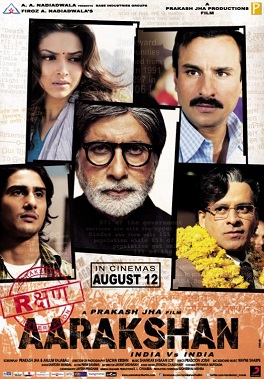
Aarakshan


I saw Aarakshan yesterday. It's a good movie, I would say. Not great from a purely artistic point of view. Good acting and dialogues. But some out of place songs. A gradually increasing portion of drama as the story progressed. There were even moments when one felt that probably the story has started draggingand had lost the crispness. But definitely overall the movie scores well in the way it deals with an inflammable topic in a sensitive way while communicating the maker's point of view rather clearly. Or may be it's actually the viewer's (my) view interpreted by him (me) as the maker's view. The climax resembles the Anna Hazare movement in its look. That adds an appeal to the experience of watching the movie, though rather coincidentally.

The way the storyline gradually drifts away from the issue of reservation and casteism to that of education wasn't accidental I am sure. In fact, it makes a very strong point: the issue of reservation and casteism are really not central to the woes of the Indian society. The central issue is that of education. The evils of casteism can't be mitigated by reservations. Not because the idea of reservations in itself is evil. It is not. But because, its correct implementation is probably impossible in presence of too many stakeholders in the game. It's impossible to prevent people from misusing it. In fact, it's not just reservation policies which are misused by politicians but the overall combination of reservations and class-struggle.

There were some dialogues which probably carried the maker's take on the matter. Once, the hero asks the question regarding why we don't have ITS (Indian Teaching Services) as we have IAS and IFS? There was one more where his wife asks why, instead of wasting so much money on reservations at higher education and job, government doesn't invest all its crores on improving the primary education system.

The way the hero deals with the overall situation in the movie was obviously very dramatic appropriate for a movie. But the message was valid for the real world. The key lies in making education accessible to everyone irrespective of their background.

I would like to add the following points from my side:

An idea worth considering for the government of India would be to have a kind of mandatory education service for all post-graduates of the country. If you aren't in teaching and you hold a post graduate degree you must devote x years (May be 1 or 2 years) of your professional life to education. Countries like Israel and Korea have successfully implemented compulsory military services in their country. I feel, it's practical to implement something similar for education.

The other thing, though slightly in a broader interest, is that education must be partially freed from being widely perceived as a professional training. Education is about life, not profession. It should be seen as a vehicle of sharpening thoughts and knowledge which are general tools for leading a better life, of which professional advantage is a small subset. But, let's leave all this to a separate discussion.

Thursday, August 25, 2011

An Anecdote from a Team-Experience

During the first few years of Rhythmica, when I used be active in it, I came across two kinds of people -- those who wanted the best out of the programme, and those who wanted the best out of the people.

Former category people were usually very talented; set very high standards for themselves and for others; and considered a musical performance as the output of the hard work. For them, it wasn't justified to compromise on the quality of the music. Substandard performance was unpardonable. At every stage of preparation, they advocated ruthless curtailing of anything substandard.

Latter category consisted of people who gathered in the music room for fun. They would, on an average, be less musically talented. They wouldn't have much to do with the highest levels of perfection. For them, a glitch here and a glitch there was absolutely OK. They would make friends, get into romantic relations, help out the more talented ones, and sulk if neglected.

Another example exists in all organisations. There are techies and there are managers. Techies don't usually think much of the managers. And managers give a damn to that. The tussle continues, and they thrive under the same roof.

It was when I was trying to characterise my responsibilities as a convener that I realised that both these types of people are required in a team. And whether one wants it or not, both these varieties would exist in any group.

Talented people are good to realise the potential of a group. The peak potential of the group is the peak potential of these individuals. Their presence is a must to take a group to the heights of achievement. The latter group are important for the existent of a group. They aren't dead weight. They are a cement which keeps the team together. A massive structure is required for resources to come together and create something that makes a difference. Usually individual talent is not enough to realise such teams.

A leader's job is to engineer two things:
- Realisation of potential
- Repeatability

The talented ones advocate such high levels of dedication and hard work as would cause severe burnouts in the less capable ones. As individuals, they may be capable of sustaining very high standards demanding exceptional efforts. That mayn't be true with others. A talented person, in absence of essential team-related qualities in himself, will look at this incapability as a disqualification, and will castigate anyone who doesn't concur. Often, this may create conflicts, not just with less capable people, but also with comparably capable people. Everyone is not at their best all the time. Being caught in the weak moment, and being reprimanded by a peer, who isn't necessarily more talented, for not meeting standards may sometimes be unacceptable to them, especially if they are inwardly rather confident that they do maintain high standards. Due to this reason, it is often seen that groups consisting of extremely talented people don't always do well, especially when it comes to durability. Music bands, research groups, etc. often form and fall apart in no time. I guess, the reason behind it could be the lack of team-related talents in its members.

A team will sustain when most of its members are happy, not just with themselves but with each other. They will come together again and again when they feel like meeting each other. A team will make its mark not just by one momentous performance, but by continuing to do so over and over again. A minimal prerequisite for that is the existence of the team.

An individual talent may look at this scenario as a parasitic relation between the less talented and the more talented. That's not justified. A team forms a critical mass for resources to come together and contribute towards the creation of something non-trivial. Such teams don't merely feed on the talents of the individuals, but gives them back a lot. The most important payback is the society of talents.
A society that's formed in an orderly fashion, and not by chance meeting between two maverick geniuses. When collaboration between such two geniuses is good, not just for others, but for themselves too, the presence of a happy group around them supports such an association, even when such an association mayn't be pleasant to the two geniuses themselves.

My Top Inspirations and Inspiring Moments

A list (which I intend to keep editing for ever) of events, moments, people, experiences which have resulted in lasting changes in me (mostly positive) and have shaped my life in a profound way. I don't claim to have arranged them in any particular order.
Learn to understand: When my father had said in my fourth class that I should try to understand the subjects rather than trying to score higher. It affected me deep and has a lot to do with my future attitude towards studies.
Tintin: When I first came across the first Tintin book in eighth class in my friend Sumantro's place, I had never seen a comic any better illustrated than Chacha Choudhary, Phantom, Amar Chitra Katha. I asked my friend what this thing was which did look like a comic but was also like a book. He said it was the best comic in the world. That day, my outlook to comics, cartooning, storytelling, everything changed. In the next 2 years I had read all Tintin books. My style of cartooning still is influenced by it. I finally succeeded to procure the complete series much later, in 2002.
R. K. Laxman: My father had brought home a calendar with one Laxman cartoon per page. I learned from it that cartoons can be drawn with basic instruments like pencil, sketch pens and water colour.
50 Classics: A thick book that Sumantro possessed which contained 46 classics and 4 epics, abridged and translated into Bangla. I came to know that there are so many books which are called classics: novels which are old, but evergreen. My fanciful mind immediately set out on the path of writing novels. In seventh class I had already written a story which ran to nearly 80 pages. In my ninth grade, I wrote a story running into nearly 120 pages. Of course, I gradually lost momentum. But the fascination with books and writing stayed on with me. I continued writing short-stories and essays.
बातचीत : The first chapter in our tenth class Hindi reader, an essay by Pt. Ramchandra Shukla. It had tough  Hindi, arranged in thick paragraphs, all of almost equal length (each of nearly half a page). It analysed various aspects of talking. I found it very inspiring that a simple day to day topic could be picked and a deep analysis could be done on that. I also came to see essays as the purest form of intellectual expression unhindered by narrative forms or poetic rules. Essays are, for sure, my favourite form of serious communication.
अरे तू तो अच्छा गाता है यार! : My cousin, who I always used to think of as sort of a bully, who otherwise used to dismiss me as a studious moron, once remarked when I was casually humming something (a Kishore song). The experience of being thus noticed was so thrilling, I actually started attempting to do some serious singing. This has led to an heretofore unbroken association with music.
Water Colouring: Book by Milind Mulick inspired me to revive my love for water painting. As my juvenile attempts to paint failed, I was instigated to give up painting for 15 long years. I suffered with the idea that I had poor sense of colours. However, around 2005, my love for painting came back in all its glory after I came across the above work. Thereafter, I have continued to make small attempts. Slowly, but surely, I have made significant improvements.
Academic books: There are many academic books which have been major influences in shaping my academic interests. Resnick Halliday (Physics) probably is at the top. But there were others. William Hayt (Electromagnetic theory), D. V. Hall (Microprocessors), C by Ritchie and Kernighan (Programming), OOAD (Booch), Compilers (Aho, Ulman, Sethi), Economics by Samuelson (Economics).
Scientists: The earliest inspirations were Marie Curie, Addison, James Watt. I used to think then that scientists run the world. After you are too intelligent to become a prime-minister, you become a scientist. Therefore, I decided to become a scientist.
Rail Shunting: I always used to wonder how a train stays on a track, and how it jumps from one track to another. I had tried to observed both the make of train wheels and the design of shunting while travelling in trains. I had never been able to make a complete observation. In sixth class, I could work out a design on paper which seemed to work. I cycled several kilometres to the nearest rail-track to my house to verify my discovery. And to my great delight, I found that I had got it exactly right.
Philosophy: I first came across Swami Vivekananda's ideas in 1993 through my friend Abhijit, who, in his first year BTech in IITK had got involved in these things, and had shared with me his initial experiences. He had once said that it's possible not to feel cold by simply imagining that it's not cold. I had tried it, and had found it works. I then bought one of his books in a book fair. It costed me Rs. 55. My father called me mad. I read much of it, and was launched into the pursuit of philosophy. It also sowed the seeds of my interest in spirituality which I have kept veiled behind piles and piles of verbose philosophy.
Ancient Manuscripts: In some TV programme, I had come across images of ancient Indian manuscripts written on this leaflets which then were tied into little stacks with a string. That about around 1986. The idea of the painstaking effort with which ancient wise men had documented their knowledge, with crude writing instruments and surfaces, and no method of automatic copying, had a lasting influence on me. There was a period when I took to doing my homework using nib pens which needed me dip the pen in an ink-pot every now and then. That was probably in seventh standard. Well, I couldn't stick to that method of writing for long. But I managed never to let go of fountain pens. I still use one. I still struggle to write in a good handwriting. And the idea of a beautiful thought written in a beautiful hand still appears very beautiful to me. I still often find it more natural to make handwritten notes of my thoughts before I create an electronic version of my writings.

Sunday, August 14, 2011

Love and Patriotism

In all these years, tomorrow's going to be the first Independence Day I will spend away from India. I don't know if I am missing my country. But I am missing today my home, my family, my people. I am missing my wife's chatter about her college lectures, my son's little antiques. I am missing the exhausted sigh I heave slumping down on the sofa on returning home from office after a heavy day, as if to breathe out all the tensions of life. I am missing the evening tea which, for me, stands as a pinnacle of affection and pampering care from my wife.

May sound melodramatic, but today I have been listening to the National Anthem since morning. It's bringing moisture to my eyes. I am even playing aamaar shonar bangla again and again. The images of rural Bengal, the ponds, the green fields, the mud huts, the palm and coconut trees -- the environs which I have never lived within, but have only visited and seen in pictures -- and those words of Tagore! Could a national anthem of a country be any more unassuming, any more innocent? It just says, 'I love you my Bengal!'

These tears of ecstasy aren't about patriotism. They flow in thankfulness for that divine blessing we humans have got which allows us to be aware of all the beauty that surrounds us. It needn't be for the richest nation of the world. It needn't be for the most popular tourist destination. It needn't be for the most beautiful person in the world. That beauty may lie in our poverty: in how we share our scanty provisions and help each other out through difficulty. In the sweat with which we build something together, however insignificant. That beauty could be in every little thing which makes us all happy and sad together.

Yesterday afternoon, I was walking through the university town of Ann Arbor. The fall semester is starting. I could see students moving into their apartments. Their parents helped them with the luggage. For fleeting moments, I could feel what they must be feeling. The nervousness and anticipation in the young heart. The strong pain of separation in the parents. The dirt in the new apartment. The chores of setting everything up. The experience of getting acquainted with a new roomie. There were students sitting around a table somewhere, doing their assignments probably. And there was a senior giving some orientation tips to freshmen at some street corner. The place appeared to me the most beautiful little corner of the world. It reminded me of IISc, Roorkee...and all my friends and all the good times.


Some time back, there was a brief phase when I almost believed that 'Patriotism is the virtue of the vicious' (Oscar Wilde). But he must have been talking about its bellicose variant which drives people to wage wars on others. Probably, that variant happens only when you think your nation is great and it needs to be greater still.
Love doesn't arise from the sense of greatness of the object of love, but from the fineness of our sensitivity  for little details of beauty. Your beloved mayn't be the most beautiful in the world; but it doesn't diminish the truth in your saying you love her. Your child mayn't be cutest; but that doesn't reduce the satisfaction you get from embracing him. Your life mayn't be a shining example of success; but you may still serve it, love it. When someone builds a house, he falls in love with it, however small and dingy that house may be. The love resides in his awareness of each brick he has laid, each ounce of mud he has used as cement, each straw he has collected to make the thatch.


The ability to be aware of the all pervading beauty also serves us to stay away from becoming overly footloose. If there is something specific that takes us afar, well and good. But if the absence of something here takes us there, we will probably never stop shuttling here and there. Before setting out on a journey to faraway lands, it's good to make sure to some extent that the absence, the void, is not within ourselves. It takes effort to grow the ability to find that thing you are looking for right where you are, preferably within yourself. That's love. That's patriotism.

This day, I am separated only for a brief episode from my wife, my child, my country. Tomorrow morning, for the first time in life, I will not hear the Independence Day celebrations and National Anthem playing at some nearby school. But, I am happy I played the national anthem today. I am happy I am thinking about my dear ones today. I wish I could preserve those two drops that escaped my eyes today. Because they are full of love. Those precious two drops are full of the feeling of being alive.

Tuesday, July 05, 2011

Endurance and Enjoyment

In my personal life, I see the benefits of endurance and patience on an everyday basis. Sometimes, with many things in my mind, all of them individually capable of messing my mind up completely, I feel like giving up everything and running away. But with growing age, I see that the frequency and intensity of occurrance of those frustrating moments is going down. I see that there's great merit and benefit in not reacting violently to certain conditions. Things often don't need a herculean effort to sort out. They just need us to stay put for a moment. They pass by themselves, giving us that space to think clearly again.

But there's also another lesson I have learned which I wish to share with you. Crises keep coming and going. In between, there are invariably moments when we have the space to think clearly. Let's call them open moments. As crises pass giving place to open moments, it's very necessary for us to switch from endurance mode to enjoyment mode. This means that, while crises are often just to be endured, it's very essential to leverage the open moments to feel life in its beautiful form. As these moments come, we should quickly gather all the positivity in us and start leveraging. Those are moments to enjoy life, work hard, dream, do something creative and charitable, and often to prepare for the next crisis, which may be just round the corner.

I have found that the ability to switch between endurance and enjoyment modes with agility is a great way to make life more valuable.

Tuesday, June 14, 2011

Global Variables and Globalisation

Isn't globalisation in economics a bad design choice in the same way as global variables are in a computer program?
In computer programming, global variables are sometimes a convenient shortcut. However, they are discouraged for larger programs as anything happening to a global variable results in a large part of the program getting affected. In such cases, the cost of detecting the extent of impact and correcting them exceeds the benefits of global access to the variable. In design terminology, this condition signifies lack of modularity, and is plain BAD! On the other hand, in economics, we have many global variables. We have middle east for oil. Japan for motor spare parts. Asia for cheap intellectual labour and so on. If anything happens to any of them (as happened to Japan recently), the impact is immense and damages incalculable.
Going by the tradition of modularity as observed in engineering discipline, we would probably have done well to engineer our society in smaller modules, and limiting interaction between disparate modules to the bare minimum.

The principles of modularity has another important lesson. While we use encapsulations (i.e. hiding details within modules from other parts of the program) a lot in computer programming, the read-only access is a lot more liberal than read-write access. The socio-economic equivalent to this situation could be that we decide that there remains much less restriction in the flow of information than restrictions on flow of goods. Going by this principle, things like right to information, lokpal bills etc. would be encouraged. On the other hand, patents and copyrights, export and import would be discouraged.

Of course, this thought, though interesting for sure, has difficulties:
Legacy. The human civilisation is the oldest, biggest and most complex legacy system that we have to deal with. It's been under construction since much before concepts of good design were known even in the field of engineering. So, strictly speaking, we are maintaining it rather than designing. It's ridden with lack of modularity, redundancy, inefficiency and dead-code. Attempts to correct it have more often than not resulted in genocide and war. However, like it happens in software system, a lot more stuff gets added to the economy at an ever accelerating rate as time passes. Ideally, we should apply principles of good design in what we add. Quite ironically, it doesn't happens. Our economics is more and more globalised than before. It's funny that something similar happens in the software world. A software system is usually at its best when it begins its life. It's design superiority deteriorates progressively through its maintenance phase, eventually leading to its obsolescence.
The Human Element. The elements of the socio-economic system are -- ah! the ancient problem -- humans. They can't simply be asked to pretend not to know how to reach out and seek connections.
Definition of Modules. How do you define boundaries for socio-economic modules? Geographical proximity? What should be the ideal size? National populations? What's the measure of size? Population? Area? GDP?
Apart from these fundamental difficulties, the fact remains that running, maintaining or designing the socio-economy is an act more akin to industrial software engineering, where it turns out to be critical that we respond quickly to emergent situations and market pressures, than to cleanroom software design where we have the luxury and time to follow good principles. But we mustn't forget that while we design our socio-economy, there's no external customer, no competition, no time-to-market pressures. Yet, all the haste gets created within the system all the same!
What's the hurry? What's this speed achieving? And more than that, this speed is of what?Where do we want to get? Where are we really leading our society to?

These are more philosophical questions, though.

Monday, June 06, 2011

About Being Rich

Isn't our obsession to become rich essentially biological? Probably, death by starvation has been prehistorically a dominant reason for deaths of members of our species. And therefore, it has probably entrenched such a deep rooted fear, essentially genetic, in us for starvation that we wish to push it as far away from ourselves as possible. Probably, so far away that it can't affect any of our progeny, leave alone us.

But if you were to think logically, isn't it such a waste of effort to try to be endlessly richer and richer? We live in a chaotic world where there exist such possibilities as could wipe us out of existence in no time: diseases, accidents, wars, natural calamities. Yet, we struggle and struggle to diminish the unlikely possibility of starvation to more and more minuscule proportions than ever!  We never stop for a moment to think how bloated our perception of this exceedingly minute probability of starvation, and of our ability to prevent it from touching our n-th generation by mere accumulation of material resources, is.

The auxiliary aspects that associate the sense of power, sexual attractiveness, and status to being rich are also seemingly fallouts of the same prehistoric notion where hoarding more and more resources was the only way to ward off starvation. We are not only biologically driven to try and be richer and richer, but are also prisoners of our instinct to idolise those who have more money. This re-inforces our primitive obsession for more and more money, and gives it this power which more or less defines how our society is today.

The instinct which drives us to the obsession to hoarde money is probably rooted in ancient forms of adaptation, but is probably completely inapplicable in the present conditions. Surprisingly, the above very biologically driven thing is perpetrated by those who, on the face, are the most clever and designing ones!

Such puppets we are to our biology! Really fascinating!


Friday, June 03, 2011

The Hunger-Strike Approach

Baba Ramdeo's decision to go for hunger-strike against corruption and the Government's unprompt response to the resolutions made following the Anna Hazare strike is ... well ... striking!

I definitely appreciate the Yoga guru's concern to contribute in yet another way to the society's ills apart from bodily or mental ones. Probably, lots of people have pointed fingers at him on the point that his trying to change his role like this is uncalled for. While I would say that the point shouldn't be ignored, I feel it's someone's fundamental right to decide to do whatever he wishes within the limits of Law.

However, there's a deeper, more long term, concern. What is corruption for these people? Black money in Swiss Banks? Politicians misusing their powers? Bureaucrats taking bribes? What will happen if these instances of corruption are removed overnight? Nothing! Thousands others will come to take their places.

Corruption, like education, poverty, unemployment, is a deep rooted social disease which can't be solved with a revolution. It will require a deep, sustained process of cleansing that has to happen over a protracted period of time. Oversimplifying it and presenting it to the community as if it's something outside them is misleading. I don't even know if it will result in more harm than good.

One point in favour of this is, of course, if the initiators realise that these revolutionary events may mark a start of a national movement. May be, it will awaken the people to stand up when they see corruption being practiced in their field of vision. Hope it happens.

Meanwhile, I would plainly say that I find it unbecoming of Baba Ramdeo talking of gallows for corrupt politicians.

Thursday, June 02, 2011

Keeping Sanity Intact

I don't necessarily do a good job in the above. However, surprisingly perhaps, I have never felt that my professional commitments have played a major part in ever tiring me out. But when I club that with many interests and hobbies, family commitments, social interactions etc., sometimes it gets overwhelming and I just lose it.

But when I am managing well, I think the following are the mechanisms:
Concentrating on one. Even if there are many things to do, it helps to forget about all others for a while but the one immediately at hand.
Learning to let go. It's important to realise that since there are too many good things to do in life, we are anyway going to end up not doing most of them. So, it's best to pick a handful and stick to them.
No hurrying. I feel seriously fatigued if I have to do anything in a hurry. Doing things in a soft pace allows me to get into the flow and enjoy the job.
Time-management. All standard time-management techniques: planning, scheduling, tracking, discipline. Also, where possible, I don't try remembering anything. My life runs on zillions of reminders on phone, Lotus Notes, gmail, yahoo...my wife ;)
Breaks: Getting up once in a few minutes, and taking a day off every now and then. I don't think I tire out more these days. But I have recently learnt to acknowledge fatigue. Also, I have stopped denying my body and mind a well-deserved rest. Well, most often.
Fitness. I am not a fitness guy. But as years go by, I seem to be tending a bit towards it. I would like to think that I have several years of active life ahead of me. A sick body is a big impediment. A fit one is an instrument to carve out higher objectives. So, a bit of exercising: walking, jogging, cycling, swimming, yoga...whichever I feel inspired to do. I have moderate dietary habits. So, that's taken care of, more or less.
Masochism. Over the years, I have developed a taste for the torturous feeling that one gets on seeing hordes of incomplete assignments. A half-read book, a half-written story, an incompletely developed software, pending research, incomplete drawings...earlier used to drive me mad. These days, I feel at home with this predicament. I don't feel uncomfortable even with the idea that when I die, I would be having plenty of unfinished stuff to do with me. The ability to add a tiny bit every once in a while -- taking a tiny steps towards the destination of a long journey -- often gives me a heady feeling.

Wednesday, February 16, 2011

Fair Deal to Women

  • I don't know if there's any such thing as male domination for it makes it appear as though males are responsible for whatever wrong is happening to women. But, we don't need statistics to know that women have a tough life to lead. I am not talking about women who are fighting for reservation in parliament, but women in our daily life: our mom, sister, wife, daughter. While I strongly oppose any attempt by anyone to show that 'only' men have caused all this, I really wish to see some real fairness on a day to day basis. That'll happen when
    - our women will be able to walk with a feeling of safety on our roads.
    - when they are treated as intelligent people by everyone, including, by other women.
    - when they don't have to cover their true potential with aggressiveness or sexuality to be noticed.
    - when feminine sense of aesthetics don't just get accepted, but define future art forms.
    - when women are able to lead a fulfilling life where they feel that their potential is being utilised, not necessarily in career sense, but in overall sense.

    I invite you all (particularly women) to add to this list. Just one request: please don't let it turn into a male-bashing session. Give thoughtful and insightful inputs. Not grievances.

Tuesday, December 21, 2010

Thank you Mom and Dad!

Research is a way to continue to wonder like a child all your life. It's not about how smart you are. It's not about how you did in your exams in schools. It's not even about fame and recognition. It's about the thrill in discovering an added level of order in the chaos around.

What would I have done if I hadn't known to wonder? To ask questions? And to seek their answers? What a drudgery life would be devoid of questions! I would have had to seek pleasure in owning cars, houses, being in top positions...being successful, in convincing myself of the meaningfulness of my existence by spotting envy and admiration for me in others!

My parents. They didn't send me to the best schools. They didn't expose me to the best sources of knowledge. They just left me free to wonder. I feel thankful to them!

Friday, October 22, 2010

The Thin Line

There's a thin line between scepticism and cynicism. Since it's our occupation to be on the leading edge of scepticism, we researchers often tend to cross that line. To be brieft, scepticism is good, because it earns us our bread. Cynicism is bad, because it makes us bitter, suspicious (of people, not just concepts), sometimes bitter and almost always unapproachable.

In our lab in IISc, I feel, we all used to suffer from the highest degree of cynicism. People were too eager to be looked at as top-notch computer scientists to each other. Lest they appeared as something else, they would refrain from talking anything else with each other apart from computer science, that too cutting edge. The show of intellectual vanity was rather ugly. And to see some really good, likeable people (author included) being consumed by it was disgusting. There could be, and happened, only one consequence. We were hardly interacting but in the shallowest of matters, because we just didn't have so much computer science in us that we could talking about only that. The plight was such people did their work as well-guarded secrets. I didn't have a clue what my neighbours were doing. I am sure, the ignorance graph was complete. The situation explains to a large extent why researchers are so often associal geeks. Being a researcher myself (of whatever calibre), I can vouch for it that no research subject is designed to make a person callous and ignorant about his physical surroundings and fellow-beings. It has to be a result of a deep insecurity which forces one to recede into a shell, to carry their laptops to meetings, and to get their coffee to their desks!

Researchers are humans. More than anyone, they ought to remember it themselves. And they shouldn't shy away from interacting with their peers on terms which don't re-inforce their image as authority in their field of study. There are other more valuable aspects of one's personality. Why not be comfortable with them?

What's this anxiety?

Thursday, August 19, 2010

Reply; Don't Forward

I don't ever forward chain mails. I delete most of them. To some, which have meaningful contents, I find replying to the sender a more meaningful thing to do, than forwarding it to many. Some reasons are:
- Down the recipient tree, the seriousness of the thought about the issue discussed in the mail is diluted to near zero-concentration.
- I think, getting a reply to a casually sent mail suddenly makes you take the contents more seriously. Particularly, it's a prove that someone read the mail seriously.
- Throwing the matter back up into the recipient tree has a larger chance of meeting more sincere audience than down below.

An Example
Please read on for an example of a reply I wrote to a problem we all feel about.

For a change I pressed the reply button.

I agree with the idea of this mail, i.e. stopping the squandering of public money would help. But, I do wish to add a bit to this view. Even if the figures are authentic, saying that all this money would make the life livable for crores of poor people may be over-optimistic. Poverty and deprivation aren't mere lack of material resources. They are more deep rooted. Merely by diverting money from the plentiful to the deprived is not a solution to this problem. It won't take any time to turn those crores into worse demons than our few thousand politicians are if only they had money and power.

I feel, there's no evil in providing good facilities to public servants, provided they do their job. If they misuse the resources, it's a pity and they should be prevented from doing so. Not so much to save those resources (or money) but because that money symbolises the trust and respect that public places on these people. These people must exhibit very high work ethics so this trust is justified. But the problem of low work ethic is not limited to only politicians. It's a larger problem which pervades the society. Merely by replacing a person in a position of power and influence is not a solution; nor will diverting resources to other sectors of the population answer this huge issue.

Very unfortunately, problems of ethical poverty are deep rooted, probably a consequence of centuries of oppression. They have taken time to set in. They will most probably take time to go away. Probably, we may have to wait until the complete generation infected with this virus fades away giving place to a newer, more ethical, generation. I am rather doubtful about how much success, attempts to accelerate the pace of this social reformation will meet.

To end this, I want to thank you for the mail. I don't find forwarding it to an endless number of thoughtless, emotional junta (almost all of whom will probably rid themselves of their responsibility by forwarding it to some more people) of much use. Instead, replying to the more thoughtful audience in this group, along with my 2 paisa thoughts will probably matter more.

Thanks and regards,
Sujit
- Hide quoted text -


On 19 August 2010 12:17, ... wrote:


Politician's drama

mail of the week…
Natak


Mr. Rahul Gandhi do this work just for an hour....without media.
Then tell us what you got...
If you really want to Change our India....No need to show us.....
We will follow you......Definitely.


“K
arunaa”Nidhi Fasting

First time in the world history fasting only 4 hours and that too with an AC …….
This is the comedy of the year 2009….
Fastingstarts after breakfast and ending before lunch. Interesting one!!

Dont forget to forward this mail, We have to show these type of drama's to everyone


stop this....................grow up to be an indian


Govt. Concessions for a Member of Parliament (MP)

Monthly Salary
: 12,000

Expense for Constitution per month
: 10,000

Office expenditure per month
: 14,000

Traveling concession (Rs. 8 per km)
: 48,000
( eg.For a visit from kerala to Delhi & return: 6000 km)

Daily DA TA during parliament meets
:500/day

Charge for 1 class (A/C) in train: Free (For any number of times)

(All over India )


Charge for Business Class in flights
: Free for 40 trips / year (With wife or P.A .)

Rent for MP hostel at Delhi
: Free

Electricity costs at home
: Free up to 50,000 units

Local phone call charge
: Free up to 1 ,70,000 calls.

TOTAL expense for a MP
[having no qualification] per year : 32,00,000 [ i.e. 2.66 lakh/month]

TOTAL expense for 5 years
: 1,60,00,000

For 534 MPs, the expense for 5 years :

8,54,40,00,000 (nearly 855 crores)


AND THE PRIME MINISTER IS ASKING THE HIGHLY QUALIFIED, OUT PERFORMING CEOs TO CUT DOWN THEIR SALARIES.....


This is how all our tax money is been swallowed and price hike on our regular commodities.......
And this is the present condition of our country:

The image
http://news.bbc.co.uk/olmedia/85000/images/_89378_india_poverty_child_by_river_300.jpg
http://weblogs.nrc.nl/weblog/wereld/wp-content/uploads/indian_poor.jpg
855 crores could make their life livable !!

Think of the great democracy we have.............
PLEASE FORWARD THIS MESSAGE TO ALL
REAL CITIZENS OF INDIA .....
but,

STILL Proud to be INDIAN


I
know hitting a delete button is easier..........bt.......try 2 press fwd button 2 make people aware of it!


Monday, June 28, 2010

A Proud Moment and a Wishlist

Saina Nehwal scored a hat trick winning 3 tournaments in 3 weeks repeating Padukone Sr.'s feat. She is now going to be World No. 2, probably. That's a wonderful achievement. A very proud moment for India. I hope she keeps doing well for a long time. Would it be wrong to say that India isn't doing that bad in sports these days?

A wish-list:
- Hockey must improve.
- Not being in football map is disgraceful.
- Sania Mirza must get back to her form and put India back into tennis map.

This is the first time I thought so seriously about sports. But this morning while going through the newspaper, I honestly felt proud on seeing Saina's achievement. Really great!

Monday, June 14, 2010

A Thought on Thoughts

There's this angel and devil model of our mind that comic books and cartoons have popularised to such heights. I feel there's a lot of truth in it. The subconscious part of our brain which is supposed to be stronger than our conscious brain, is home to both these gentlemen (or ladies as your case may be). It's also the battleground of moral war which these two people wage against each other. The result of each battle is the verdict of our subconscious. This being the stronger part of the brain, might also be the output of our brain itself. That is, if we equate ourselves, not considering the fact that our conscious brain is equipped with some unique qualities, to beasts.

This may be source of pessimism for some of us. Particularly those, whose brain hosts a strong devil and a feeble angel. If all our actions, and hence our life, are slave to the dictates of these two people, isn't there any hope for us to grow beyond our born destinies?

But there are a few things to note. One is that our conscious brain is the gatekeeper guarding the exit of all things coming from the world of thought to that of actions. And secondly, most importantly, even though its own raw powers are dwarfed before the subconscious's, conscious brain has the capability of learning from years and centuries of conscious thought that has been done and recorded by the entire human race. Subconscious lacks the power to learn (except through the slow process of evolution). Conscious can choose to act on results which it mayn't be equipped alone to arrive at. This incremental process of knowledge acquisition has made conscious mind, potentially a much stronger part of the brain.

Of course, exercising of this power depends on education, learning, reading and listening.

All this sounds so sickenly similar to discourses on karma, praarabh and free-will! That's the downside of learning. Over so many centuries, so many people have thought up so much that it's awfully difficult to sound original every time.

About Value

Why do we do research, man?! In fact, why anything?
One simple answer is: to make ourselves happy, prosperous, richer etc. That's OK.
But the 'why' becomes significant when we are talking about making choices between various things.
Often, there's a question raised about the practicality of the topic of research. For example, should a person do research on philosophy, or on digital electronics. Simplistic answers are:
- Whatever you feel like.
- Whichever is funded well.

These formulae may work in very clear cases. But, sometimes, things aren't clear enough. For example, whether you have enough funds for a research project depends a lot on whether you are interested enough in it or not. As long as the settlement of this balance between interest and funding is with one person, it may reach a steady state after some soul-searching. But what happens when the researcher is not the one who funds the research? His interest will hardly work as a great motivation for the military general who may be the one to sign the funding cheque.

Framing the whole problem of deciding research can be framed conveniently as a business problem where everyone has different (sometimes conflicting) motives. But the motive of profit-making unites all motives. Economic forces reign supreme. A capitalistic model.

But ignoring the fact that this model is insufficient to define motives of research could have disastrous effects on everyone. If economic forces are allowed to decide all research policies, it will drive the frontlines of knowledge in such directions as will mutate the whole body of human knowledge into an ugly monster.

The point is: what really is the meaning of the word 'useful'? What are those basic acts A, B, C... etc which are useful. If we are able to define that set, we could just argue on that basis to define the usefulness of other activities on the basis of laws like the following ones:
Law of composite activities: Say, some other composite act X is a combination of acts A and B. If A and B are known to be useful, we may conclude that X is useful.
Law of enabling activities: Say, an activity X results in increase in the ability of people to do activities A and B, then we may conclude that X is useful.

There might be many such laws if we give it a thought. That's the easy part to come up with such laws. The difficult part is to define a fundamental tenet of usefulness. The law that lets us conclude that atomic activities like A and B are useful. Their usefulness isn't derived from the usefulness of some other activities.

Let me dwell a bit on why our current knowledge falls short of achieving the above. Say, arbitrarily assign some positive value to some activities. If more of such acts are done, there is an overall rise in the 'value'. Thus, these acts are useful in that sense.

Say, one such act is 'eating'. A person who eats feels happy. So, there's a sense in assigning some positive value to eating. The more people eat, the more value there is. Nice and simple!

But there's trouble brewing there. If I eat too much, I get indigestion. My arteries may clog and I may die of heart attack. So, eating too much now may result in my dying early reducing the total number of times I enjoy eating. Also, suppose I am a criminal psychopath. I like killing people. The more I eat, the longer I live. The longer I live, the more number of people I murder. Hence, my eating results in many other people not living enough to enjoy eating. Hence, whether my eating indeed is valuable overall depends on what other activities it enables or disables, and the value contained in them.

Both the difficulties above are operational. They talk about the difficulties in computing the actual value of an activity. The difficulty arises from our inability in determining what other activities it may enable/disable. This difficulty, though significant, is not fundamental. It doesn't still present the fundamental difficulty of defining usefulness, or 'value', to be more precise.

The sense of that fundamental difficulty can be got from the apparent vacuousness of the idea of assigning value to such mundane things like eating, sleeping, having sex, etc. To me, doing this makes the whole idea of life appear vulgar! So, it's all about maximising eating and making merry?! There's nothing more than that?! Even computer programs, which can be broken down into a sequence of bits, or an electronic circuit, which can be looked at as a combination of numerous gates, seem to have a more respectable existence. At least when brought together, they serve purposes which can't be served by individual bits or logic gates. On the other hand, it appears blasphemous to compute the value of the most elevated life on the basis of the number of meals, sleeps and copulations it eventually results in.

There lies the problem of value. That hunch: That the value of elevated acts must lie in something less vulgar than can be reduced to a large series of mindless animal acts. I haven't read much of ethics, but I surmise that this is, in some way, the essential problem of that subject.

...and that's also my underlying thought when I ask: 'Why do we do research?'

Note: I foresee a link to this post appearing in many many of my future posts.

Monday, June 07, 2010

Programming and Home-making

What a tedium it used to look to write functions, let alone classes! During my ME, while I was generally regarded as a good programmer, my obsession with good programming practices was almost jeered at by my colleagues. Once, one labmate of mine had some programming issue which he said he wished to take my help in. While I waited later for a few days, he never came to me. Finally, I asked him what happened. He said that he was afraid I would use a lot of functions in the program which would then make it difficult for him to understand it. Instead, he had taken help of another PhD student there. He had made a program which was one straight line monolithic piece of code with not a single function call. Then I had felt funny. These people are definitely stupid -- incapable of appreciating the beauty of programming, I had thought.

About a decade afterwards, starting to live with a wife who was pedantically disciplined in keeping the household in shape was a shock. It was a toilsome process to learn that each thing had to have a designated place for itself, and that every time after being used it was supposed to be put back to that place. It automatically created an entry barrier to introducing housing articles. The process of procuring a domestic article was invariably accompanied by the process of figuring out where it would sit. The need to avoid cluttering the house with unnecessary articles was paramountly important. The household must be lean and mean. It was more in the fear of meeting with angry stares and words from the better half than from any real appreciation of the method that I learned it.

I haven't changed much fundamentally. I am still a bit untidy and need some monitoring to keep things in place; I am very much absent-minded and need uncountable reminders to keep doing my stuff. But, where I have really changed is in my appreciation of that household discipline that I had to initially imbibe with so much unwillingness. Now, I can see how similar it is to maintain the household in order to the problem of writing a large and complex computer program that is usable and enhancable by others. Same principles apply.

Intuitive variable/function/class naming; using of namespaces/packages and folders to arrange the source code, these are all programming parallels to the discipline of having a place for everything and everything in its place. Encapsulation and modularisation are similar to the division of responsibilities. Maintaining punctuality at home is not so much about mindless discipline. It's objective is the same as that of the discipline of concurrent programming -- to optimise use of processors, to about race-conditions and deadlocks, to keep multiple threads/processes from interfering with each other in destructive manner. All this eventually boils down to good timing. Each process doing its job isn't enough; it must do it when it's supposed to, so that other processes who arrive expecting a readymade output from the process don't have to wait.

Now I am surprised how, in my younger days, I couldn't see that what good principles and practices apply to my intellectual life are applicable to my day to day life too. In fact, I would go to the extent of saying that loyalty to good methods in professional life, if not present to the personal life, loses much of its meaning.

Related post:

5S -- the Management Mantra of Tidiness

Thanks Uncle!

Today, at the gate of the Manyata Tech. Park, a young chap, clad in trendy T-shirt, jeans, goaty and iPod plugged asked for a lift to IBM building. I gave him. And he paid for my favour by saying 'thanks uncle!'

Rascal! *^%*^@%*&^

Wednesday, June 02, 2010

The Unreality of Reality Shows

Yesterday, I was watching Indian Idol - 5. My wife likes it a lot, and dotes on some of the competitors. But for her thriftiness, nothing stands in her way to send zillions of SMSs to make some of them go ahead in the competition. I am not jealous of those competitors. And that's definitely not the reason for my writing this article

But this article is indeed with the motive of expressing my disgust with the reality shows being aired these days. That's a tacky topic to write on. But I will be more specific in things which I disapprove of.

First, a mention of things which I approve of. I think the competition has risen to unprecedented heights. Competitors are awesome. They are superbly talented. And more than that, they generally show tremendous grits in handling stress.

But beyond that, everything is a minus. Firstly, the way things are judged there is really aweful. SMSs sent by by and large a section of population with nothing better to do are far from representative of the public opinion. More serious listeners (assuming it's a music-based show like Indian Idol) will send a few SMSs under the influence of disgust that's caused by the feeling that undeserving candidates may win because of good looks and other gimmicks. But they can't continue to do so. The scepticism of the knowledgeable and judicious portion of the population about these SMSs mattering is pretty much of the same nature as in democracy -- when people think that there are far too many morons voting for a junk candidate for our votes to count

This pressure of impressing a very thoughtless majority audience brings out startling acrobatics on screen. In the opening episode, a girl is hailed as a simple village based contestant who has struggled her way to the competition against general opposition of her traditional village patriarchs. Some million votes (and SMSs). A couple of episodes down the line, she is found draped in all sorts of dresses which don't fit in well with her village background which was such a strong sympathy earning factor for her in the first episode. But, it doesn't matter if those who voted for the upliftment of an underprivileged talent in the first episode turn up their noses now. A few episodes' survival in the show has already earned the lady a semi-celebrity status. Now there's another -- bigger -- section of the audience for which the co-effecient of reflection of her bare shoulders and calves wins far more support than her underdog beginnings. Millions of votes again. As many SMSs.

Similarly, singers are made to dance, act and make faces. Dancers are made to fight with each other in well-rehearsed manners. Judges applaud and insult competitors in such melodramatic ways! Often they engage in verbal broils with each other which look supremely unbecoming and unnatural. It sends shivers thinking what kind of incentives make these great people behave in such artificial ways in the sets.

On the one hand, these days, judges' participation in the actual fate of the competitors has been drastically reduced by SMS competitions. On the other, during the performance, and in the few critical minutes that follow the performance, the judges bias the audience's judgement critically by making faces and hailing applauds and insults of their choosing. I am sure that most of the people who send their SMSs are impressionable enough to be seriously affected by minor twitches in the face of the judges. The whole thing appear like a setup where people are made to pronounce the judge's opinion. Additionally, it appears that the bias that the judges sometimes show during the performances aren't merely their personal opinion; they could even be pre-fabricated verdicts of the entire strategy of the organisers geared completely towards maximising TRPs.

Overall, the gaudiness of today's reality shows far outweighs the increased levels of talents. I'm not ready to believe that exposition of talents is critically dependent on fake spices of melodrama being played in the name of 'reality.' They stink of a systematic manipulativeness that arbitrarily alters the mass behaviour, and creates business models around them, thus closing the gates of redeaming oneself once the negative aspects start surfacing. In this world of mass-production, there has been little knowledge created on ramping down industries. They have just learned to grow bigger and bigger. And by the time the justifiabilty of their existence becomes questionable, it's too late to wind it up gracefully. The only way is to stretch them, at the cost of manipulating the consumption patterns of the population in unnatural ways. Companies keep getting bigger first devouring other companies, then governments, and then entire nations; soaps keep running for ever and ever, news programmes keep reeling the same sensationilsed coverage of a news item for hours, days, weeks.

Heck! What am I writing?!

I have equally disgusted thoughts about news channels, soap operas and the way the experience of TV viewing has become off late. But, I will speak of it some other time, if I do.


Related post:
SMS Competitions